The Feminization of NH’s Workforce

Posted October 22, 2012 by Brian Gottlob
Categories: Demographics, Gender, Help Wanted, job growth, Labor, Recession

Tags: , , , ,

Nothing gets you thinking about gender equity issues more than being the father of three daughters, except maybe being the father of four or more daughters.  In my upcoming October edition of  “Trends Lines” I am looking at trends in NH’s labor force.  One of the more significant trends is the increasing percentage of women employed at businesses in NH.  Despite the fact that men participate in NH’s (and the nation’s) labor force at higher rates (about 9% higher in NH) than do women, women now are a slight majority of employees at businesses in NH.  Women comprised 51% of employees covered by unemployment insurance during the third quarter of 2011 – the most recent data available.   Only in Hillsborough and Sullivan Counties are men a majority (and by less than 1%) of employees at NH businesses.

Among workers with the highest level of educational attainment, those with a bachelor’s degree or higher, women comprise 52% of those employed by NH businesses.   Moreover, the percentage of NH workers with the highest levels of educational attainment who are women is likely to increase because the percentage of new hires (not including recalls of  layoffs), with at least a bachelors degree, who are women, is now even higher (53% – see chart below).  These differences don’t seem large, but over time  they have tremendous implications for the economy and for society.

I don’t know if this data says more about the changing nature of the workplace or the changing nature of the male workforce, but as the father of three daughters, my anecdotal experience leads me to believe it is more about the latter.

State-by-State Economic Outlook for the Next Six Months

Posted October 19, 2012 by Brian Gottlob
Categories: job growth, NH Economy, U,S, Economy

Tags: , , , ,

The Philadelphia Region Federal Reserve Bank is producing a leading economic index for each state.   The index contains the same economic variables for each state so it is not customized to the specifics of each state’s economy.  Some of the index variables are national  (similar to  my “PolEcon NH Leading Index”) but all of the key economic indicators included yield important information about the likely direction of any state’s economy.  The graph below from the Philly Fed suggests that NH, along with VT and CT, will lag the region and much of the country in economic growth over the coming months.

The Philly Fed index isn’t designed to predict just job growth like PolEcon’s (my) NH leading index, but the two indices move in similar ways with changes in the NH economy.  I’ve test the ability of both to accurately forecast near-term (6 month) job growth and the PolEcon index does a  significantly better job.  But the PolEcon Index was modeled and  fit specifically to NH data, testing a number of economic variables that have the strongest relationship to NH’s near-term job growth.  Doing that for 50 states might be prohibitive, especially for an institution (The Philly Fed.) that primarily serves one economic region of the country.   I like the Philly Fed index because and it is great to have a readily available (read free), state-by-state, near-term, economic outlook from a respected and unbiased source.  I like it even more when it agrees with the PolEcon Index, as it does now.

The Skills Gap Debate – Round 1

Posted October 18, 2012 by Brian Gottlob
Categories: employment, Help Wanted, job growth, Labor, NH Economy, Skills Gap

Tags: , , , ,

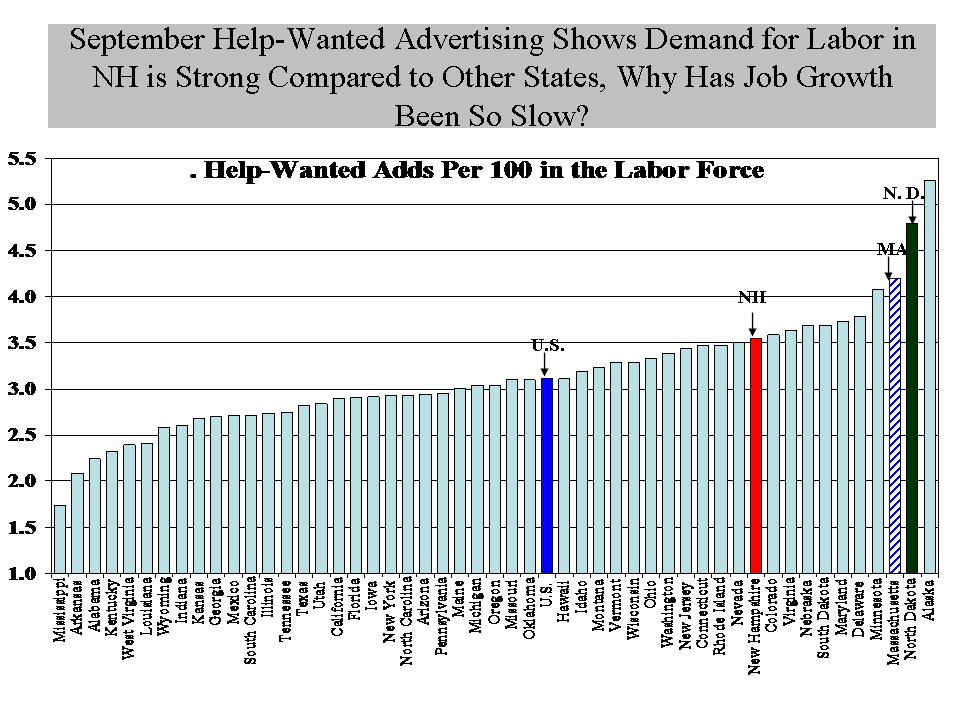
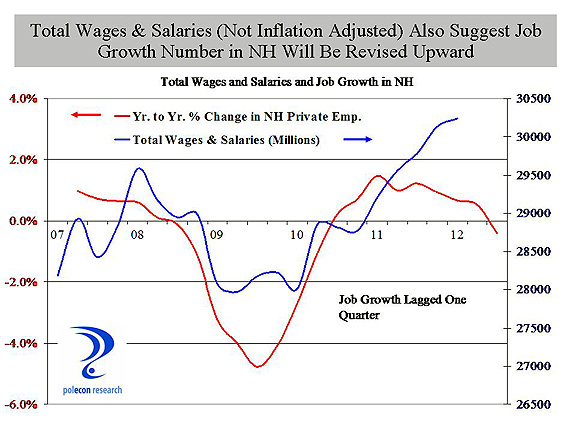
Two charts may tell an important story about New Hampshire’s labor market and perhaps trends in the economy.  Help-wanted advertising has been rising in NH and as I’ve written before, it suggests job growth should be higher in NH  based on the long-term relationship between help-wanted ads and employment growth in the state.  A “skills gap” is one explanation for the divergence between help-wanted and job growth in NH, but I also offered that the divergence, along with trends in aggregate wage growth in NH  may mean employment numbers will be revised upward.   My money is still on an upward revision of job growth, with the skills gap playing an important  role for some industries and occupations, because NH has more help-wanted ads per 100 individuals in the labor force than all but 10 states – job growth should be higher (chart below).

I would be more convinced of the skills gap being broadly responsible for slow growth in the state  if a high percentage  of help-wanted ads in New Hampshire were for the highest skill occupations (professional, technical, scientific and management), but as the chart below shows, NH ranks well down the list of states on the percentage of help-wanted advertising that is for the highest skill occupations.  A skills gap could still exist between available jobs and available labor for occupations requiring specialized skills and training, even if they are not in professional, technical , or managerial occupations.  Anecdotal evidence suggest many employers are having difficulty finding workers with the right skills.  The skills gap demands further investigation, right now I am more concerned about what the relatively lower demand in NH for the highest skill occupations implies about our state’s economy.

What’s the Breaking Point for Oil Prices in Northern NE?

Posted October 17, 2012 by Brian Gottlob
Categories: Electricity, Energy, NH Economy, Oil

Tags: , ,

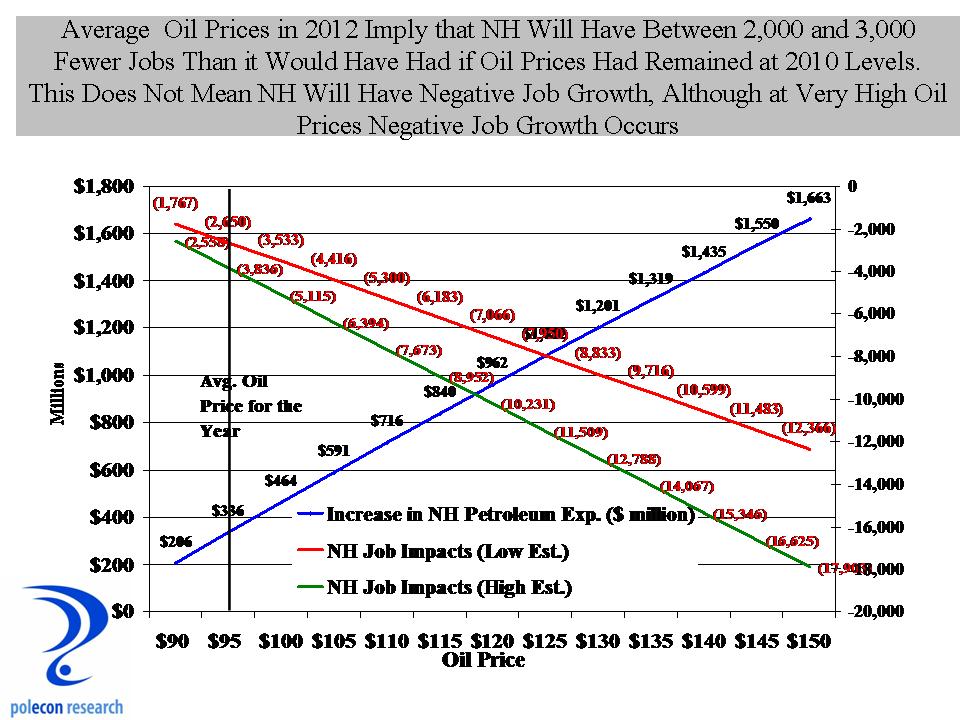
Because the Northeast is the one region of the country where a high percentage of households heat with oil, high oil prices can take a particularly heavy  toll on household budgets in the region.  Not all states in the region are similarly affected however.  Maine get hits hard because of its weather, the fact that its industrial mix is more energy dependent than say NH , MA, or CT, and even VT.  Plus their extensive tourism industry gets hurt when gas prices rise.  In NH, a lot of economic activity also depends on travel to the state which is hampered by high gasoline prices, and overall, NH has a relatively high rate of non-discretionary driving (that is we have a bit longer average commutes and a higher percentage of commuters traveling further) that hurts budgets when gas prices rise but our industrial base uses less energy per dollar of GDP than most states (MA and CT are lower in NE).  I’ve done some econometric modeling to see how sensitive employment changes are in New England to changes in the price of oil and gasoline.  All states are affected by higher oil and gasoline and all energy prices but the MA economy is somewhat less sensitive (the elasticity of employment with respect to oil prices is lower) than any of the  Northern New England states.  In Northern NE, NH is the least sensitive to oil prices but as the chart below shows, even at current oil prices, or at the average price during all of 2012 (about $96), employment in NH is 2,000-3,000 lower than it would have been if oil prices had remained at 2010 levels.

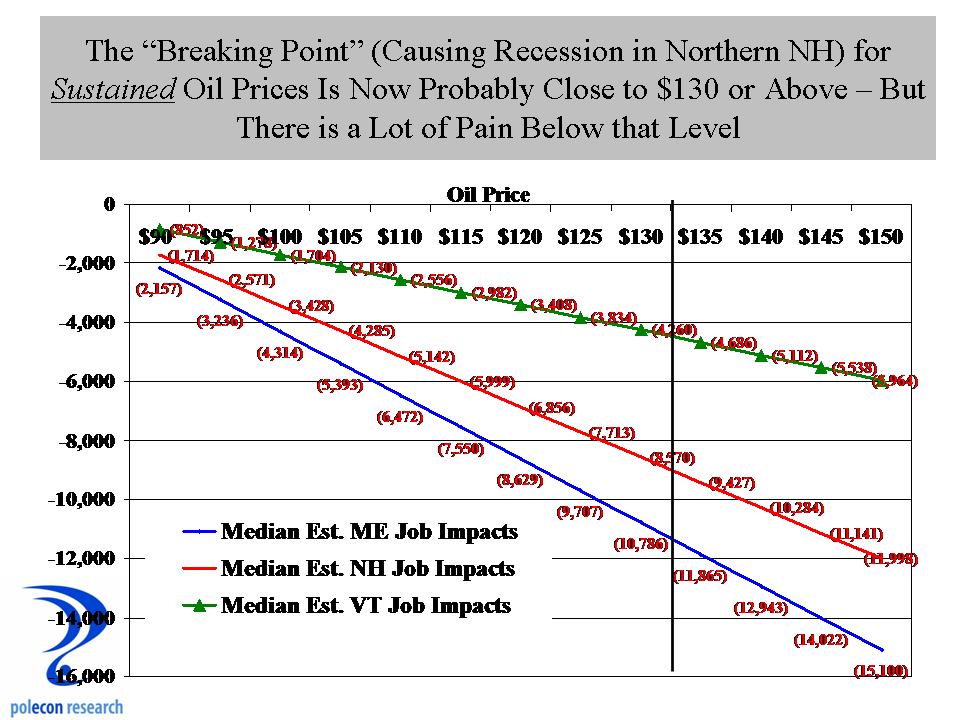
Higher oil prices act like a tax increase on the consumer, reducing disposable income and resulting in a shift in  purchases away from some goods and services to pay for higher energy costs.  In addition, high energy prices (especially gasoline prices) have a tremendous negative psychological impact on household and consumers confidence and sense of economic well being.  How much is too much of an increase in oil prices in Northern NE?  At what point do higher oil prices (which largely determines gas prices) tip the region into recession?  Based on the same models used above, the point at which slower job gains or actual job losses would occur is probably at a sustained price (for months on end) of at least $130 to $135 bbl.  But that changes depending on economic conditions and is also a function of the energy intensity of each state.   Strong economies can take more shocks without falling into recession.  In a weak economy it takes a smaller oil price increase to induce recession.  In NH, the breaking point price is now probably closer to $125 – $130 bbl, and in Maine a bit lower, while in Massachusetts, the price that would induce recession is probably closer to $140.

What Does the “Misery Index” Say About Election Results?

Posted October 16, 2012 by Brian Gottlob
Categories: Election, employment, NH Economy, Politics, U,S, Economy, Unemployment

Tags: , , , ,

I am not a political analyst and this is not a political blog.  The polemics of political discourse are as tedious to me as the graphs I use with two Y axes are no doubt tedious to politicos. If you are prone to apoplexy or unable to view any data or information without an ideological lens, stop reading now.

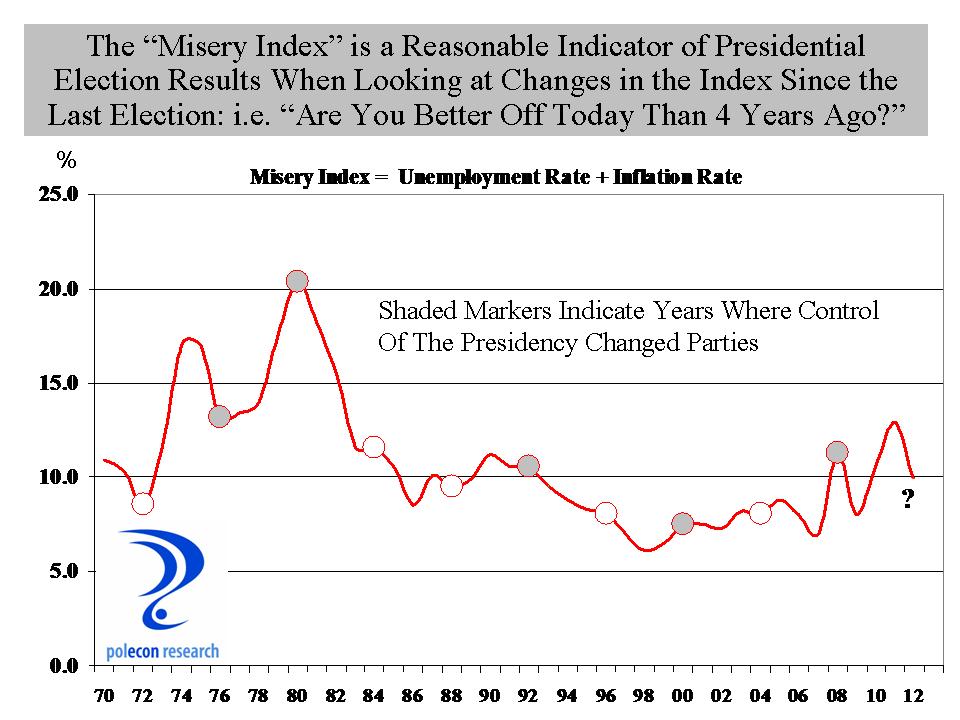
Since Ronald Reagan closed a presidential debate with Jimmy Carter by asking “are you better of today than you were four years ago” that question has been a benchmark in every presidential election and with good reason because  the answer to the question is a pretty good predictor of election results.  But how do you operationally define “better off”?    The sum of the unemployment rate and the inflation rate is  referred to as the “misery index”, since a high reading on either one or both of the components would likely have a negative impact on household sentiment.  When the misery index is lower in an election year than it was in the previous presidential election, the party in power typically retains the presidency,  and when the misery index is higher, the presidency typically changes parties.  The chart below highlights the relationship.  The chart line shows the value of the “misery index” in the 3rd quarter of each year (just before the election) and each circular marker indicates a presidential election year.  The shaded markers indicate a change in control of the party in the White House.

With the exception of the 2000 election of George W.  Bush over Al Gore, when the misery index was lower in an election year than it was in the prior presidential election year, the party in power retains the White House and when the misery index is higher,  party control of the White House changes.   The chart suggests that the 2012 election should be close, but probably leans toward President Obama’s reelection.  Looking at the individual misery indices in  swing states also gives The President a slight edge.

The misery index doesn’t say much about NH’s gubernatorial election however.   The chart below shows that declines in the misery index (compared to 2 years earlier during the prior election for governor) do not appear to be associated with changes in party control of the governorship in the state.  The chart does does show that a change is more likely to occur in a year in which the gubernatorial election coincides with the presidential election.

Overall, however, the chart suggests that NH voters do not hold gubernatorial candidates responsible for weaker economic conditions nor are they likely to credit them for good economic performance.  Rather, they make their choices based on the perceived qualities of candidates.  Isn’t that refreshing?

Burn More Gas to Burn Fewer Dollars

Posted October 15, 2012 by Brian Gottlob
Categories: Electricity, Energy, Natural Gas, Oil

Tags: , , ,

The National Oceanic and Atmospheric Administration is forecasting over 20 percent more heating degree days for East of the Rockies and depending on your fuel, heating costs could be up by as much as 19%  over last year (if you heat with oil).  That’s bad news for the almost 50% of NH households that heat with oil  (compared to just 6% nationally).

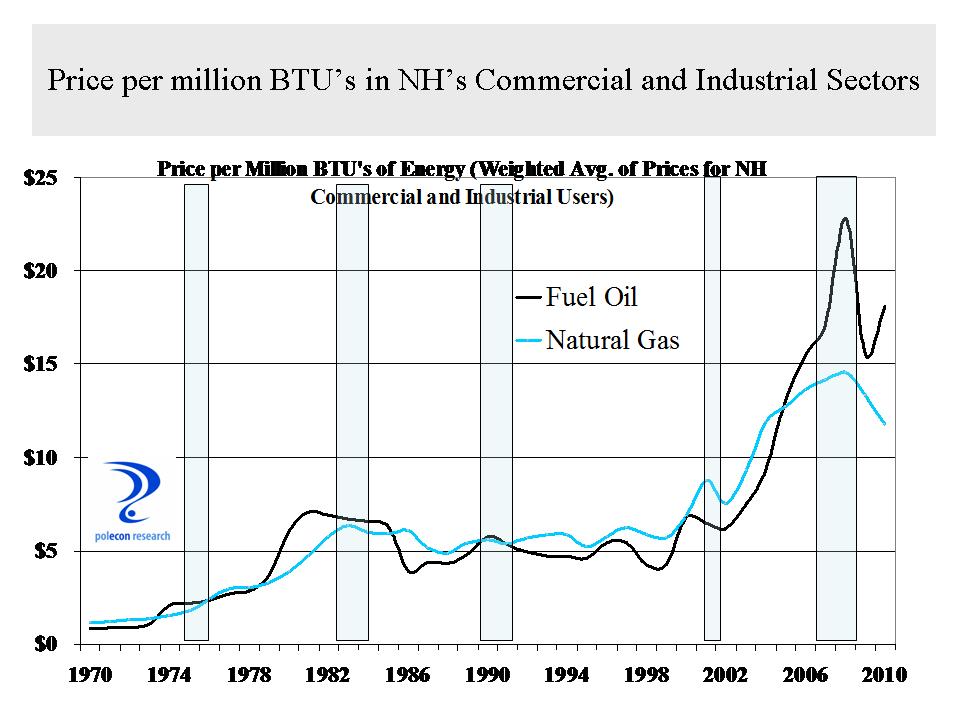
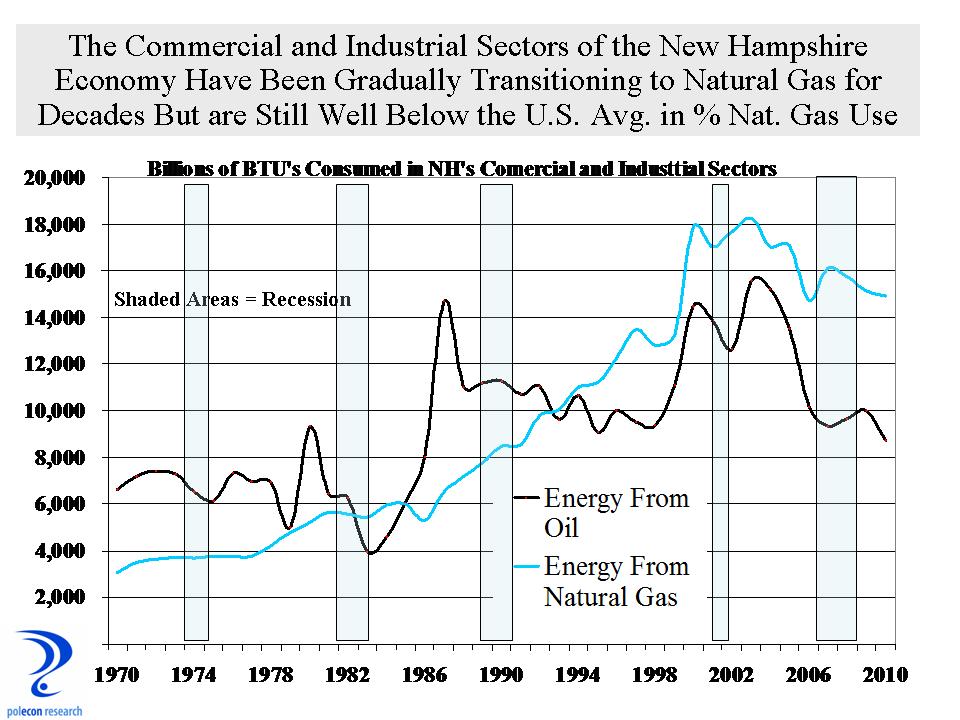
The growing disparity between oil and natural gas prices during the past decade ( graph above) has led to greater use of natural gas in the commercial, industrial, and electric industries in NH and elsewhere,  but NH still lags in natural gas usage as a percentage of all energy use in the state.

That is unfortunate because later this decade growth in domestic supply of natural gas (led by dramatic increases in the supply of shale gas) is forecast by the U.S. Energy Information Agency to outstrip growth in demand.  Prices, although expected to rise gradually, are still forecast to be lower in 2035 than they were in 2005.

Stable natural gas prices should make investment in natural gas conversions more attractive to NH  households. Lending programs by NH banks and credit unions, directed at energy efficiency,  could facilitate that.  But it is in transportation that conversion to natural gas could have the biggest impact on NH’s and the nation’s energy expenditures and our need for oil imports.  The last time I checked, however,  there were no dealerships in NH offering the one natural gas powered passenger vehicle produced by major auto manufacturers, there are less than a dozen natural gas “filling stations” in the state, and there are no rules and regulations in place for homeowners to make use of the natural gas lines to their homes by installing already commercially available residential natural gas auto refilling equipment.

Manufacturing’s Toughest Sell

Posted October 12, 2012 by Brian Gottlob
Categories: Demographics, Educational Attainment, employment, job growth, Labor, manufacturing, NH Economy, Skills Gap

Tags: , , , ,

The percentage of younger workers in the workforce is declining in NH, as it is across the country, but the trends are different for specific industries and occupations (more about that in a later post).  Simply put, some industries are capturing a larger share of a smaller cohort of younger workers and the key for any industry or occupation is to have appeal for younger workers and students.  How does an industry capture more younger workers?   Is it because the industry is perceived as being desirable or “cool,” or do younger workers respond to signals about the opportunities in an industry or an occupation?

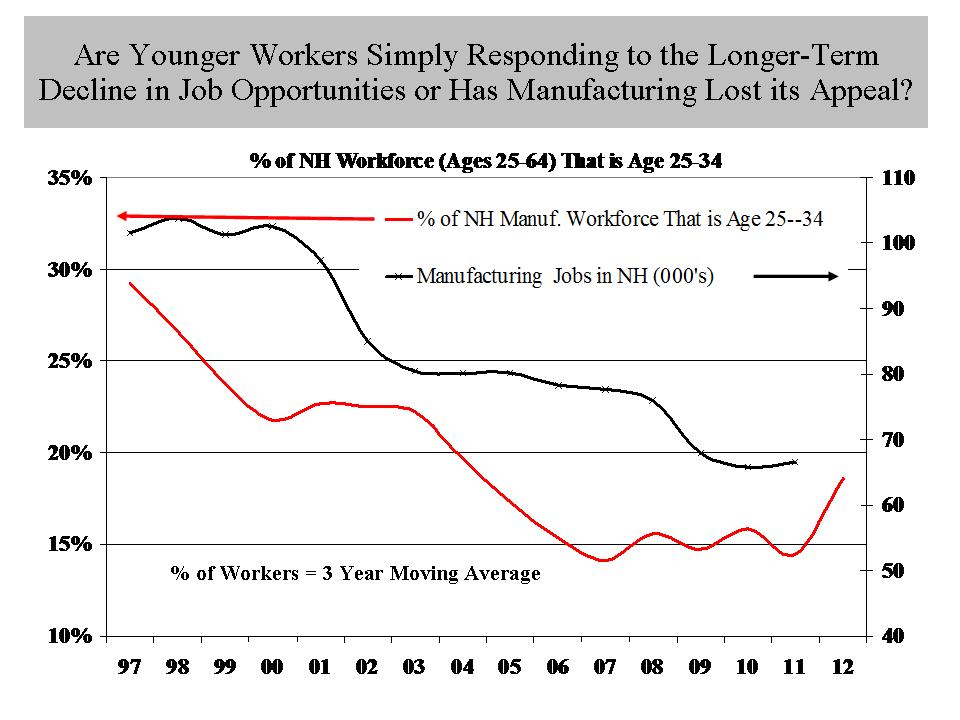
Manufacturing is one industry that has been capturing a smaller share of younger workers (government and utilities are others).   The chart below shows that over the past 15 years the share of younger workers (age 25-34) declined in NH’s workforce (age 25-64).  But the chart also shows that the drop was more pronounced in manufacturing than in the workforce overall.

Government employment hasn’t been perceived as cool for some time but job opportunities have grown or remained steady (except in very recent years) over the years suggesting that “coolness” is a factor in the career choices of younger workers.  For manufacturing it is likely to be a combination o cool and opportunities.  While manufacturers now have good opportunities for young workers, that perception must overcome  decade s of    labor market signals showing large declines in manufacturing employment.  The decline in younger workers in manufacturing roughly corresponds to the change in manufacturing employment in the state (chart below).

Manufacturing employers are in a difficult position.  Fewer households have workers with a history of manufacturing employment, limiting the legacy effects that can contribute to career choices.  A “twist”  (changing occupational makeup) in the manufacturing labor market mean that much of the public and almost no  high school guidance personnel have an understanding of the types of jobs in manufacturing. A general lack of “coolness,” perceived lack of opportunities, and  limited understanding of the opportunities that exist in the industry all mean that manufacturing will have a tough time capturing a larger share of the younger workforce, but it is important to do so for a number of reasons. I just don’t know if manufacturers can do it alone.

Empiricism – 1, the Orthodoxy of Ideology – 0

Posted October 11, 2012 by Brian Gottlob
Categories: Uncategorized

Tags: , ,

The tally is in and according to the NH Department of Revenue, last year’s $.10 cut in the rate of the state’s cigarette tax resulted in a loss of $12 million dollars for the state.  Note that tobacco revenues were down much more than that for the year, but that is the amount attributable to the rate cut.  It is about $500,000 less in revenue (out of over $200 million) than I forecast in a study that I conducted for a number of health related organizations, you can read it here.

In that report I wrote:

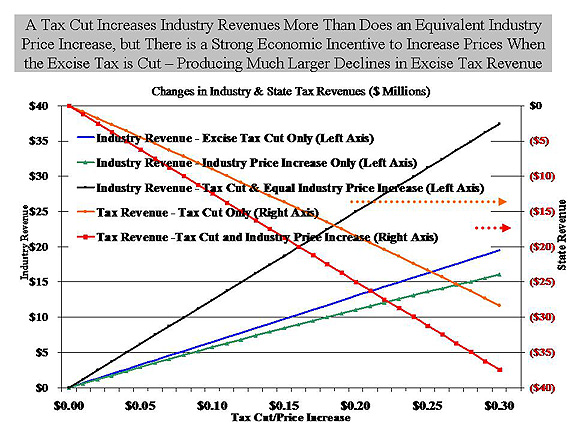
Industry revenue (net of excise taxes) is estimated to increase by $6.5 million with a $0.10 decrease in the states excise tax.  However, if the industry increases prices by the average over the past 20 years ($0.10 – the median is $0.08), industry revenue increases by an estimated $12.5 million.  Clearly there will be a strong incentive to capture the potential surplus from an excise tax decrease (rather than allow it to be passed on to consumers).  At the same time, a $0.10 excise tax decrease will lower state government cigarette tax revenues by $9 million, but if the industry raises prices by $0.10 then revenues will decline by $12.5 million.”

About a week after the rate cut took effect the industry raised prices by $.10 in New Hampshire.  In case you are wondering,  industry prices are not the same and do not move similarly in all states (look at the industry produced “Tax Burden on Tobacco” for historical state sales and price data to confirm this).     If you want a way too busy chart thati illustrates the strong incentives the industry has to raise prices when tax rates are cut,  here it is ( from page 22 of my report).

The $12 million reduction in revenue related to the rate cut is also $16  million less in revenue than the proponents of the tax cut argued in a “study” introduced during legislative debate ( that does not appear to be available any longer online).  There are a lot of reasons why cigarette sales and revenues decline over time (demographic changes, gasoline prices, etc.) all of which I included in my modeling of revenues but none of which were included in the estimates produced by advocates.  Advocates of the rate cut never mention these factors when sales drop, they only cite tax rate increases for declines (higher rates do decrease sales) but they are now offering them  as the reason why tobacco revenues are are  $16 million less than they forecast (because the orthodoxy says lower rates on their own can never be accompanied by lower revenues).  Except that isn’t the reason.  Factors outside of the rate decrease (demographics, gas prices etc.) account for the difference between the total decline in tobacco tax revenue over the year (just over $20 million) and the amount attributable to the rate decline ($12 million).  So about $8 million in the total decline in revenue is a result of factors other than the rate cut.

Sometimes cuts in tax rates can increase revenues, but the belief that they always do has become an ideological orthodoxy that can undermine cases where reduced rates can empirically be shown to increase revenues.  I am all for ideological arguments in policy making when they are based on evidence and not orthodoxy, but we run a risk of making bigger errors in public policy when we can’t distinguish between the two.

What’s Wrong With This Job Growth Picture?

Posted October 10, 2012 by Brian Gottlob
Categories: Uncategorized

Tags: , , ,

I’ve recently written  and spoken about the declining trend in New Hampshire’s rate of job growth relative to the state’s past performance and relative to the growth of neighboring and states across the country (as an aside, suggesting  that the emperor’s new vestments may not be as fine as others envision is not the best way to relax and enjoy the procession).

Pointing out that NH shouldn’t feel entitled to superior economic performance has generated a fair amount of  “discussion” but the analysis is not especially useful if it simply reinforces hardened ideological positions about how to best facilitate prosperity in the Granite State.  One way to help avoid that is to not end our analysis of job growth in NH by simply noting disturbing trends.  We need a better and more consensus understanding of the causes of NH’s  slow rate of  job growth and of its decline relative to other states.

In the first ever Trend Lines blog post I begin by asking a basic question:  Could the most recent job growth picture in NH be distorted by numbers that will later be revised?  Monthly job growth counts are based on  surveys of employers and they can be revised significantly, especially in small states, when they undergo their annual “benchmark revisions” early each year.   There is some evidence that NH’s job growth will be revised significantly upward. In NH, and the nation, there is a strong statistical relationship between the volume of help wanted advertising and the annualized rate of job growth.  The chart below shows the relationship between on-line help wanted advertising in NH (the number of ads per 100 people in the labor force), and the year-over-year rate of job growth in the state.  The strong relationship is evident except in the most recent data from the past year or so.

Two potential reasons for the recent break in the relationship between help wanted advertising and job growth in NH are the so called “skills gap,” as well as the possibility that the help wanted and job growth relationship has not changed and the recent job growth numbers will be significantly revised upward.  The belief that there are many jobs being offered for which there are not enough qualified job seekers has profound implications for the policies necessary to grow NH’s economy.  There  is a skills gap but I am skeptical that it could have such a dramatic impact over just the past year.  In addition, the occupations comprising help wanted ads in NH don’t suggest a dramatic increase in the skills gap over the past year.  In later posts and writings I will be looking further at the “skills gap” issue.

Another possibility,  that the jobs data is wrong and will be revised upward early next year, is real,  but that doesn’t mean the revisions will show NH is again outperforming its neighbors or the nation.  It just means we will look less bad over the past year or so than we do right now.  One indicator that job growth will be revised upward in NH is the growth in wages and salaries in the state.  The chart below shows that wage and salary growth (not adjusted for inflation)  is indicating a stronger labor market than are the job growth numbers.