Posted tagged ‘NH’

The Lastest 50 State Economic Outlook

February 7, 2013

Back in October I posted about the Federal Reserve Bank of Philadelphia’s leading index for each of the 50 states.  The Fed’s leading index for each state contains the same, six, state and national variables so I think they miss some of key indicators that can affect individual states but they are a great way to quickly compare the trends across states.  It is  also good to get a dispassionate, “outsider’s” view of the direction of every state’s (including your own)  economy.  Below is the latest summary of what each state’s  leading index is saying about the growth prospects over the next six months.

LeadingIndexes1212

Unfortunately, NH is again showing up in the group of states that is expected to lag in economic growth over the short-term.  PolEcon’s NH Leading index contains more NH specific economic indicators than does the Philly Fed’s NH Leading Index but the two indices generally agree on the short-term direction of the NH economy.  Not this time.  PolEcon’s NH leading Index is signalling an uptick in the rate of NH’s employment growth.  As I noted back in October, statistical tests show a stronger relationship between PolEcon’s Leading Index and the rate of NH’s employment growth than the relationship between the Philly Fed NH Index and NH’s employment growth.  I wish I could say I was confident my index was going to be more accurate this time but I can’t.  I do take some comfort in knowing  that whenever I have had the most doubts about the predictive ability of the NH Leading Index it always seems to do the most to confirm its value.

NH Leading Index

The Surest Way to Limit the Cost of College is to Graduate on Time

February 5, 2013

Since my last post on the potential for a student debt crisis I’ve been asked several questions about what is happening in New Hampshire.  I can’t adequately answer those questions here but since it is being reported that the University System of NH is holding-off setting tuition rates until the next state budget is clearer, I thought I would take a quick look at one college cost trend in NH along with what I think is one important metric when considering the cost of college.

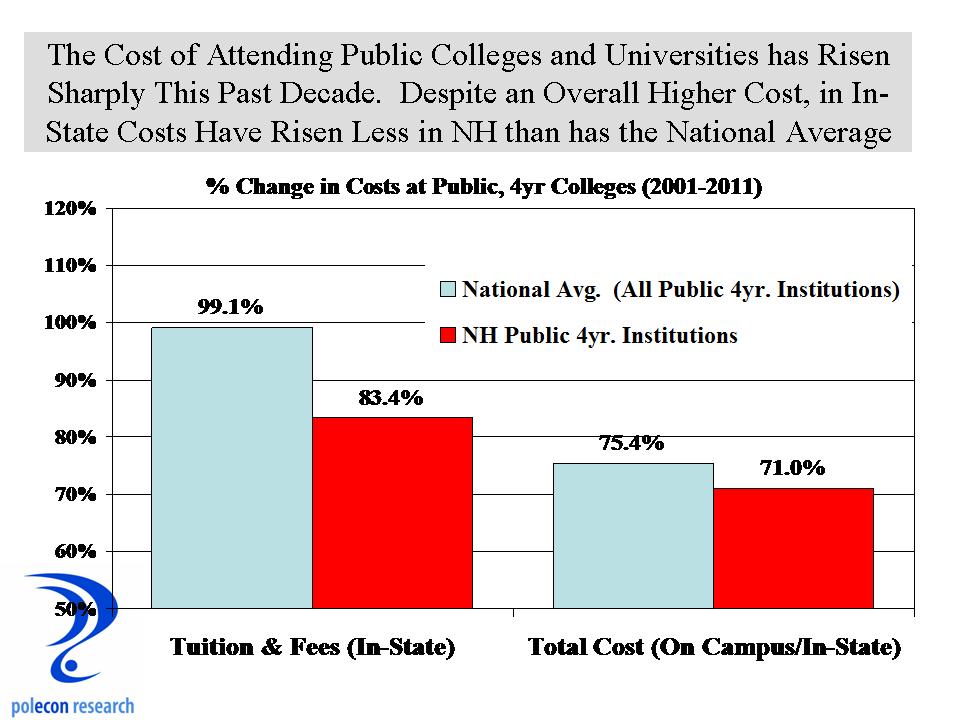
It is not an epiphany that the cost of college is rising faster than the cost of most goods and services and it is generally recognized that the cost of college at NH’s public higher education institutions is higher than the national average.  What is surprising is that over the past decade, costs at NH’s public 4 year  institutions have risen less than the national average.  I am not saying that they haven’t risen well above a comfortable rate, just that given the constraints of state support, tuition and fees, as well as total costs for in-state undergraduate students  at NH’s public colleges have risen more slowly than the national average.

Rise in Cost of Public Colleges

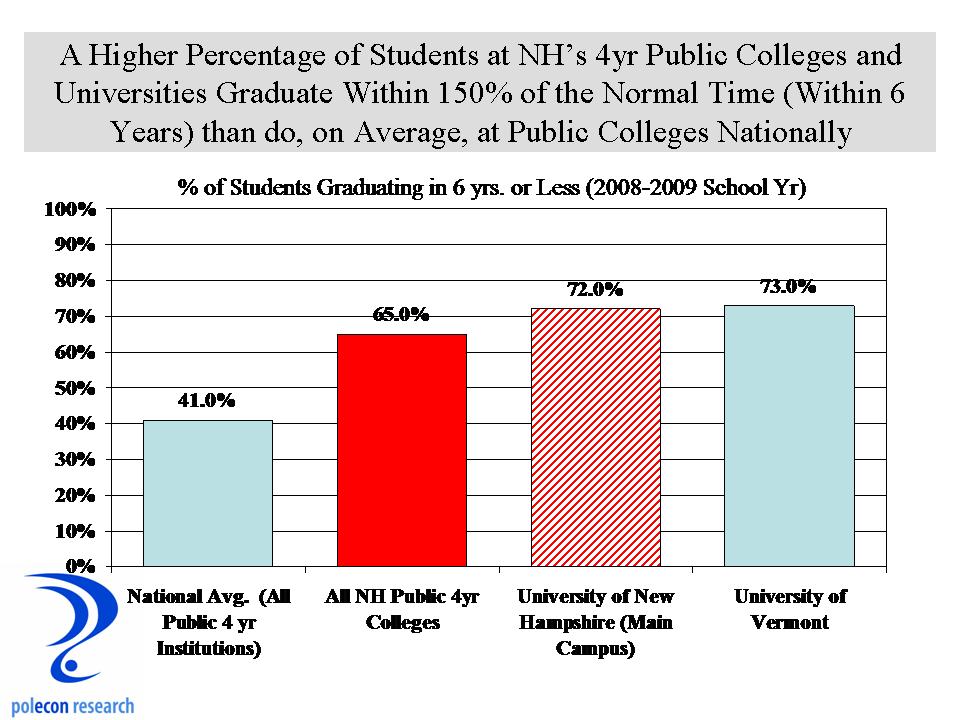
It sure didn’t feel that way over the past several years as I have had the pleasure of sending two children to different public universities identified as having among the highest costs of any public universities in the nation (UVM and UNH).  But a lower annual cost doesn’t mean as much if it takes more years for a student to graduate.  Fortunately a higher percentage of students graduate within 150% of “normal time”  at NH’s (and VT’s) public 4 year colleges than they do nationally (see chart below).  So far my students are 2 for 2 in graduating on-time and the next one is in the batters box in North Carolina, what are the chance that we can bat 1000?

Graduates within 6 years

Why Can’t a Man Graduate More Like a Woman?

January 31, 2013

Brains are the most valuable resource in the 21st century.  Unless your state or region sits on top of a recently discovered oil or natural gas formation, skilled, well-educated individuals are the key source of competitive economic advantage throughout the U.S..   NH’s stellar growth in a slow growth region during the 1980’s and 1990’s and early part of the 2000’s was primarily driven by the increased concentration of “talent” in the Granite State.  A great state to live and work, with access to a regional labor market with a major metropolitan area that is home to world-class companies and institutions, and facilitated by NH public policies that increased the returns to education (by allowing individuals to keep more of the fruits of the education and labor) are largely responsible.  But in NH, as in the nation, half of the population appears  not to be contributing as much as they could be to a concentration of  talent that can provide us with a competitive advantage.  Females are now both entering and graduating from higher education institutions at rates that significantly exceed those of males.  I don’t know what is wrong with young males in this country, but as the father of young females, I didn’t need to look at a lot of data to know that young males have been a disappointment for some time now.

In NH, an increase in individuals with the highest levels of educational attainment  has largely been the result of an increase in the number of females in our state with at least a BA degree.  Increasing in numbers, females with at least a BA degree in NH now comprise more than 50% of NH’s labor force aged 25-64 with at least a BA degree.

Growth in Females with BA

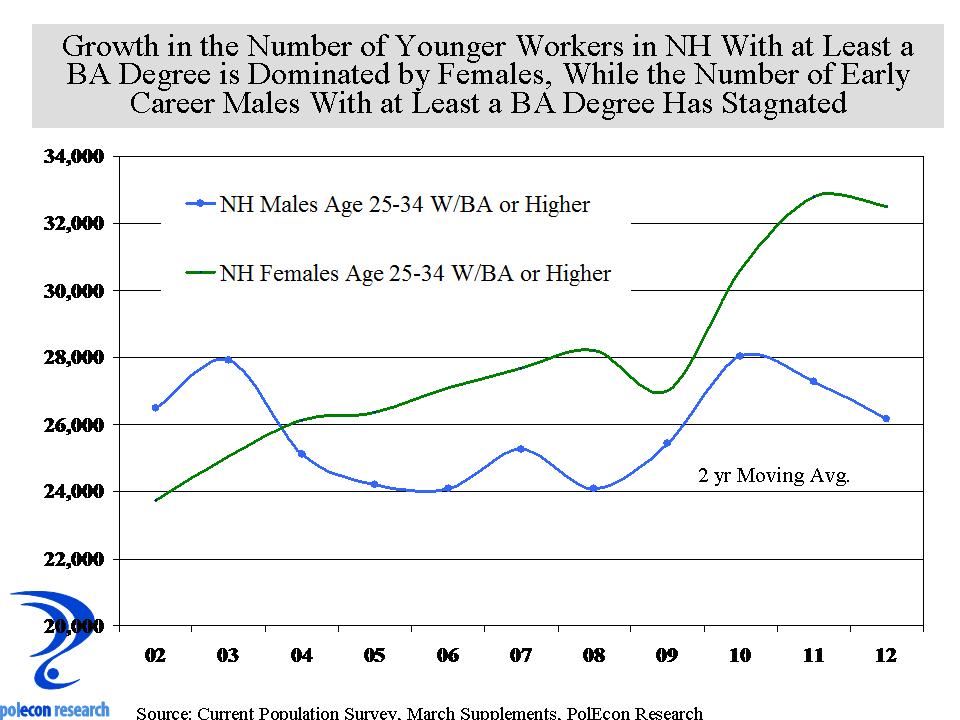
I am pleased that the number of women with higher levels of educational attainment in NH is increasing, but I would be just as pleased if the number of males was increasing similarly, so that the growth in “talent” in NH didn’t depend so much on just continuing the positive trends among women.  Unfortunately, it doesn’t look like that is going to happen soon.  As the chart below shows, the trends in the educational attainment of NH’s younger labor force (age 25-34) shows that the number of males with at least a BA degree has been stagnating, while the number of females has risen substantially.

Age 25 to 34 With BA

I’ve got no particular insights into reasons for these trends and I have no direct experience with the decision and thought processes of  young males,  for most of the past several years its been my job to hate them, but  I could probably overcome some of that if they started contributing more to the concentration of skill and talent among us.

Longing for a Recovery in Housing

January 30, 2013

On only a few issues can I say that I would be happy to be wrong.  My views on likely home price appreciation and New Hampshire’s housing market  is one of them.     Housing is important to the state’s economic recovery and longer-term prospects for economic growth.  By way of shameless self-promotion, I will be on NH Public Radio’s “The Exchange” discussing some of my views on the topic.  I’m not a real estate economist so it will be interesting to hear how my views differ from someone who will also be a guest and who is a very good real estate economist,  (Russ Thibeault from Applied Economic Research).

The problem I have with most discussions of the  housing market is that housing is by far the economic metric that individuals have the most emotional, psychological and often direct financial attachment to.  Discussions of the housing market are the  most prone to hope, optimism, and wishful thinking, and the least amenable (and welcome) to dispassionate analysis.   If you want something to be true  it is as easy to find evidence to support your view as it is to dismiss evidence that contradicts it.  Every day we hear about the housing comeback nationally so we want to believe it is happening in NH, and we will look for any sign that it is.   I don’t see much evidence that the housing market is recovering as fast in NH as it is nationally and I don’t see factors in the near future that will contribute to it being so.   Long term, job and population growth are the best determinants of home price appreciation in a region and neither bodes well for a quick housing comeback in NH.  The chart below shows the relationship between year-over-year home price appreciation in each state and job growth during the same time period.  Each marker represents one state’s value on job growth (the horizontal or “x” axis) and its rate of home price appreciation over the same time period (the vertical or “y” axis).  Some states with large price declines are seeing out-sized rebounds but job and population growth largely determine price appreciation trends over the long-term (during bubble times that relationship breaks down but eventually it returns to trend),  NH is the red marker and reflects a state with both low job growth and appreciation rates over the past year.

job growth and home price appreciation

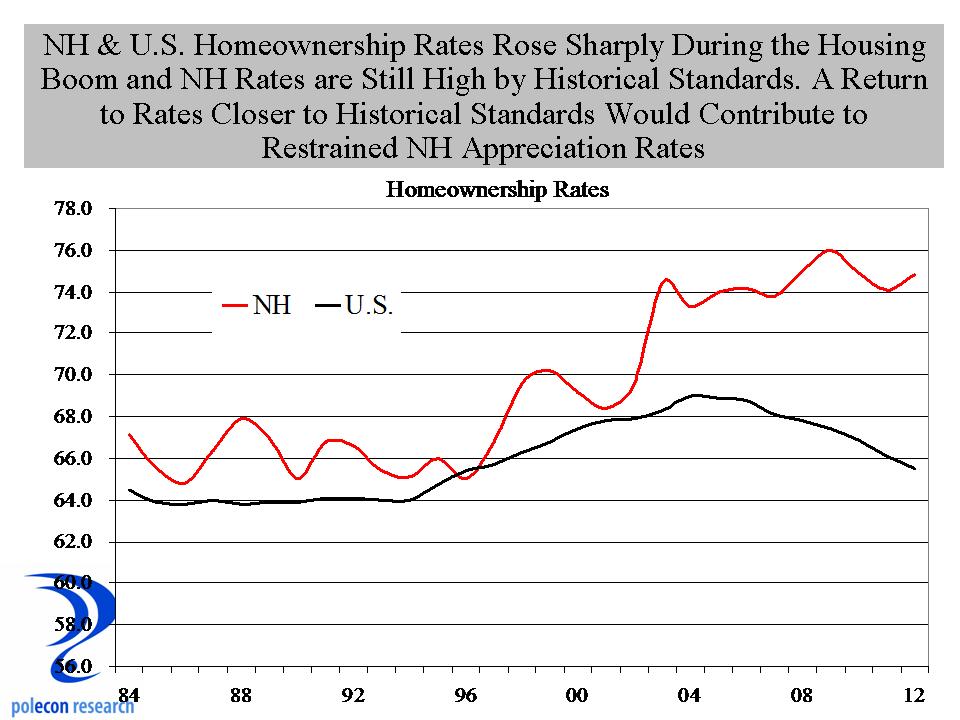
I know home sales have increased significantly in NH over the past year but I wonder how large a role  investor purchases for conversion to rental housing is playing in that trend.  For a number of reasons, that I will discuss in future posts, I think economic, demographic, financial, socioeconomic and social trends are likely to favor the performance of rental housing relative to homeownership in NH for several years.  Nationally and in almost all states, the homeownership rate fell during the housing market crash.  NH has a high homeownership rate and it barely dropped during the crash.  Many states are seeing homeownership rates begin to rebound and will see demand and price appreciation benefits from that.  Meanwhile, NH’s rate remains at historically high levels and given the demographic and other trends I don’t have time to discuss in this post, I think the rate will move lower and  closer to the state’s long-term rates.  That won’t help price appreciation.

Homeownership Rates

Gosh that sounds apocalyptic, its not, it just means that we shouldn’t soon expect the big price rebounds seen in many states.  Except I know we will expect exactly that, because residential real estate is about psychology and  about comparables and comparisons,  what has happened in the past.  Any industry strongly influenced by those factors is going to regularly disappoint.

Raising Issues With Raising the Gas Tax

January 28, 2013

“With the Patriots headed to the Super Bowl, now is not the time to increase the beer tax.”   Either the Governor strongly identifies with us commoners or there was going to be one heck of a Super Bowl party at the Hassan household.   I hope our Governor’s positions on important fiscal issues are more considered than her sports predictions and  I wonder  how she feels about raising the gas tax in New Hampshire now that many Patriots fans are more likely than they were a couple of weeks ago to go driving to ski, shop, or hike next Sunday.

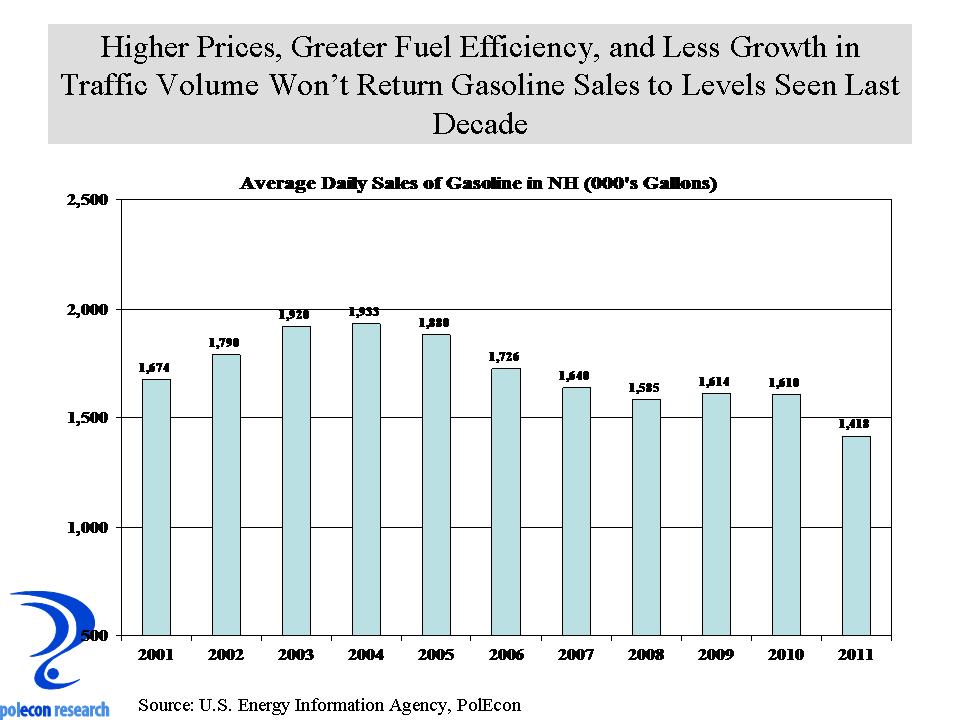
No doubt revenues from NH’s gasoline tax and its road tolls are stagnant or declining.  Higher gasoline prices have reduced discretionary driving and prompted greater fuel efficiency in our choice of automobiles and a steep recession further dampened gasoline consumption.

NH gasoline sales

No doubt there are a lot of transportation infrastructure needs that are clamoring for state revenues that are not likely  to increase organically.  Gasoline sales (and the revenues derived from them) will not rebound to levels seen early in the past decade.  Beside greater fuel efficiency, the volume of traffic at key border locations (I93, I95, Everett Tpk.) has declined by 7.4% between 2004 and 2011.  Traffic volume at toll booths on these roads, however, declined by just 3.9% during the same time period (chart below).

Border traffic

Of course the implications for gas tax and road toll revenues are significant, but those trends follow trends across the nation.  When I look at the data, the smaller decline in toll booth traffic than in overall border traffic suggests to me  that commuting is being less affected than is more discretionary travel.  That has even more profound implications for longer-term trends in NH’s general revenues because they depend so heavily on discretionary travel and discretionary spending.   One measure of how important discretionary travel is to NH is the fact that the state ranks fourth in spending per capita on gasoline.

Gasoline Exp per capita

Like beer or cigarettes, its not that we drink or smoke that much more than residents of other states, its that our numbers are increased by the high volume of visits the state receives.    I appreciate that the implications of the gas tax in terms of infrastructure investments is an important discussion to have.  I also think a discussion of the implications of a higher gas tax on the larger revenue issues facing the state ought to be evaluated.  That evaluation needs to be more thoughtful than the typical arguments made by opponents of any excise tax increase (“if we raise the gas tax we will lose not only gasoline sales but a billion dollars in potato chip and chewing gum sales”).  I don’t know whether the gas tax should be raised and I don’t know what the impact of an increase would be in a larger economic and revenue context but  I do know that higher gasoline prices affect a number of revenues because I have analyzed that in the past.  That isn’t reason enough to drop the idea of raising the gas tax, but it is reason enough to discuss it in a broader context than just the funding of infrastructure.  Maybe I’ll get that chance when my invitation to the big Super Bowl party in Exeter arrives, I’m eagerly off to the mailbox now to look for it.

Striking an Economic Strategy With Maslow’s Hammer

January 22, 2013

The great psychologist Abraham Maslow is famously quoted as saying:  “When the only tool you have is a hammer you tend to see every problem as a nail.”   Maslow gave us all too much credit. When we (NH) have a hammer and know how great it is, we not only treat everything as a nail, we actually perceive everything to be a nail.  We (me included) develop a blindness to “non-nail” problems and creative problem solving takes a back seat to picking up that hammer and smashing the problem.

NH’s relatively low state and local tax burden, especially compared to other states in the Northeast, has and should continue to provide the state’s economy with significant competitive economic advantages.  In an era where “talent” – skilled, well-educated individuals are the resource businesses are most in need of, our state’s fiscal structure has been a magnet for higher-skill, more highly-educated and more mobile individuals and families.  So why does it currently not appear to be offering a competitive advantage (based on job growth and population migration data)?   The question is whether our fiscal system will be enough of an advantage in today’s economy to assure the kind of growth and prosperity the state became accustomed to over much of the past several decades.  Based on the screams of joy I heard last week, the answer for many in NH is a resounding yes.  The news that Massachusetts’ Governor Patrick is proposing to raise income tax rates in that state has been greeted by many in New Hampshire as if the cloud that is NH’s slow job growth is about to be lifted.  Once those new Massachusetts tax rates are enacted NH’s schools and students will perform better, our electricity prices will drop, our young people will choose to enroll in the  newly affordable colleges in NH,  and our communities will be safer, cleaner and offer more and better services at ever lower prices.  For too many in our state,  the future of  NH’s economy is largely determined not by what we do as a state, but by the mistakes that other states make.  I’m no Doc Rivers or Bill Belichick but I don’t think their game plan is ever solely predicated on the other team’s mistakes.   Great states, like great teams, can succeed even when the other “team”  is playing their best.

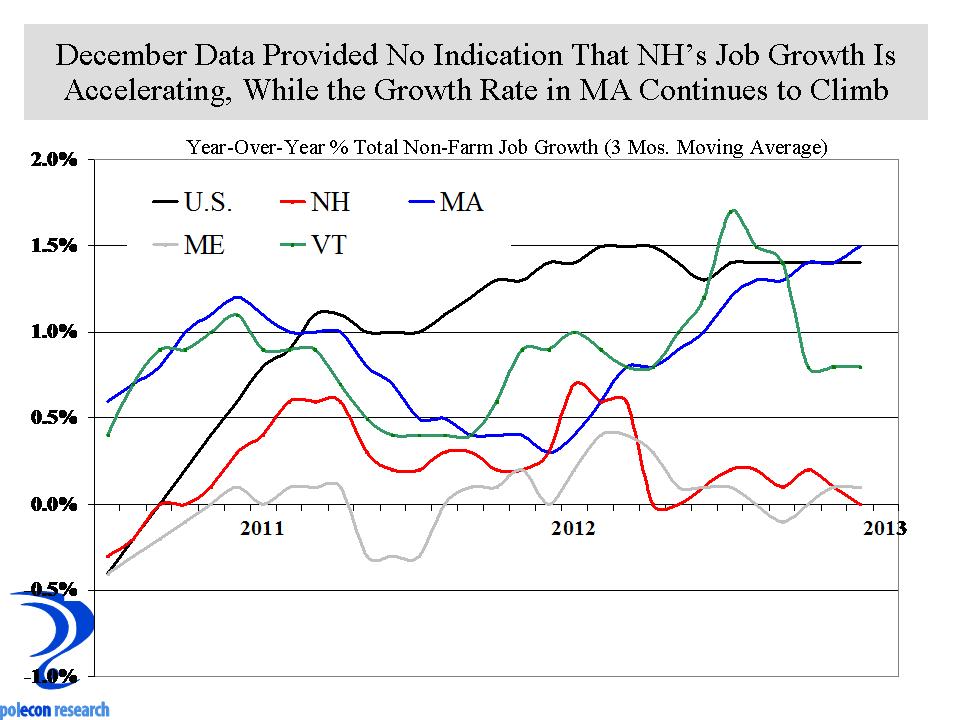
The monthly state job growth numbers for December, released late last week, continue a disappointing trend that should have NH businesses, policymakers, and citizens asking whether Maslow’s hammer is the only tool to use in shaping an economic strategy for NH’s future.

Annualized Emp. Growth

In the case of economic policy in NH, the “nail” is the high taxes which we have been pounding with our hammer for decades.  For the most part,  NH has successfully pounded that nail well below the surface.  As the chart below shows, state and local taxes as a percentage of personal income in NH are well below the U.S. and neighboring state averages.  Occasionally the nail it pops-up but is usually driven down.  Note that while it did rise for a time during the recession, this was a result of a slow and declining income growth rather than a rise in taxes.

State and Local Tax Burden

The problem is that our love of the “hammer’  as our primary economic tool appears to result in us using a longer and longer nail set in an effort to achieve the same levels of economic success as we have in the past.   Governor Patrick’s proposal to raise Massachusetts’ tax rates may benefit NH, I hope it does, but if it increases the use of our hammer, to the exclusion of other tools,  the benefits may be illusory.  A low tax burden is a great asset but the skilled, well-educated, individuals that drive economic success for the most part (it is certainly not unanimous)  also want the amenities and services that people free from want generally like to enjoy – things like good schools, civic, cultural, social, natural  and recreational amenities.  People want to pay as little as possible for these amenities for sure (and in many cases they expect them for free), but they want them nevertheless.  I think NH’s advantage is really been about providing ‘value” as much as it is about providing just a low tax burden.  As long as we can provide the services and amenities that people want, at a tax price lower than other places, we should be a magnet for the kind of individuals that will help our state thrive.

Our state’s hammer is and will continue to be a great tool, but not for every job, and not if it is used indiscriminately.  Every increase in a tax or raising of a fee isn’t an end to the “NH advantage.”  It wasn’t during the 1980’s or 1990’s when the state was growing remarkably even as taxes and fees with tinkered with (and even one or two major changes) by both Republican and Democratic administrations.  The key is knowing the true economic consequences of changes to different fiscal policies, which ones really hurt or help the economy and which ones have little impact  and by how much.

I like NH’s hammer and I have argued how it has been a great tool in helping us build a house that withstood the ill winds that blew through the Northeast region for decades.  I hope NH’s basic fiscal structure doesn’t change.  But we have become so comfortable wielding our hammer that in our casual over-reliance on it we may just be pounding on the thumbs of those who would live in the nice house with which it was built.

Entrepreneurship and Gender Equity

January 16, 2013

I’ve written a couple of times (here and here) about gender equity issues in employment and unemployment.  I have an interest in almost all labor market issues but on this one I have three terrific and personal reasons for my interest.  One of them is a scientist in training and in a few years will be confronting the labor market issues I  examine  here.

My initial hypothesis was that larger businesses in NH would likely have more extensive policies and recruiting  efforts that would result in a higher percentage of women being employed in larger businesses in professional, scientific and technical industries in the state.  These industries include things like legal, architectural, engineering, laboratory, computer programming, accounting and scientific firms as well as veterinary services but not human medical services). As the chart below shows, that is not the case, as the smallest firms have a higher percentage of their employees who are women.   These industries also have the highest percentages of employees (male or female) with at least a BA degree.  Again, as the chart shows, smaller firms had the highest percentage of women among the employees with the highest levels of educational attainment.

Female Emp in Prof and Tech Industries

My new hypothesis is this – I don’t think (or at least I hope) that larger firms have any preference for hiring men over women.  Rather, it is that a higher percentage of the smaller firms in these industries are likely to be women owned and newer businesses started, owned, or managed by women.  I think the fact that the percentage of all women employees at larger firms, who have at least a BA degree or higher is greater than it is at smaller firms suggests that larger firms don’t just hire females predominately for lower-skilled occupations.  Women still represent a smaller percentage of graduates from many professional, scientific and technical programs (although that is changing) and thus present a smaller percentage of the potential workforce for many industries.  For smaller prof./scientific and tech. firms that are started, owned or operated by women,  female employment with the highest levels of educational attainment could, however,  be expected to be higher than at larger firms.

Anyway, that’s my story and until I get more evidence, I’m sticking to it.  More than just my interest as a parent, I think the issue has larger implications for policies to support gender equity and to increase the supply of highly skilled workers.   It may be that promoting entrepreneurship among women is among the best approaches to both.

PureHost is “PureHell” and a Reprise of a Cautionary Column

January 15, 2013

Unless I send-out email notifications about posts on this blog I don’t get a lot of readers. Either I don’t have much of anything interesting to post or people have more than enough to look at without needing another nerdy economic and policy blog to read.  I’d put-up a poll to determine which is more responsible if I weren’t afraid of the results.   Thanks to my web host (PureHost or “PureHell” as I have come to know it) any email that contains a link to my or another WordPress blog is filtered from outgoing or incoming email – thus no email notices to eager readers who just need a little prompting about the “can’t live without” information in this blog.

So while I spend another day with poor tech support trying to resolve the email foible, Ive decided to reprise a column (slightly shortened) that I wrote for Business New Hampshire Magazine after the November 2010 elections.   It is a cautionary opine about the election results and in retrospect holds-up pretty well.  I liked it in 2010 and I like it as much now –  Business New Hampshire Magazine liked it so much that they stopped asking me to write a policy column shortly thereafter.

(From a January 2011 Column I Wrote for Business NH Magazine)

The  Double-Edged Sword of Populism

“Mass movements can rise and spread without belief in a God, but never without belief in a devil.”

      Eric Hoffer “The True Believer: Thoughts on the Nature of Mass Movements” (1951)

The tsunami that swept conservative Republicans into elective office this past November is due, in large part, to a mass movement called the Tea Party that shook the political ground and released seismic levels of populist energy in New Hampshire and across the country.

It’s a businesses community’s dream if the November election produces a public policy agenda of smaller government, lower taxes, and fewer regulations.  The big government, more regulation, higher spending, and bailout policies of recent years are the “devil” that unified the Tea Party movement in New Hampshire and the nation and what makes the movement’s agenda attractive to many business leaders.  But neither seismic nor populist energy is predictable, and neither has yet been effectively harnessed.

From its inception in 2009 through the November elections, what the Tea Party was against was more important to the business community than what the movement was for.  As long as the business community and Tea Party populism share as their common “devil,” big government, more regulations and more spending, then their interests are generally aligned.    But many, if not a majority in the loosely defined Tea Party movement have no love for much of the business world – big business, finance, insurance,  and multi-national companies to name a few – they just happen to dislike President Obama and most Democrats more.

What “devil” will unify and sustain the populist movement after it has vanquished Democrats and/or big government?  For businesses in New Hampshire, especially larger corporations, the stakes are large.   The anti-immigration sympathies of Tea Party populists will clash with New Hampshire businesses increasing need to hire technology workers.  The average educational attainment of foreign-born workers in New Hampshire is higher than that of its native-born population.  About 45 percent of New Hampshire’s foreign-born residents have a bachelor’s degree or higher (the second highest of any state in the nation) compared to about one-third of native-born residents. Foreign born residents in New Hampshire make up an especially large percentage (32%) of al PhD’s and young workers age 25 to 34 with graduate degrees (24%).  Thirty (30) percent of computer programmers in New Hampshire are foreign born as are 25 percent of the software engineers in the state.

Populist calls for protectionism and anti-globalization sentiments can also threaten what will be about $4 billion in exports by New Hampshire manufacturers in 2010, as well as the jobs that those sales support, up about 60 percent from $2.5 billion just since 2005,.  In addition, the New Hampshire economy relies more on foreign direct investment than all but three states.  In 2008, almost seven percent of workers in New Hampshire were employed by foreign-owned firms.

New Hampshire’s economic successes over the past several decades are the result of a transition to an innovation-dependent, technology-rich, economy that increasingly relies on workers with higher levels of educational attainment, across virtually all industries.   Research and development, strong universities, high performing schools, attracting and retaining talented employees, and a reputation for being “ahead of the curve,” all support innovation.  There are different ways policy makers can support or facilitate innovation but it is critical that they recognize its importance.

The recent election is sure to produce many spending, revenue, and regulatory policies in New Hampshire that will please most businesses.  But at least a portion of the business community should be wary of becoming a unifying “devil” of the populist movement.   Small business is off- the-hook and it is easy to see why.  Most small businesses receive no loans, subsidies or other support from the government, and relatively few sell goods and services outside of the U.S. or hire any foreign-born workers.  Moreover, most of the high-profile public policies that energize the populist movement have their greatest impacts and generate the largest costs for small businesses.  Not all Americans love businesses or even capitalism, but they increasingly worship small business, according to one public opinion poll, small business is viewed more favorably by the public than are churches.

Big government is at the top of a short list of unifying ‘devils’ needed to sustain today’s populist movement, but “big” business isn’t far behind.  While occasionally justified, in New Hampshire it would be unfortunate.  New Hampshire is home to world-class, innovative businesses whose connections throughout the world benefit the state’s economy.  Financial institutions in the state have avoided the practices that evoked populist outrage and their lending has been a key to the milder recession and stronger recovery of our state’s economy.  Only about 100 New Hampshire businesses have more than 500 employees and only 260 have more than 250 employees, but combined they employ one-third of all workers in the state.  That is far from a majority, but if a movement targets businesses employing one-third of New Hampshire’s workers, it is best described as something other than populist.

We Need Better Incentives for Households to Reduce Electricty Consumption

January 14, 2013

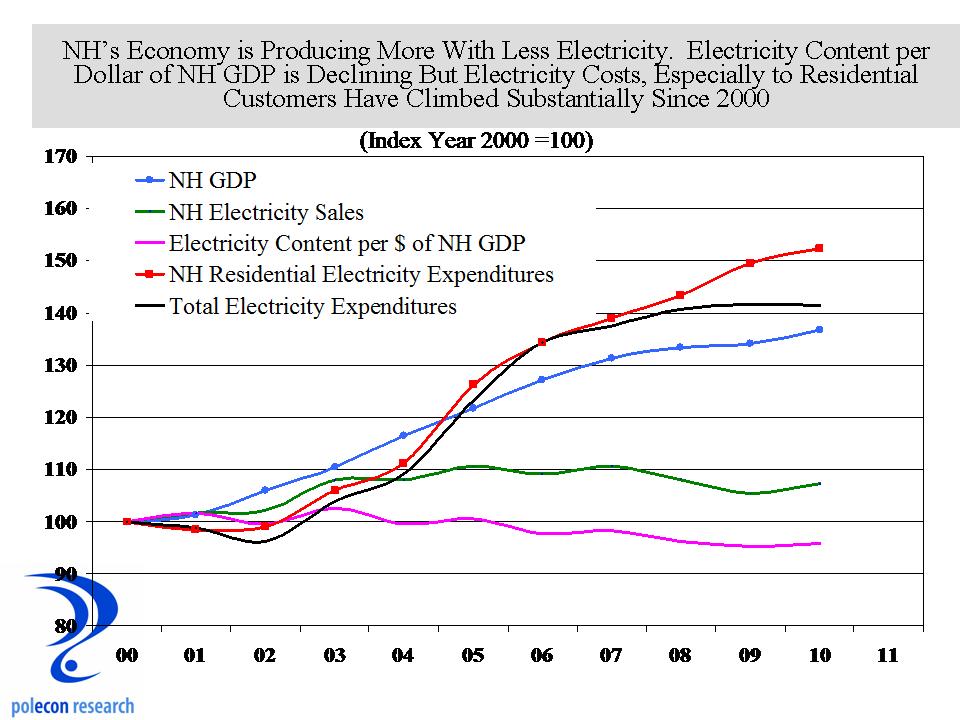
Just like the NH and US economies are producing more goods and services with less and less energy content (as measured in BTUs per dollar of gross domestic product), so too is the NH economy producing more goods and services with the same or less electricity content.  As the chart below shows,  over the previous decade the total electricity consumed in NH (in kwhs) increased by just over 7%  while real gross state product increased over 36%.  The result is that electricity content (in terms of khws) per dollar of real NH GDP declined during the decade.

Electricity Consumption and Expenditures in NHl

Conservation and a changing industry mix have gone a long way toward restraining electricity consumption but a steep recession also contributed.  High electricity prices play a role in creating incentives for conservation but as the chart also shows, despite only a 7% increase in electricity consumption during the decade, total expenditures on electricity in NH increased by over 40% while expenditures by residential customers increased by over 50% during the decade.  Unfortunately, in a regulated market that guarantees a rate of return for some producers of electricity and which depends on variable  fuel costs, consumption of electricity and expenditures on electricity do not (for long) show the negative relationship that they do in many markets.  I think this tends to discourages household conservation efforts because they see less evidence of the payback from their efforts, even less so than say in oil and gasoline markets.  With gasoline or heating oil markets an individual or household can take steps to reduce consumption that yield tangible results in terms of reducing energy expenditures.  Reducing oil or gasoline consumption won’t always reduce absolute expenditures, as in the case of very dramatic price spikes seen in the recent past, but consumers at least see (and feel) a direct impact on their cash outlays as a result of their conservation or consumption behaviors.  But how do financial incentives for conservation affect  consumers of electricity when guaranteed rates of return allow for electricity prices that offset the impact on expenditures of their conservation efforts?   I think they produce what appears to be happening now in NH, the conservation efforts transform into just a  quest for lower prices.   Electricity consumers seek lower-cost providers of electricity who may not offer ceilings on future prices but who also don’t set a floor on prices because of guaranteed returns or because a shrinking base of customers requires guaranteed returns be paid for by fewer customers.  I am all for lower electricity prices but I get to call myself an environmentalist when I support incentives for conservation.  Such incentives will work best when they don’t yield only intermittent or temporary benefits

I don’t know whether the proposed Northern Pass Transmission Project (NPT) will actually result in lower prices for wholesale electricity or not.  I’ve seen conflicting studies from proponents and opponents (by way of disclosure I conducted a study of the NPT employment impacts for competitors of the companies planning NPT but I did not examine impacts on electricity prices nor do I have any contracts or agreements with anyone opposing or competing with NPT).  I do know that NH spent an estimated $1.616 billion on electricity in 2010 (the last year for which data is available from the U.S. Energy Information Agency).

NH Electricity Expenditures

That means if proponents of NPT are correct, and wholesale electricity prices in NH are reduced by about $25 million, and that wholesale price results in a similar reduction in retail electricity prices (?), then electricity expenditures in NH would be about 1.5% lower then they otherwise would be.  Whether illusory or not, given the consumption and expenditure trends lines above, it is hard to see that this impact on wholesale electricity prices will have much of an impact on the high cost of electricity in NH.

Ideologically Uncomfortable Economic Growth in New England

January 11, 2013

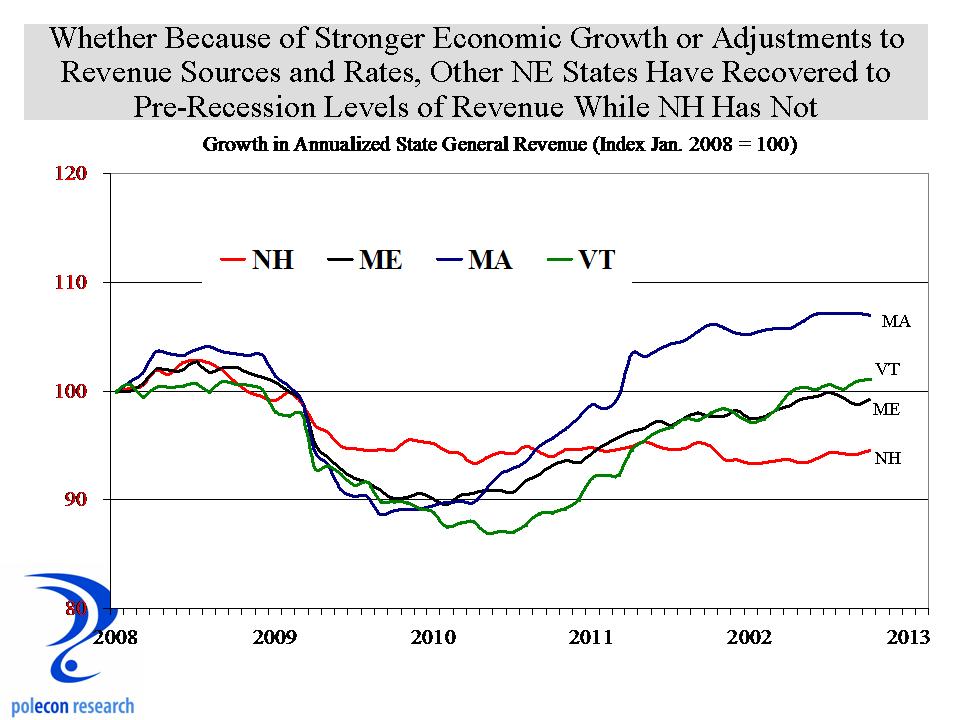
State government revenues in NH have grown more slowly over the past few years than almost every other state in New England and there aren’t any signs on the horizon that revenue will grow substantially over the next biennium.

General Revenue Growth

Some of that is the result of policy decisions that looked to reduce taxes in NH in order to increases economic growth, some is the result of other states willingness to expand or raise taxes, and some of it is the result of the fact that NH’s economy has been growing more slowly than most NE states with the exception of Rhodes Island and Maine.  How much of the slow revenue growth is attributable to a weaker economy and how much is attributable to policy changes is difficult to discern.  In some cases it is easy, the cigarette tax was reduced and produced less revenue (almost exactly the amount that I forecast) but more generally, slower growth (or declines) in revenues will occur in a weak economy regardless of policy changes.   Even without a definitive answer to that question we can still learn something from the fiscal and economic experiences of NH and neighboring states over the past few years.

Because it seems that it  is all ideology all the time in public policy debates these days, lets filter the revenue and growth debate through the ideological prism that characterizes most legislative bodies and public debate today.  For some in NH, it is bad enough that both Massachusetts and Vermont (that would be two-thirds of the Holy Trinity of New England socialism if socialists were allowed to believe in the Holy Trinity) have enjoyed stronger economic growth than NH over the past nearly two years.  But it is even tougher to accept that each of these states can enjoy faster growth than NH at the same time they are seeing stronger growth in revenues, and maybe even at a time when they took steps to keep revenues from falling too far, because to ideologues on one side, more revenue has to mean slower economic growth and the only way to get stronger growth is to cut revenues.

NE emp growth

The other end of the political spectrum will argue that the collecting more revenue has allowed these states to invest in more of what their economies need to grow, but there hasn’t been a whole lot of “investing” by state and local governments anywhere in recent years and each of these states has taken some steps to reduce the size and scope of state government expenditures in recent years.  The reality of course, as it almost always is, is somewhere in that wasteland (according to ideologues) known as “the middle”.   The stronger revenue growth of some states is largely a function of stronger economic growth and not necessarily the “investments” those revenues allowed but it can also be said that their generally higher levels of taxation have not disadvantaged their economic performance in relation to NH with its lower level of taxation.  Some of NH’s slow revenue growth is the result of policy decisions but most is related to an economy growing more slowly than neighboring states.  If there is anything to learn from recent economic and revenue trends it is that taking less in revenue  does not, in itself, guarantee stronger growth and that more revenue doesn’t always stifle (although it could) economic growth.  I know business taxes in NH remain high, but that has been true for as long as almost anyone can remember.  It didn’t keep NH from growing faster than any other state in the region for most of 30 years so I doubt it is the singular reason why we are growing more slowly now.  That doesn’t mean it isn’t an issue that should be addressed, it just means that its not likely the only answer to NH’s problem of slower economic growth.  For all of us non-ideologues, I hope lawmakers look to broaden the range of issues in the policy debates over how best to strengthen NH’s economy.