Posted tagged ‘job growth’

Hiring by Age: More Evidence of a Skills Gap?

December 10, 2012

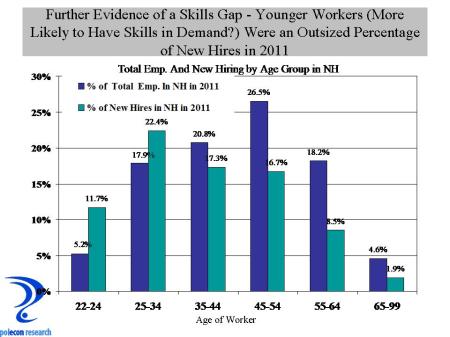
I know its a tough labor market for young people and recent college grads, but they still represented a larger portion of new hires in NH in 2011 than would be expected based on the percentage of employment by age in the state.  The chart below shows the age distribution of  employment in NH in 2011 along with the percentage of new hires in the state by age group.   Although job growth has been slow this recovery, the chart still shows that among those who have been hired for a new job (that is the hiring that is not a “call back” of a previously laid-off worker), younger workers make up a disproportionate number of the new hires.

Emp by age

This could be more evidence of, as well as a subset of,  the “skills gap” debate.  Many employers complain that the skills that young workers and recent grads posses don’t match their needs, and this is true for many occupations, but what this data also seems to suggest is that the mismatch between the demands of employers and those seeking work among the existing workforce is even greater than that for younger workers and new entrants to the labor force.  It suggests a bigger problem than just getting kids into the right majors and training programs (although that is a big part of it).  It points to a larger problem of a fundamental change in the types of occupations in demand (or the skills required of the same occupations) as well as a “twist” in the labor market that results in differences in the occupational make-up of industries.  It is a much more difficult , slower, and likely painful process to have the existing workforce adapt to these changes in order to increase their employment prospects than it is to begin with the next generation of workers, although both will challenge future employment and economic growth for some time.

Of course it is possible that employers just prefer younger and perhaps less expensive workers and that is what accounts for their outsized share of recent new hires.  Or it could be a function of the type of industries that were hiring in 2011 (I will be examining this hypothesis).  It may be more comforting to view labor market trends from those perspectives but it won’t get us any closer to taking the personal and policy actions necessary to create greater alignment between the skills of our workforce and the skills needed for a more prosperous economy.

A Simpler But No Less Troubling Explanation for Job Growth Trends

December 5, 2012

A lot of analysts, me included, have been looking for reasons why employment growth has been slower much of this recovery.  That prompts questions about whether the slow recovery from recession is the result of cyclical factors (related to swings in the business cycle) or structural factors that fundamentally and longer-term alter the ability of NH and the nation to create jobs.   While some wait for cyclical factors to improve job growth, in NH there is a lot of talk about demographics, migration, and too often (by me at least) the skills gap or mismatch between job openings and the skills of job seekers.  Much of the demographic story, especially concerns about NH’s ability to attract people from other states,  is relevant – except perhaps for the overblown concerns about NH’s “aging” (more about that in future posts).  I believe demographics and things like the skills gap play an important role in the slow recovery and more general downward trend in job growth, both before and following the recession.  But today, I offer another, simpler thesis, but  one that may be no less troubling.   If you look at job growth trends in NH by industry, you see that since the recession, employment weakness has really been most concentrated in  three sectors of the economy;  construction, government, and financial services.   The chart below shows job growth trends over the past several years for total non-agricultural employment in NH,  as well as total employment minus construction, government, and financial services.  Absent the three hardest hit sectors of the economy, job growth following the recession (until recently that is) didn’t look that much different than the recovery from the briefer, milder recession of the early part of the last decade.

recovery

I know construction,  government, and financial services are important but they still represent just over 20 percent of employment in the state, so the weakness in employment isn’t as broad-based as pessimists (including me at times) suggest.   But what is more troubling is that the weakness in these sectors are more structural than cyclical and thus we may be waiting for a rebound that may never occur.  I don’t think that is true for construction, where at least some rebound will occur as the housing market improves, as business investment strengthens, and whenever the fiscal health of governments improve enough for infrastructure spending to pick up.   But weakness in government and financial services employment is likely more structural.  New financial services regulations are likely to be an impediment to job growth in that industry for some time and there is no end in site for the budgetary impediments that will likely continue to weigh on job growth in the government sector.   I, and others, will continue to look at the implications of such things as demographics and skills gaps on recent and prospective job growth, but we can’t fail to recognize that sometimes  answers are less complex than the questions.

The Home Price Rebound That Wasn’t

November 29, 2012

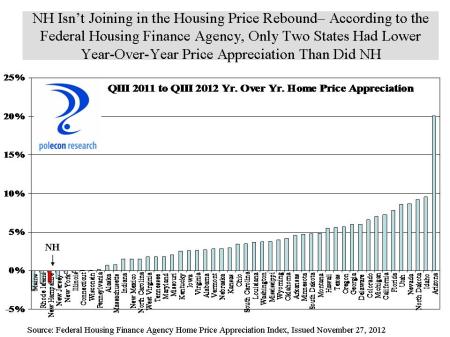
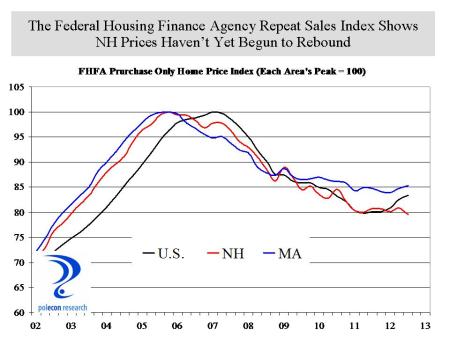
The Federal Housing Finance Agency released its latest home price appreciation index on Tuesday and while the data support the belief that housing is bouncing back across the country, and is now becoming a positive influence on economic activity rather than a drag,  the news is not good for New Hampshire.   The FHFA’ s repeat sales home price index shows that NH is one of only a few states that had price depreciation between the third quarter of 2011 and the third quarter of 2012 and only two states (Maine and Rhodes Island) had lower appreciation rates than did New Hampshire.

Repeat sales indices are the only accurate way to measure changes in home prices.  Simply examining median sales prices doesn’t account for the fact that the characteristics of the houses sold may be different (location, size, type, etc.) unless the repeat sales method is used.  I am by nature an optimist.   I am rooting for the housing market because its rebound is important for the prospects of the NH economy and its not so bad for my balance sheet either.   I am also not looking for yet another reason for realtors to take exception to some of my analyses.   I am, however,  a believer in the wisdom of markets (most of the time) but a lot of what happens in markets is driven by pure stupidity – or, rather, inattention, misinformation about fundamentals, and an exaggerated focus on currently circulating stories (the housing market is back, Mitt Romney has got the momentum in the swing states).  At least one of those stories is true , the housing market is coming back as a whole in the nation, just not everywhere.

As I have noted in prior posts, no amount of exhortation and cheer leading about housing can overcome the fact that values are determined by fundamental underlying demand for housing which includes population and job growth, the formation of new households, and the need to replace older housing units.   Both NH’s job and population growth have been weak relative to a majority of states over the past couple of years.  Regressing  job and population growth over the past year in each state on the FHFA’s home price index-based change in home prices in each state shows a highly significant relationship (R=.603) accounting for about 40 percent of the variation in home price appreciation across states.  There are variations in markets within each state, and this analysis is an oversimplification, but nevertheless it is important to remember that home price appreciation cannot, for long at least, outpace the fundamental determinants of the demand for housing – job, population and  household formation growth, and the need to replace obsolete structures.

Equity in Unemployment

November 26, 2012

I started this analysis wondering if the percentage of jobs in professional, technical, and scientific industries in NH that are held by females is greater among younger workers in the industry than older workers.  I became sidetracked by the unexpected finding that the percentage of workers in those industries is about evenly divided between men and women (and as a spoiler the percentage that is female is larger at younger age groups – consistent with my “‘feminization of the NH workforce” theme from an earlier post).  One caveat before proclaiming gender equity in professional and scientific fields, the data do not account for the specific occupations in the industries.  That is, it is possible that the conventional wisdom that women are less employed in those industries is not supported, but the fact may remain that the more professional, scientific, and technical occupations in those industries (as opposed to the management, support and other occupations) may still be dominated by males.  Unfortunately there is data from different datasets that supports this thesis, although it does appear to be changing.

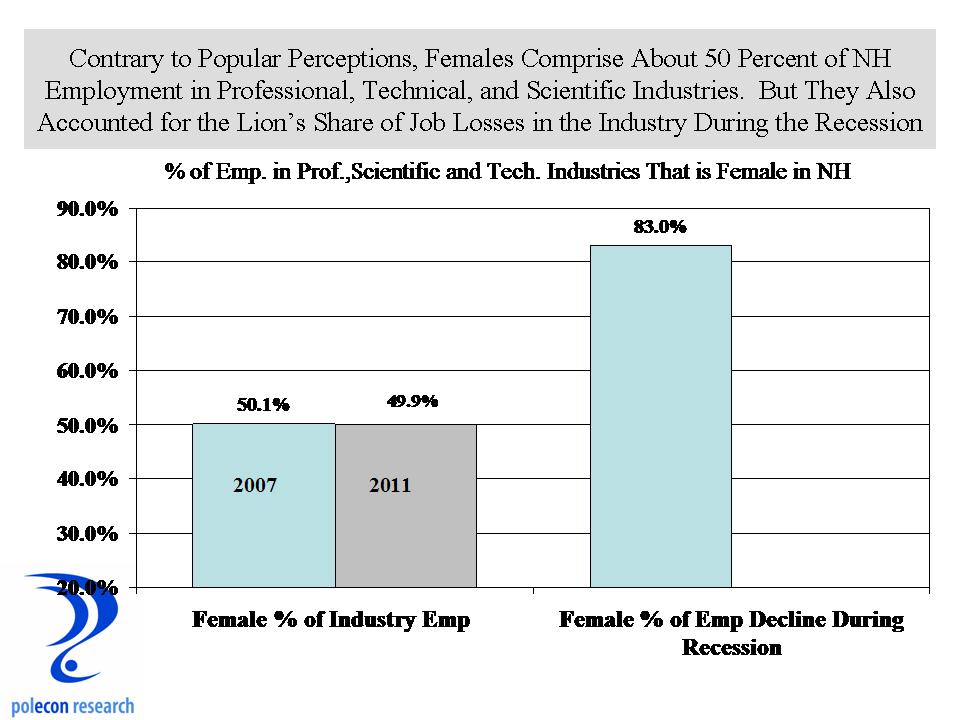
The chart below shows that women comprise about half of the employment in the broad industry grouping of professional, scientific, and technical industries.

The real kicker in the data is that it shows that reductions in employment in those industries came largely at the expense of female workers.  Again, this may just be a function of the reductions in those industries occurring in specific occupations more likely to be populated by females, a viable interpretation.  It may also be related to an increase in female employment among younger and newer workers in the industry who’s employment  may be most vulnerable in a recession.  Nevertheless, such a high percentage of  decline in those industries coming at the expense of female workers is well beyond what would be expected based on probability and chance alone.

Job Growth May Depend on Narrowing the “Skills Gap”

November 21, 2012

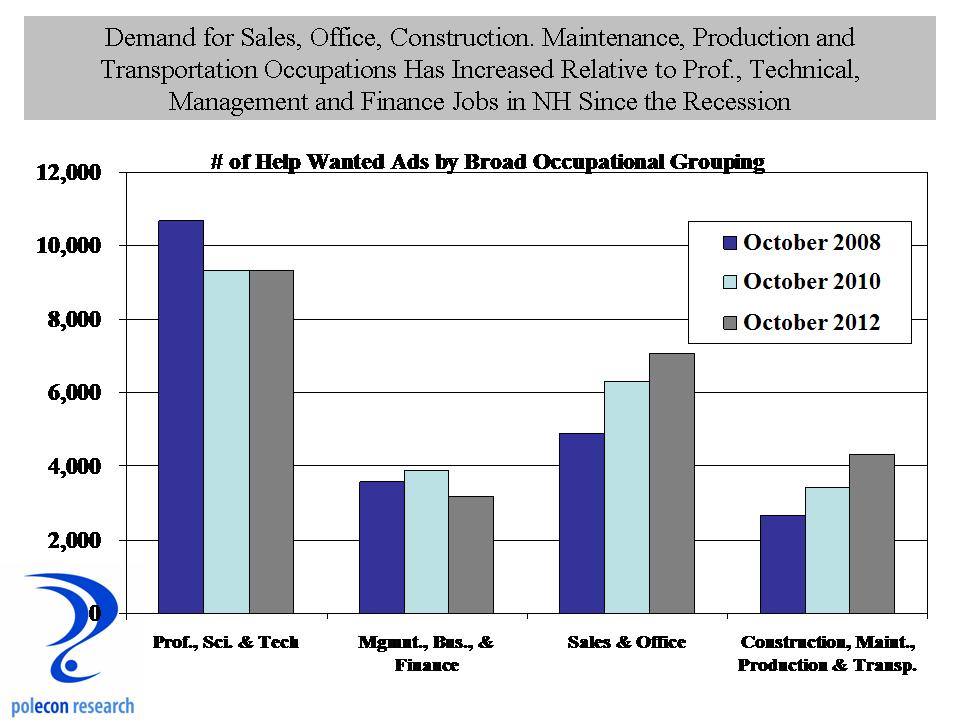
A quick review:  The “skills gap” explanation for slower employment growth this recovery posits that there are large numbers of jobs waiting to be filled but hiring is sub-par after the recession because of a lack of qualified candidates to fill those positions.  Twice I have presented some evidence on the issue, here and here.  Most of the concern and evidence about the existence of a skills gap addresses very high-skill technical, scientific, computer, and engineering occupations because our nation, and by extension our state, seem to perpetually be unable to produce enough individuals in those fields to satisfy industry demand.  As  a result we “import” a lot of that talent from foreign countries (more about this – I promise – in a future post).  There is some evidence of this in NH.  As the chart below shows, professional, scientific, and technology occupations are the largest,  broad category of help wanted ads in the state.  But they have also evidenced the smallest increase (a decrease actually) since the recession.  There is still a significant demand but it may be that an inability to find qualified applicants has companies in need of those occupations from considering more hiring in the Granite State.  A quick review of data for Massachusetts shows that demand for professional, scientific and technical occupations has increased during the same time period.

But  more direct evidence of a skills gap comes from the demand for construction and production workers.  I am especially interested in the potential skills gap for production workers.  The chart above shows that demand for construction, production, and transportation workers has increased significantly since the recession.  Although still a much smaller category of help-wanted ads than professional and technical jobs, the increased demand is consistent with anecdotal evidence I heard this week at a roundtable discussion of the Seacoast economy.  At that discussion, representatives from industry, higher education, and economic development organizations cited specific examples of companies frustrated at their ability to hire skilled production workers.   Some are forming partnerships with NH’s community college system to increase the supply of needed occupations.  Those initiatives show promise and I hope the state’s four-year colleges and universities develop more partnerships to address the skills gap in professional, scientific and technical occupations as well because, increasingly, job growth in NH appears to depend on it.

Some Thankfull Job Growth Numbers

November 20, 2012

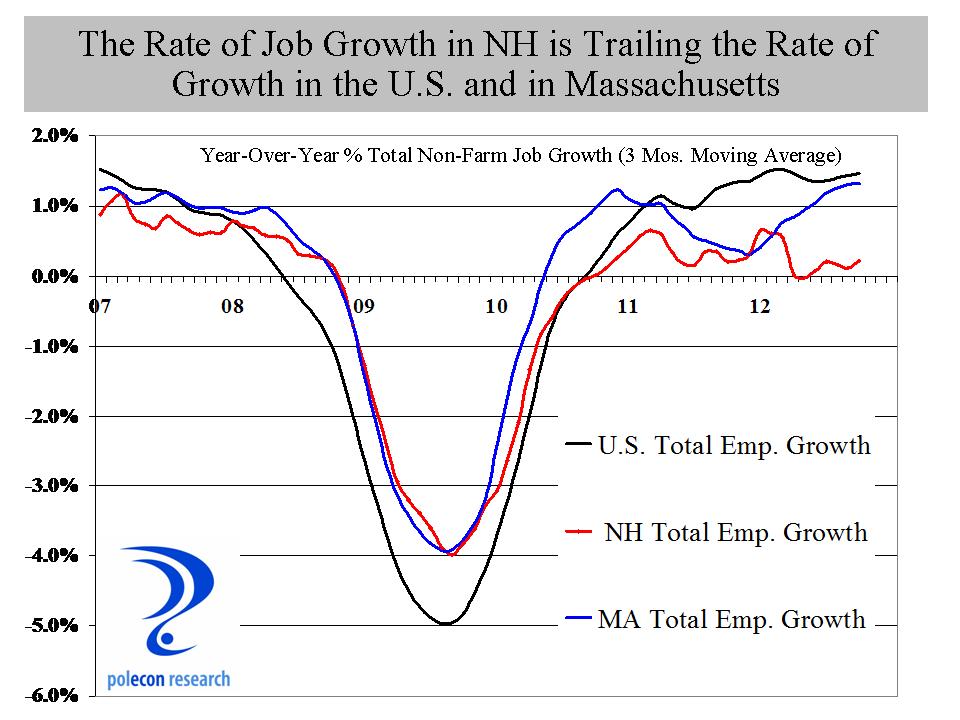
The U.S. Bureau of Labor Statistics released its monthly report on state and local employment today and the good news is that, preliminarily,  New Hampshire added 1,000 jobs in October.  The bad news is that this is just 1,200 more jobs than the state had one year earlier in October of 2011.  For optimists,  the most recent trend is likely to be the most important and the monthly report is consistent with the rise in PolEcon’s NH Leading  Index.

Nevertheless, the longer-term job growth trend in NH has been weak.  Looking at growth in just private sector employment, the situation is no better for NH.   As I have noted here, I  believe job growth in NH is being underestimated but even if that is true, it is hard to see how the recent past will be revised enough to make NH’s job growth picture look comparable to that of our neighbor to the south or the U.S. as a whole.

The Recession’s Impact on The Entrepreneurial Economy

November 5, 2012

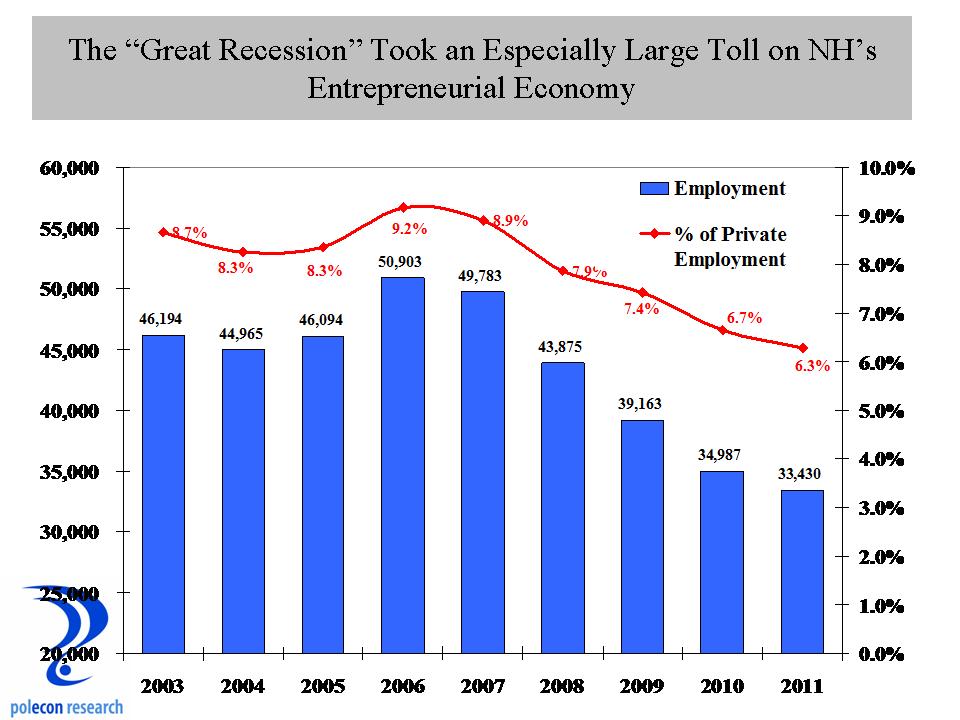
The cost of the recent recession in terms of jobs lost was great,  but the  longer-term cost could be far greater because of the impact the recession had on NH’s entrepreneurial economy.   While small businesses are cited as being responsible for the majority of new job creation, the fact always left out of that truism is that most of the job creation by small businesses come from new businesses, and more specifically, a small number of new businesses that become “gazelles,” new businesses with the potential to grow much larger.  Most small business will always be small.  They start, they fail, and with a lot of churning they are the businesses with whom we most interact on a daily basis. New Hampshire and New England increasingly have relied on our economy’s ability to generate new and innovative businesses to maintain a dynamic economy, a decline in entrepreneurial activity would have significant implications for our ability to continue to do so.

Looking at data on employment by age of businesses in NH from the past decade, it is clear that while NH may have suffered less than most states during the recent recession, it is not so clear that our entrepreneurial economy did as well.  The chart below shows that the recession had an especially large impact on NH’s entrepreneurs, as the the number of people employed at firms operating for three years or less declined by 34% between its peak in 2006, and 2011.

As a percentage of private employment, workers at firms three years old or has fallen from over nine percent of private employment to just over six percent.  This data does not mean that 16,000 workers in firms three years old or younger actually lost their jobs.  Remember, this is time series data so the firms in 2006 that were three years old or younger are not the same firms in the three year old and under category in 2011.  Certainly there were substantial job losses among young firms during the recession (as well as some gains) but the data more likely suggests that the next wave of new businesses (some of whom could be expected to become “gazelles”) simply did not start or  were not able to survive and grow.   For how long those effects lasts should be a question for anyone wondering what to do about the slow pace of job creation in the state.  It would be nice to have a control group of data from Massachusetts to examine for comparison purposes but they do not participate in the program from which these data are drawn.  Recessions always take a toll on smaller and newer businesses because those businesses are often in more precarious financial positions.  The data for NH do not go back earlier than 2003 so it is difficult to say whether this recession was different in its impacts on entrepreneurial activity in NH but we really should be concerned about whether the impact of the recession on entrepreneurial activity will have longer-term impacts on the NH economy.

The Skills Gap Part Deux: Some Evidence and Who’s Fault is it Anyway?

November 2, 2012

A good national job growth report  was released today that showed private sector job growth was up 184,000 in October.  With government job losses at -13,000, total employment increased nationally by 171,000.   We  have to wait a few weeks to see NH’s job growth for the month but regardless of the number, the underlying causes of the state’s relatively slow recent  job growth still need to be debated .  A solid and empirically-based understanding of the  factors influencing job growth rates is the only way to formulate effective economic  policy in the state.  I am on record as saying (probably too often) that I believe NH’s job growth numbers will be revised upward at some point (probably with the annual revisions released early next year).  But even if that is true (errr, when it is conformed to be true),  by historical standards, recent job growth in NH will still have underperformed.   Whether job growth is slower now than in the past because employers are not willing to add additional workers or because they are not able to find qualified workers  (the “skills gap” argument) is among the most important issues to understand in setting both national and state-level economic policies.  If employers are unwilling to add employees that are readily available,  then the efforts to spur job growth focus more on factors affecting businesses (tax rates, regulations, costs etc.).  If job growth is constrained because employers are unable to find qualified workers to fill open positions, then the focus of efforts to spur job growth will be more effective if they look to increase the skills of the labor force, and/or better match them to the needs of employers.  In reality this is not an either or question because inadequate attention to the needs of either employers or the workforce will produce sub-optimal economic growth.  But in today’s polarized policy environment whatever light is shed on these issues is too often separated by an ideological prism that produces policy proposals aimed at either the needs of business or the needs of the workforce to the exclusion of the other.   If job growth is slowed because there are too few qualified workers to meet the needs of businesses then it is not policy maker’s  fault  but they can help alleviate the problem by adopting more “human capital” policies.  Businesses bear some of responsibility for any skills gap because studies have shown that businesses spend less time and money training workers than they did decades ago, and that more of the training that does occur is concentrated on management positions rather than mid- and lower- level positions.  In an age when job turnover has accelerated, and the tenure of workers with one businesses continues to decline, it is understandable that businesses would be less willing to invest in workers who may only be with their firm for a short while.  But who is more responsible for the decline in employer-employer loyalty and tenure?  The labor market has been signaling strong demand increases in many occupations – especially technical and scientific  occupations and increasingly skilled production occupations.  Older and experienced workers may have difficulty responding to these demands if their experience, education or training is in occupations in less demand but why are younger and new entrants to the labor market not responding  to these labor market signals by selecting the majors or training programs that would qualify them for more occupations in demand?  One reason is that regardless of whether or not the labor market is signaling many job opportunities in technical and scientific occupations (or skilled production occupations), if large numbers of the emerging workforce don’t have the intellectual and academic rigor to study these subjects the positions will increasingly go unfilled, go elsewhere, or as I will document in a later post, be filled by foreign born workers.

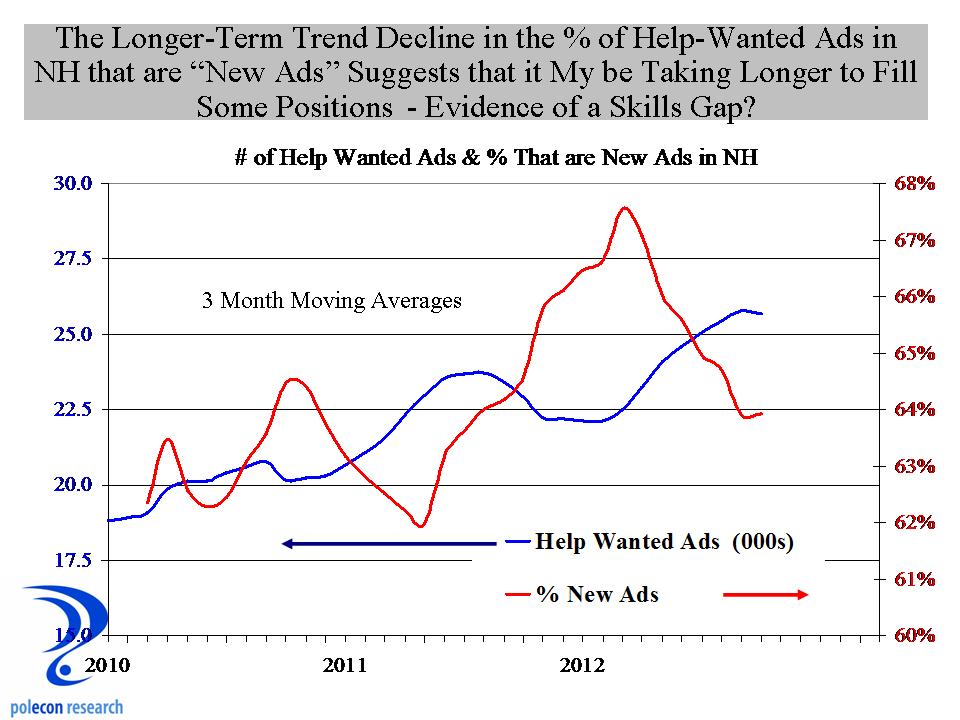
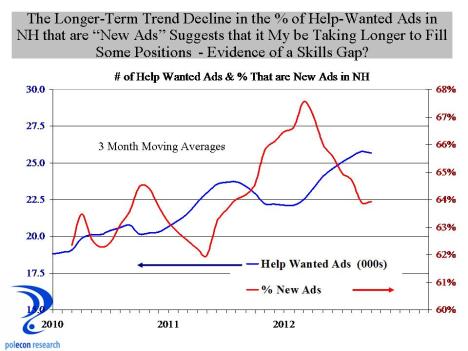
Ok, that was a bit of a rant, now back to the core issue.  Is there evidence of a skills gap in NH that is constraining job growth?  The answer of course, as it is with almost all economic issues,  is both yes and no and also something in-between and with a twist.  I will share this evidence across several postings, today I offer one, small bit of evidence that suggests the skills gap is playing a larger role in disappointing job growth trends.  I noted in an earlier post that help-wanted advertising has generally been on the rise in NH, while job growth has not.  Some of this will be corrected with job growth revisions, but evidence that a skills gap is playing a role comes in the form of the percentage of help-wanted ads each month that are “new ads”.  If help-wanted ads are rising and the number or percentage of new ads is rising similarly each month,  that means positions are being filled at a fairly consistent rate, but if the number of ads is increasing, but the percentage of ads that are “new ads” is declining, that suggest that positions are not being filled or taking longer to fill – perhaps suggesting employers are having a harder time filling the positions or a skills gap.  The chart below shows that indeed, the percentage of monthly help-wanted ads in NH that are :new ads” for the month has been slowly declining, providing some small bit of support for the skills gap explanation for job growth.  A lot more evidence is needed, but given the importance of the issue in policy making, it is worth the effort to find or refute it.
Some Good News in Some Very Bad Weather

October 29, 2012

(My apologies for the late post – I posted this 3 hours ago but it didn’t publish so I am trying again)

PolEcon’s NH Leading Index jumped from a revised + 3.7 to +13.0 this month. its highest value since January of 2011.  An Index reading of + 13.0 isn’t a signal of robust growth but it is a substantial improvement over much of the past 18 months and if it continues for another month or two it will be a clear sign of a much improved NH economy.

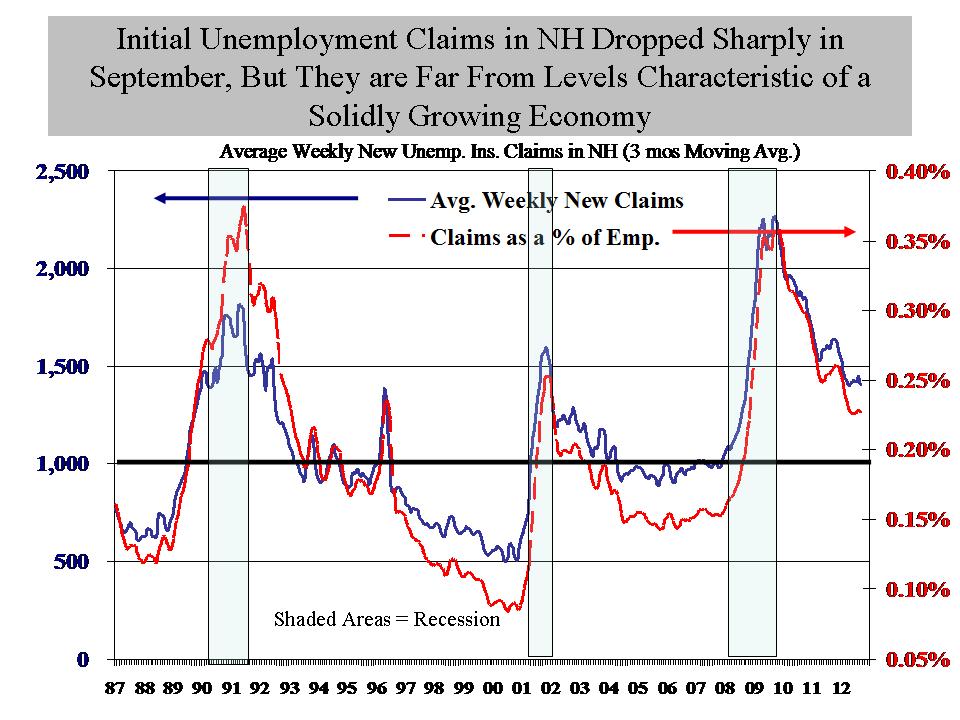
Weather and electricity permitting, the October edition of the Trend Lines will be emailed or available to read online at http://www.issuu.com/polecon.    Seven of the nine indicators in the Index improved over the month, with initial claims for unemployment insurance showing an especially large drop.  I prefer initial claims data to the unemployment rate, as it gives greater insight into the near-term direction of the labor market.  I’ve stated in a prior post that I believe job growth in NH will be revised upward, based on aggregate wage and salary growth and the volume of help-wanted advertising in the state.  Declining initial unemployment claims are another indicator that actual  job growth is likely somewhat higher than is currently being reported (NH has seen a few negative year-over-year monthly job growth reports recently). At an average weekly number of claims at 1,400 for the month, it is still much higher than the under 1,000 number that is typically seen during periods of solid job growth, but the number continues its downward trend.  The chart below shows how new claims currently compare with claims during previous periods of growth and recession.  On a three-month moving average basis, the number of new claims in NH  is now about what is was during the short-lived recession of the early 2000s, and compared to the first “great recession” of the early 1990s, it is also about as high now as during that difficult time.  But there is also a larger population in the state and also more employment  so examining initial claims as a percentage of employment in the state provides a better comparison to where the labor market stands today and where it may be heading.  That comparison makes the current labor market appear to be in the early stages of recovery from recession rather than two years removed from the official end of one, but its a sign of recovery nevertheless.

What’s Wrong With This Job Growth Picture?

October 10, 2012

I’ve recently written  and spoken about the declining trend in New Hampshire’s rate of job growth relative to the state’s past performance and relative to the growth of neighboring and states across the country (as an aside, suggesting  that the emperor’s new vestments may not be as fine as others envision is not the best way to relax and enjoy the procession).

Pointing out that NH shouldn’t feel entitled to superior economic performance has generated a fair amount of  “discussion” but the analysis is not especially useful if it simply reinforces hardened ideological positions about how to best facilitate prosperity in the Granite State.  One way to help avoid that is to not end our analysis of job growth in NH by simply noting disturbing trends.  We need a better and more consensus understanding of the causes of NH’s  slow rate of  job growth and of its decline relative to other states.

In the first ever Trend Lines blog post I begin by asking a basic question:  Could the most recent job growth picture in NH be distorted by numbers that will later be revised?  Monthly job growth counts are based on  surveys of employers and they can be revised significantly, especially in small states, when they undergo their annual “benchmark revisions” early each year.   There is some evidence that NH’s job growth will be revised significantly upward. In NH, and the nation, there is a strong statistical relationship between the volume of help wanted advertising and the annualized rate of job growth.  The chart below shows the relationship between on-line help wanted advertising in NH (the number of ads per 100 people in the labor force), and the year-over-year rate of job growth in the state.  The strong relationship is evident except in the most recent data from the past year or so.

Two potential reasons for the recent break in the relationship between help wanted advertising and job growth in NH are the so called “skills gap,” as well as the possibility that the help wanted and job growth relationship has not changed and the recent job growth numbers will be significantly revised upward.  The belief that there are many jobs being offered for which there are not enough qualified job seekers has profound implications for the policies necessary to grow NH’s economy.  There  is a skills gap but I am skeptical that it could have such a dramatic impact over just the past year.  In addition, the occupations comprising help wanted ads in NH don’t suggest a dramatic increase in the skills gap over the past year.  In later posts and writings I will be looking further at the “skills gap” issue.

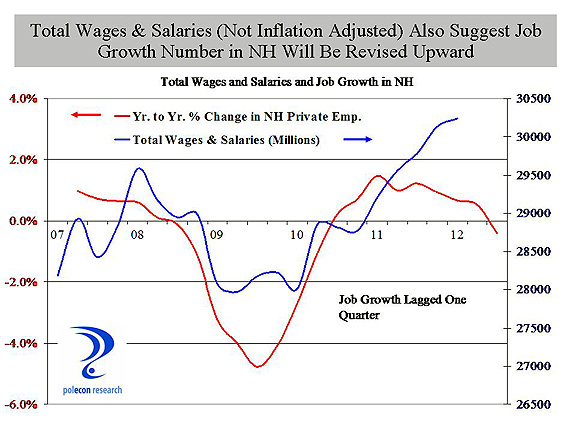
Another possibility,  that the jobs data is wrong and will be revised upward early next year, is real,  but that doesn’t mean the revisions will show NH is again outperforming its neighbors or the nation.  It just means we will look less bad over the past year or so than we do right now.  One indicator that job growth will be revised upward in NH is the growth in wages and salaries in the state.  The chart below shows that wage and salary growth (not adjusted for inflation)  is indicating a stronger labor market than are the job growth numbers.