The Recession’s Impact on The Entrepreneurial Economy

Posted November 5, 2012 by Brian Gottlob
Categories: employment, Entrepreneur, Recession

Tags: , , , ,

The cost of the recent recession in terms of jobs lost was great,  but the  longer-term cost could be far greater because of the impact the recession had on NH’s entrepreneurial economy.   While small businesses are cited as being responsible for the majority of new job creation, the fact always left out of that truism is that most of the job creation by small businesses come from new businesses, and more specifically, a small number of new businesses that become “gazelles,” new businesses with the potential to grow much larger.  Most small business will always be small.  They start, they fail, and with a lot of churning they are the businesses with whom we most interact on a daily basis. New Hampshire and New England increasingly have relied on our economy’s ability to generate new and innovative businesses to maintain a dynamic economy, a decline in entrepreneurial activity would have significant implications for our ability to continue to do so.

Looking at data on employment by age of businesses in NH from the past decade, it is clear that while NH may have suffered less than most states during the recent recession, it is not so clear that our entrepreneurial economy did as well.  The chart below shows that the recession had an especially large impact on NH’s entrepreneurs, as the the number of people employed at firms operating for three years or less declined by 34% between its peak in 2006, and 2011.
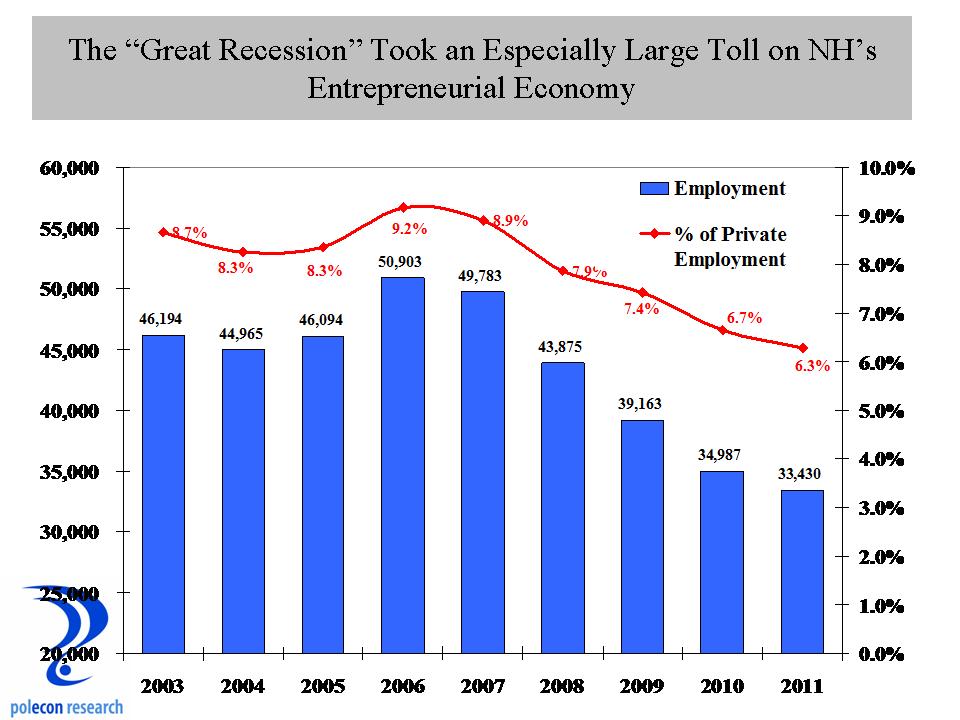
As a percentage of private employment, workers at firms three years old or has fallen from over nine percent of private employment to just over six percent.  This data does not mean that 16,000 workers in firms three years old or younger actually lost their jobs.  Remember, this is time series data so the firms in 2006 that were three years old or younger are not the same firms in the three year old and under category in 2011.  Certainly there were substantial job losses among young firms during the recession (as well as some gains) but the data more likely suggests that the next wave of new businesses (some of whom could be expected to become “gazelles”) simply did not start or  were not able to survive and grow.   For how long those effects lasts should be a question for anyone wondering what to do about the slow pace of job creation in the state.  It would be nice to have a control group of data from Massachusetts to examine for comparison purposes but they do not participate in the program from which these data are drawn.  Recessions always take a toll on smaller and newer businesses because those businesses are often in more precarious financial positions.  The data for NH do not go back earlier than 2003 so it is difficult to say whether this recession was different in its impacts on entrepreneurial activity in NH but we really should be concerned about whether the impact of the recession on entrepreneurial activity will have longer-term impacts on the NH economy.
The Skills Gap Part Deux: Some Evidence and Who’s Fault is it Anyway?

Posted November 2, 2012 by Brian Gottlob
Categories: Educational Attainment, Help Wanted, job growth, NH Economy, Skills Gap

Tags: , , ,

A good national job growth report  was released today that showed private sector job growth was up 184,000 in October.  With government job losses at -13,000, total employment increased nationally by 171,000.   We  have to wait a few weeks to see NH’s job growth for the month but regardless of the number, the underlying causes of the state’s relatively slow recent  job growth still need to be debated .  A solid and empirically-based understanding of the  factors influencing job growth rates is the only way to formulate effective economic  policy in the state.  I am on record as saying (probably too often) that I believe NH’s job growth numbers will be revised upward at some point (probably with the annual revisions released early next year).  But even if that is true (errr, when it is conformed to be true),  by historical standards, recent job growth in NH will still have underperformed.   Whether job growth is slower now than in the past because employers are not willing to add additional workers or because they are not able to find qualified workers  (the “skills gap” argument) is among the most important issues to understand in setting both national and state-level economic policies.  If employers are unwilling to add employees that are readily available,  then the efforts to spur job growth focus more on factors affecting businesses (tax rates, regulations, costs etc.).  If job growth is constrained because employers are unable to find qualified workers to fill open positions, then the focus of efforts to spur job growth will be more effective if they look to increase the skills of the labor force, and/or better match them to the needs of employers.  In reality this is not an either or question because inadequate attention to the needs of either employers or the workforce will produce sub-optimal economic growth.  But in today’s polarized policy environment whatever light is shed on these issues is too often separated by an ideological prism that produces policy proposals aimed at either the needs of business or the needs of the workforce to the exclusion of the other.   If job growth is slowed because there are too few qualified workers to meet the needs of businesses then it is not policy maker’s  fault  but they can help alleviate the problem by adopting more “human capital” policies.  Businesses bear some of responsibility for any skills gap because studies have shown that businesses spend less time and money training workers than they did decades ago, and that more of the training that does occur is concentrated on management positions rather than mid- and lower- level positions.  In an age when job turnover has accelerated, and the tenure of workers with one businesses continues to decline, it is understandable that businesses would be less willing to invest in workers who may only be with their firm for a short while.  But who is more responsible for the decline in employer-employer loyalty and tenure?  The labor market has been signaling strong demand increases in many occupations – especially technical and scientific  occupations and increasingly skilled production occupations.  Older and experienced workers may have difficulty responding to these demands if their experience, education or training is in occupations in less demand but why are younger and new entrants to the labor market not responding  to these labor market signals by selecting the majors or training programs that would qualify them for more occupations in demand?  One reason is that regardless of whether or not the labor market is signaling many job opportunities in technical and scientific occupations (or skilled production occupations), if large numbers of the emerging workforce don’t have the intellectual and academic rigor to study these subjects the positions will increasingly go unfilled, go elsewhere, or as I will document in a later post, be filled by foreign born workers.

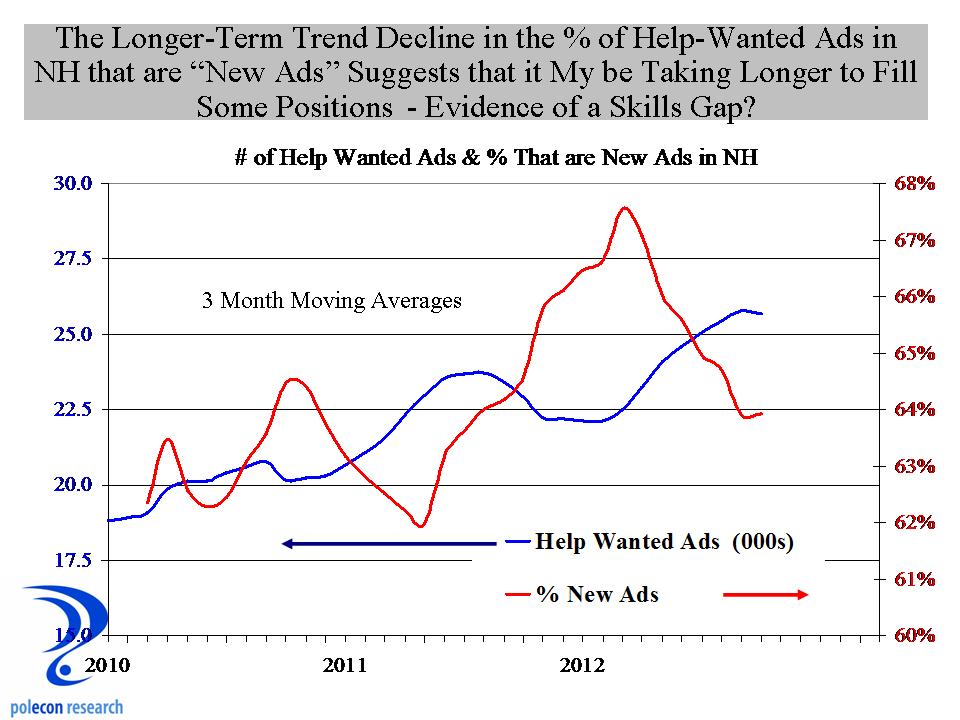
Ok, that was a bit of a rant, now back to the core issue.  Is there evidence of a skills gap in NH that is constraining job growth?  The answer of course, as it is with almost all economic issues,  is both yes and no and also something in-between and with a twist.  I will share this evidence across several postings, today I offer one, small bit of evidence that suggests the skills gap is playing a larger role in disappointing job growth trends.  I noted in an earlier post that help-wanted advertising has generally been on the rise in NH, while job growth has not.  Some of this will be corrected with job growth revisions, but evidence that a skills gap is playing a role comes in the form of the percentage of help-wanted ads each month that are “new ads”.  If help-wanted ads are rising and the number or percentage of new ads is rising similarly each month,  that means positions are being filled at a fairly consistent rate, but if the number of ads is increasing, but the percentage of ads that are “new ads” is declining, that suggest that positions are not being filled or taking longer to fill – perhaps suggesting employers are having a harder time filling the positions or a skills gap.  The chart below shows that indeed, the percentage of monthly help-wanted ads in NH that are :new ads” for the month has been slowly declining, providing some small bit of support for the skills gap explanation for job growth.  A lot more evidence is needed, but given the importance of the issue in policy making, it is worth the effort to find or refute it.

What’s Behind NH’s Recent Net Out-Migration?

Posted November 1, 2012 by Brian Gottlob
Categories: Demographics, immigration, in-migration, NH, NH Economy, out-migration, Recession

Tags: , , , , ,

I’ve written often about how important the ability to attract skilled, well-educated individuals is to NH’s past and future economic success.  Appropriately, there is much concern over NH’s recent population losses resulting  from movements of residents into and out-of the state and what it says about NH’s relative attractiveness.  Not surprisingly, that concern  results in many simplistic, inaccurate, and analytical flawed explanations for the patterns of migration to and from NH.  I don’t have a book, video, seminar, or anything else to sell that depends of any particular explanation for NH’s migration patterns so I will let the data , as it becomes clearer, shape and evolve my theories on the phenomenon.

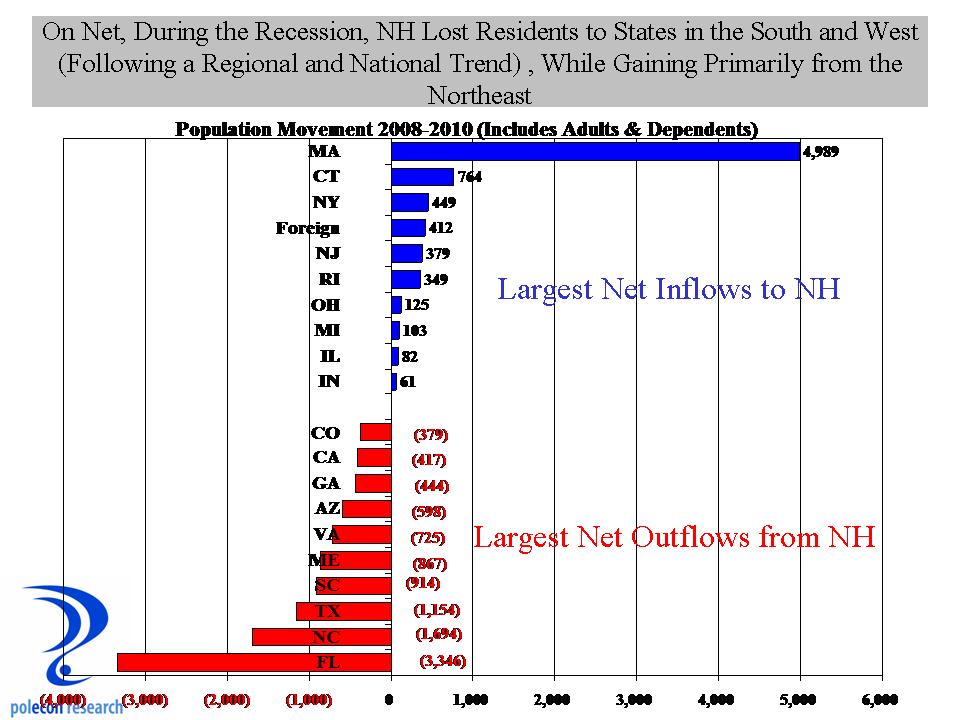
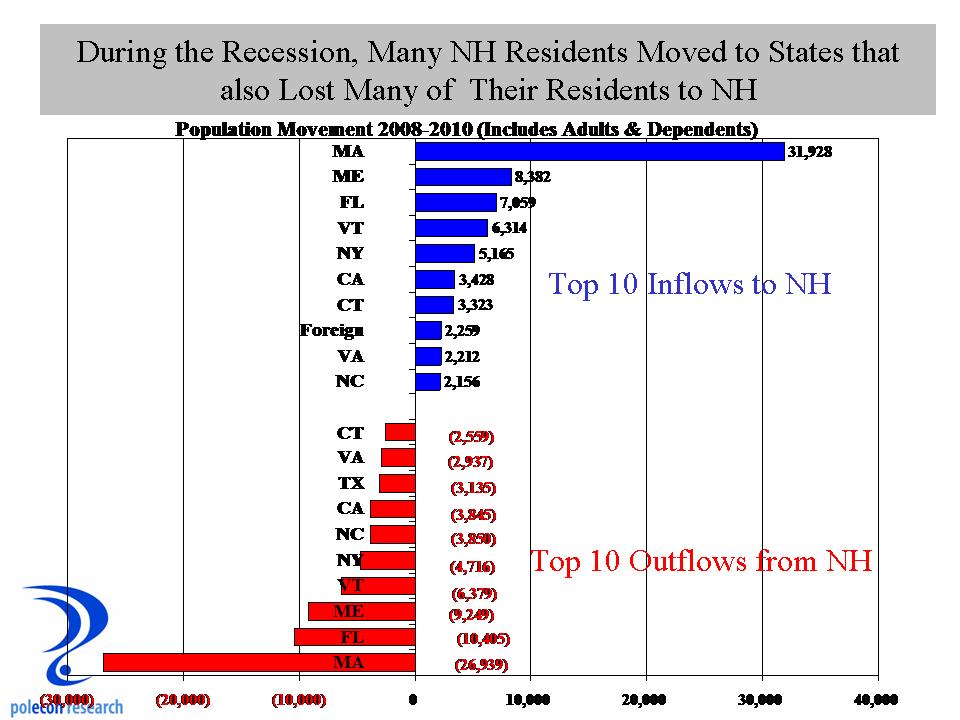
Here is the basic scenario:  NH has traditionally been a magnet for residents moving from another state (most prominently from  another Northeastern state – especially MA). During the past decade NH has attracted less net in-migration from other states, especially during the second half of the decade, culminating in net out-migration at the end of the decade.  The resulting concern by many (including me) is that NH may be losing its fundamental attractiveness relative to other states.  Because NH has relied on in-migration to fuel growth in “human capital” and the economy, this would imply very bad things about the future of our state.  I worry a lot about NH’s attractiveness  but my answer to the question of whether the state has lost its attractiveness is: “no…….not yet“.   Lets look at migration to and from the state during the recession (chart below). During the recession the patterns of the past several decades were largely the same – albeit with different magnitudes.  NH gained and lost a  lot of residents from other Northeastern states, and smaller numbers from other states in the South and West.

The difference in recent years has been that the positive net flows to  NH have been smaller for states that traditionally send NH a lot of residents (the Northeast), while the states with whom NH traditionally has net negative outflows have been larger (largely states in the south and west).   But is this a sign that NH is now less attractive?  I don’t think so (yet) and here is why. Since the housing and financial crisis and subsequent recession, the U.S. Census Bureau reports that state-to-state movement in the U.S. (on a % basis) has been about as low as it ever has been.  One reason for that,  many economists believe, is the fact that there were fewer places to move to that had stronger economic growth that often drives migration.  But another important factor has been the phenomenon of “housing lock.”

Because of the housing market bust and subsequent housing equity, credit and financial issues, both the selling and buying of homes were disrupted or impossible for large numbers of homeowners in NH and across the country.  That has especially profound impacts on net migration to NH.  I can’t explain in detail here, but migration patterns in NH indicate that the state has been especially attractive to and a magnate  for  30-44 yr. old, two wage-earner married couple families with children.  To move to NH they typically have to sell a house in their  native state and buy one in NH.  Each of those was a lot more difficult at the end of the last decade.  I believe this  reduced our core demographic of  potential  in-migrants.  At the same time, the housing market crash had less of an effect on the ability of the young, and non-homeowners to move from state-to-state.  This is the demographic group that traditionally has shown net out-migration from NH.  So the groups most likely to choose NH were most constrained from doing so during the last half of the 2000s, while the groups most likely to leave NH were not constrained from doing so by “housing lock” or other housing market issues.  The result – much lower rates of net in-migration to the state.  This explanation doesn’t account for all of the recent decline in net migration to NH, but it surely has played a significant role in the trend.

Energy Consumption and Conservation in NH

Posted October 31, 2012 by Brian Gottlob
Categories: conservation, Energy

Tags: , , , ,

The energy intensity of the NH economy (as measured by BTUs per dollar of real gross state product) continues to decline as it does in other states and the nation as a whole (chart below) .  NH is among the bottom ten states in energy intensity as more of the value of what we produce is in the form of services and in goods that have more human and less energy content.  In New England, only Maine is above the U.S. average in energy use per dollar of gross state product.

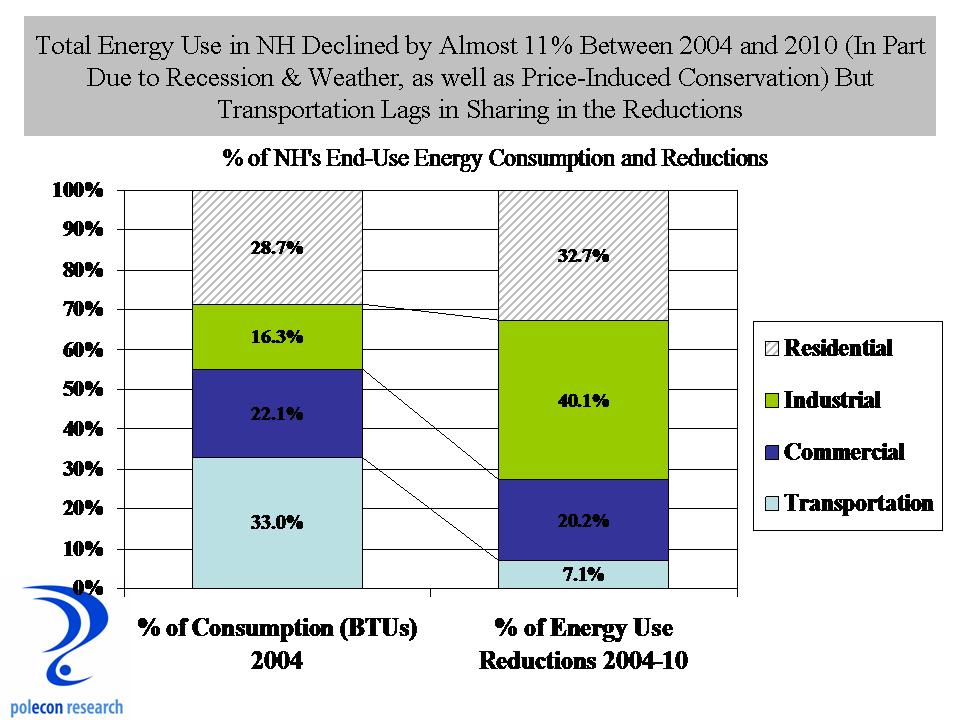
The second-half of the past decade saw especially large increases in energy prices in the U.S..  The nation als0 experienced a severe recession that reduced the demand for energy.  Between 2004 and 2010, end-use energy consumption in NH (end-use consumption excludes energy used for electricity generation) declined by about 11%.   Some of the recent declines in energy use in New Hampshire and the nation is the result of a severe recession as well as the impact of petroleum price increases.  Some is also the result of energy conservation efforts, but whatever the prompt, economic, environmental, weather or other, some end-users have cut back much more than others.  The chart below shows the percentage of total end use energy by type of end use in NH in 2004, along with the percentage of the reductions that each type of end use was responsible for between 2004 and 2010.  Industrial use accounted for a disproportionate share of the reductions, in large part because of the recession and changes in the industrial mix in the state.  But conservation no doubt also played a role.  At the other end of the spectrum is the transportation sector which although accounting for one-third of consumption, accounted for only 7% of reductions in energy consumption in NH between 2004 and 2010.   It is hard to imagine continued declines in energy use unless the transportation sector contributes more to the reductions.

What Will the “Fiscal Cliff” Mean for NH?

Posted October 30, 2012 by Brian Gottlob
Categories: Fiscal Cliff, Fiscal Policy, job growth, NH Economy, Politics

Tags: , , , , , ,

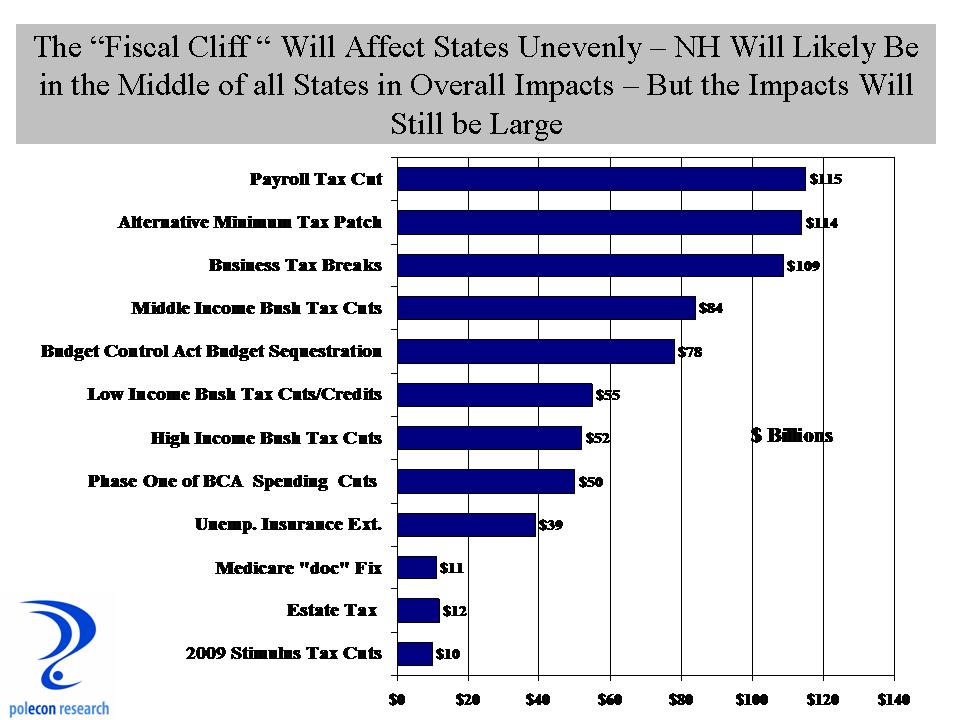
For an economy struggling to gain altitude it is hard to see how the impending spending cuts and tax increases associated with the “fiscal cliff” will do anything in the short-term but bring the economy to stall speed or push it back into recession.  At a time when compromise is seen as weakness and ideological impurity, an agreement must be reached in order to avoid the negative effects of the the fiscal cliff.  Depending on what is included, the ‘fiscal cliff includes anywhere from $500 to $700 billion in combined spending cuts and tax increases (many via the expiration of temporary cuts).

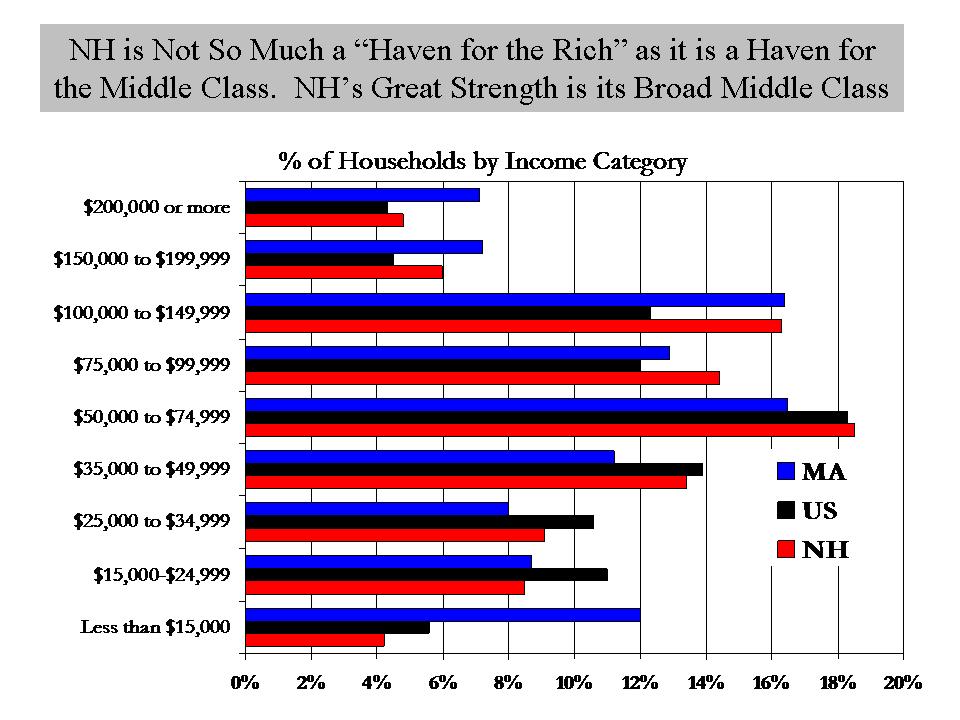
All states will feel the effects of the elimination of the temporary cut in the payroll tax but states with a higher percentage of high-income taxpayers will likely be affected more by the expiration of Bush era tax cuts.  Despite often being characterized as a “tax haven” for the rich, NH is much more a “haven for the middle class” as it has a somewhat higher percentage of high-income households than the U.S. (but much lower than MA) and a relatively smaller percentage of lower- income individuals.   The percentage of high-wealth individuals in NH is above the U.S. average, but the percentage of income taxes paid by those making $200,000 or more in NH is lower than 24 other states.

States where higher-wealth individuals pay a larger portion of the  state’s tax burden are likely to be relatively more affected by the tax cut expiration provisions of the fiscal cliff.   But NH will still see an estimated increase in payroll taxes of about $650 million, a significant drop in disposable income in the state.  In addition, a study by George Mason University’s Center for Regional Analysis estimates that the defense department and non-defense department budget cuts that will  result from  the fiscal cliff will cost NH about 6,300 jobs and $325 million in labor income.  NH no doubt will take some solace from the fact that Massachusetts is likely to see nearly 10 times the job losses from  budget cuts to defense and other purposes (especially medical) and as a result of  their high percentage of high-wealth households.

I want to think a reasonable resolution will be found that avoids the worst of the potential problems from the fiscal cliff.  Fiscal tightening is clearly warranted,  and it appears almost certain that at a minimum the payroll tax holiday will be allowed to expire  as well as the Bush era tax cuts for upper income households.  It is also almost certain that long term unemployment insurance benefits will be allowed to run out.  After that, it all depends on one four-letter word – compromise.

Some Good News in Some Very Bad Weather

Posted October 29, 2012 by Brian Gottlob
Categories: Uncategorized

Tags: , , , , ,

(My apologies for the late post – I posted this 3 hours ago but it didn’t publish so I am trying again)

PolEcon’s NH Leading Index jumped from a revised + 3.7 to +13.0 this month. its highest value since January of 2011.  An Index reading of + 13.0 isn’t a signal of robust growth but it is a substantial improvement over much of the past 18 months and if it continues for another month or two it will be a clear sign of a much improved NH economy.

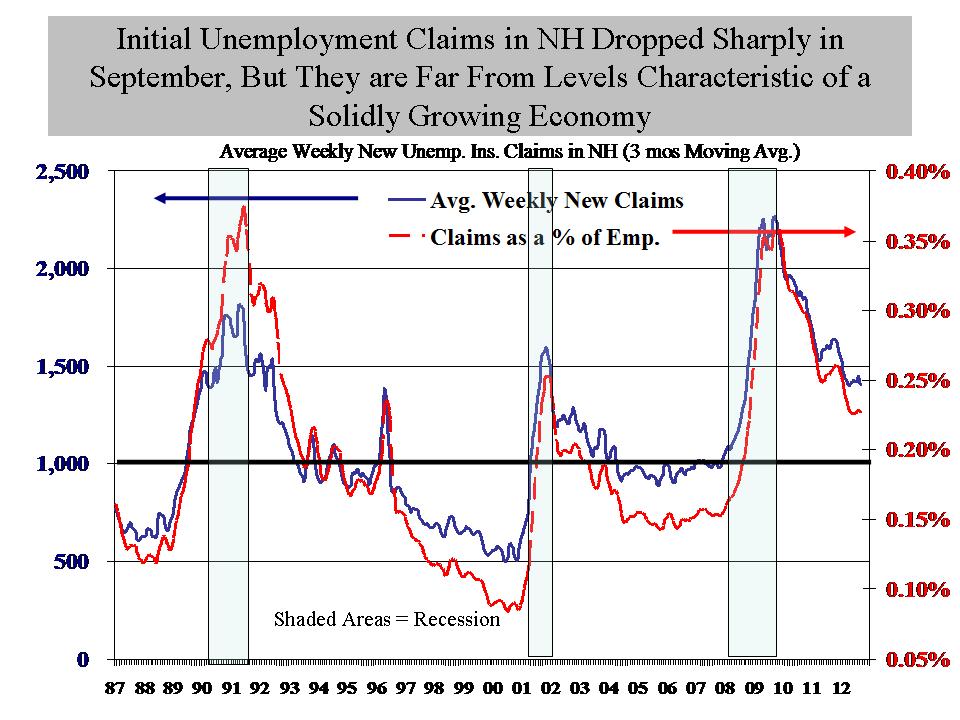
Weather and electricity permitting, the October edition of the Trend Lines will be emailed or available to read online at http://www.issuu.com/polecon.    Seven of the nine indicators in the Index improved over the month, with initial claims for unemployment insurance showing an especially large drop.  I prefer initial claims data to the unemployment rate, as it gives greater insight into the near-term direction of the labor market.  I’ve stated in a prior post that I believe job growth in NH will be revised upward, based on aggregate wage and salary growth and the volume of help-wanted advertising in the state.  Declining initial unemployment claims are another indicator that actual  job growth is likely somewhat higher than is currently being reported (NH has seen a few negative year-over-year monthly job growth reports recently). At an average weekly number of claims at 1,400 for the month, it is still much higher than the under 1,000 number that is typically seen during periods of solid job growth, but the number continues its downward trend.  The chart below shows how new claims currently compare with claims during previous periods of growth and recession.  On a three-month moving average basis, the number of new claims in NH  is now about what is was during the short-lived recession of the early 2000s, and compared to the first “great recession” of the early 1990s, it is also about as high now as during that difficult time.  But there is also a larger population in the state and also more employment  so examining initial claims as a percentage of employment in the state provides a better comparison to where the labor market stands today and where it may be heading.  That comparison makes the current labor market appear to be in the early stages of recovery from recession rather than two years removed from the official end of one, but its a sign of recovery nevertheless.

Keeping an Eye On Which Prize?

Posted October 26, 2012 by Brian Gottlob
Categories: Demographics, Educational Attainment, migration

Tags: , , , , , ,

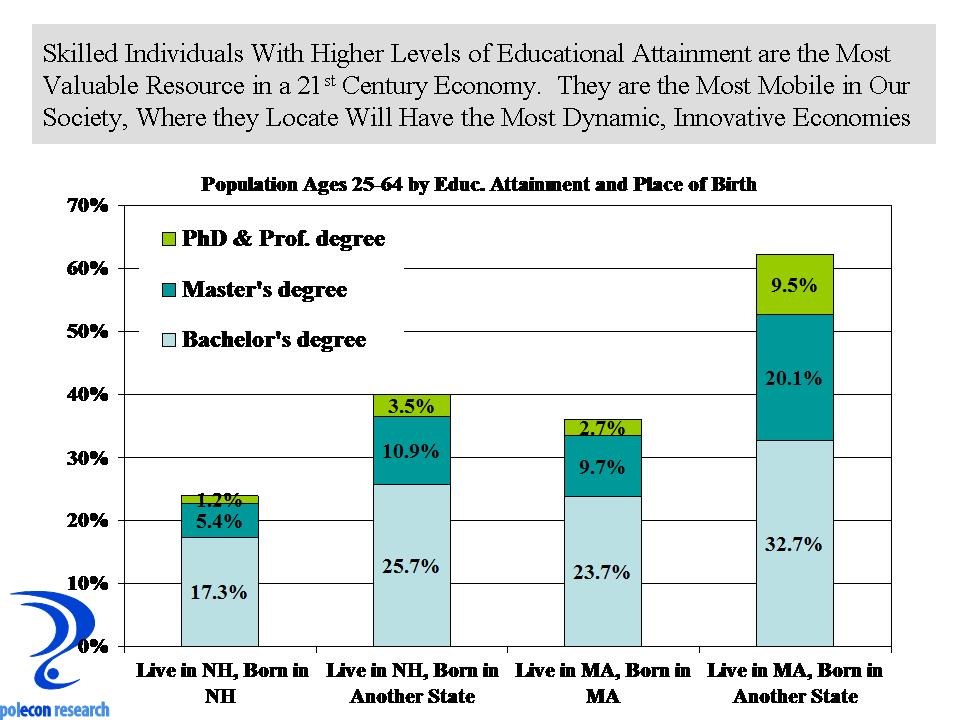
Every state is obsessed with maintaining or creating a “good business climate.”  I think NH has traditionally had a good business climate, with both the public and policymakers demonstrating a high regard for businesses,  and with a climate of mutual respect between the business community  and state policymakers.  At times they have differed in their views, and the balance of interests could change marginally from time to time, but over the years there was a nice balance where each was able to ultimately rely on one another to increase opportunities and prosperity in the state.  There is a lot of fretting over the business climate in the state and what it means for our ability to “attract” businesses. That is always a good thing to monitor, but I am concerned that we (business people, policy makers, citizens) may be spending too little time concerned with creating a climate that is attractive to individuals.  More specifically, skilled individuals with higher levels of educational attainment that increasingly are the source of competitive economic advantage in states and regions.  The in-migration of individuals with higher levels of educational attainment fueled NH’s economy and increased the concentration of technology and higher-skill industries and occupations during much of the past few decades, just as it has in other states that have been able to successfully attract skilled, well-educated individuals.   The chart below shows how the educational attainment of NH residents differs between  those who were born and continue to live in NH, and those who live in NH but where born in another state (in a future post I will discuss international migrants).

The chart shows that residents who have moved to NH from another state are much more likely to have a bachelor’s or higher educational degree.  NH regularly loses its natives with higher-levels of educational attainment to others states, just as other states lose those individuals.  Individuals with higher-levels of educational attainment are the most mobile in society.  They have the most opportunities and generally resources that afford them more choices on where to locate.  That means that the native population will often show overall levels of educational attainment lower than in-migrants from other states.  In-migrants to MA also have much higher overall levels of educational attainment than natives who live in the state,  but the native population that was born and lives in MA has higher levels of educational attainment than the native population in NH.  In fact, educational attainment among those who where born and live in MA looks a lot like the in-migrant population of NH, not surprising since about 300,000 individuals born in MA now reside in NH.

In-migration to NH has been slowing and recently stopped, with tremendous implications for our economy’s ability to grow, innovate, and remain dynamic.  Lets keep our eye on maintaining a good business climate (we can start by reinforcing our tradition of mutual respect between business and government), but I think we need to quickly  begin asking ourselves if a singular concern about business climate is sufficient to assure growth in our economy  if NH is losing its attractiveness to the individuals who are increasingly the source of its economic strength.

Spotting Bubbles After They Burst

Posted October 25, 2012 by Brian Gottlob
Categories: Demographics, Homeownership, House Prices, Housing, NH Economy, Recession

Tags: , , , ,

I’ve lived through two housing bubbles since I was old enough to know and care about them.  During the first one I was writing quite unpopular reports for developers and lenders (I’m still not very popular with realtors) that  indicated, to me at least, that the “effective demand” for housing in many areas just would not support a viable project (based on the fundamental underlying determinants of the demand for housing – population, employment, and income growth as well as new household formations).  I did not understand then nor do I do now, how an industry (home building) can survive when so many decisions it makes are made with a view toward the immediate past (what sold last week or month and at what price).  Of course everybody, including me, recognizes a bubble after it has burst.  But there really is no substitute for understanding the fundamental underlying demand for housing in a region or community when making a decision about building or buying housing.  Few have the patience or knowledge to assess the “effective demand” (the willingness AND ability to purchase) for housing versus the desire to purchase based on the current sentiment about the housing market.  Potential home buyers are not likely to get that understanding from a real estate industry that can make money from a purchase regardless of whether the purchase increases in value or not.   It is easy to see the “effective demand” for housing and the real conditions of the market after the fact, as with the many charts I see that show how  the relationship between home prices and household incomes in a region was widening prior to the last housing market crash.  Its a great way to make a call after the game is over.  Household income data is reported with a lag of more than a year for smaller areas, is subject to a significant margin of error, and may likely be revised sometime  down the road.

There really is no substitute for understanding the fundamentals but a quick and easy way to get a sense of where the home buying market is, is to look at the ratio of the monthly cost of purchasing a home (at the average selling price) versus the monthly cost of an average rental.  Both selling and rental price data is readily available in NH from, among other sources, the NH Housing Finance Authority which regularly does rental price surveys.  The chart below shows the ratio for NH going back to 1990.  The ratios can be calculated for sub-areas of the state and for communities as well.  The ratio is not a substitute for a thorough analysis of “effective” or fundamental underlying demand that all home builders should undertake, but for home buyers, it clearly shows that when the ratio gets above 130% or 140% (which can be determined with a data lag of only a few months at most) a bubble is likely forming.

The Disconnect Between the Cost of Generating Electricity and Retail Prices

Posted October 24, 2012 by Brian Gottlob
Categories: Electricity, Electricity Generation, Energy, Natural Gas, NH Economy, Oil, prices

Tags: , , , , ,

It is hard for consumers of electricity to understand why retail prices are what they are and how they are determined.  It is beyond one blog entry to fully describe the process but in overview, the suppliers  of electricity (generating companies) in a region offer to supply electricity to the market at a given price and the offers are accepted beginning with the lowest cost providers first, until enough energy is supplied to meet expected demand in the region.  The price of electricity offered by the last electricity generator needed to meet the regional demand determines the market price paid by companies that supply the electricity to businesses and consumers.  Retail prices are a function of the market price of electricity, plus many other costs such as transmission, special infrastructure charges, and profits by suppliers, among others.  Much of these costs are determined at the state level by regulators, as well as the characteristics of the retail electricity market in the state (competition) and the practices and policies of the companies that supply electricity to retail markets.

The end result is that retail prices for electricity in any state bear only a limited relationship to the cost of generating electricity in the state.  The chart bellow shows that the cost to generate 1 million BTUs of electricity in New Hampshire is about in the middle of all 50 states.  Vermont is also relatively low.  Both states have a relatively lower generating cost per million BTUs because a significant portion of the electricity produced in their state is from nuclear generators.

The correlation between the fuel costs to generate electricity in a state and retail prices per 1 million BTUs is modest, explaining less than one-third of the price per million BTU at the retail level.  The chart below show that despite fuel costs that are in the middle of the pack,  NH, VT and CT have high retail prices per million BTU of electricity.   The regional nature of electricity markets along with the policies of state governments and the actions of individual retail sellers of electricity all play a role in disconnect between costs for generating electricity  and prices at the retail level.  We don’t have much control over the  supplies of electricity beyond our state but we do have some control over the mix of suppliers of electricity which determine the cost of fuel for generation and we have a lot of control of the structure of retail markets and many other factors that determine the non-generating costs of electricity in the state and ultimately prices at the retail level.

The Changing Banking Market

Posted October 23, 2012 by Brian Gottlob
Categories: Banks, Credit Unions, Financial, Household Finances, NH Economy, Recession

Tags: , , , , ,

Public antipathy toward large financial institutions  may have been building throughout much of the past decade but it surely peaked during and immediately following the recent recession and the financial crisis that helped precipitate it.  One result appears to be a changing market structure for deposits and loans at financial institutions in NH and across the country.  The recession in our state was less severe than was the recession of the early 1990’s, and less severe than was the recent recession  in  many states because of the the overall health and strength of our state’s banking institutions.  Nevertheless, one fallout from the financial crisis appears to be a growing market share for credit unions in the state.  As the chart below shows, since the recent recession, deposits at credit unions have grown much faster than deposits at NH banks overall.  Deposits at NH community banks have grown faster than deposits at all NH banks, suggesting that deposit gains by credit unions have come largely at the expense of large banks in the state, as deposit growth for all NH banks is much lower than the growth among just community banks.  Prior to the recession and financial crisis, deposits at NH community banks were growing faster than were deposits at credit unions.

It would be unfortunate if community banking institutions that have had strong commitments and links to their local communities  and regional economies are tarred by the actions of institutions from afar. Beyond that, a fundamental change in the market shares for financial services could  have significant impacts on the regulation of financial services, on government revenues , and on market shares as the tax exempt status of credit unions contributes to their ability to compete and capture market share.  The increased concentration of deposits in the banking industry that occurred during much of the 1980’s and 1990’s may now  be occurring among credit unions.  As the services credit unions offer and their branching look more and more like those of banks, their ownership and regulatory structure may be the only thing that distinguishes them from banks.