Archive for the ‘employment’ category

A Simpler But No Less Troubling Explanation for Job Growth Trends

December 5, 2012

A lot of analysts, me included, have been looking for reasons why employment growth has been slower much of this recovery.  That prompts questions about whether the slow recovery from recession is the result of cyclical factors (related to swings in the business cycle) or structural factors that fundamentally and longer-term alter the ability of NH and the nation to create jobs.   While some wait for cyclical factors to improve job growth, in NH there is a lot of talk about demographics, migration, and too often (by me at least) the skills gap or mismatch between job openings and the skills of job seekers.  Much of the demographic story, especially concerns about NH’s ability to attract people from other states,  is relevant – except perhaps for the overblown concerns about NH’s “aging” (more about that in future posts).  I believe demographics and things like the skills gap play an important role in the slow recovery and more general downward trend in job growth, both before and following the recession.  But today, I offer another, simpler thesis, but  one that may be no less troubling.   If you look at job growth trends in NH by industry, you see that since the recession, employment weakness has really been most concentrated in  three sectors of the economy;  construction, government, and financial services.   The chart below shows job growth trends over the past several years for total non-agricultural employment in NH,  as well as total employment minus construction, government, and financial services.  Absent the three hardest hit sectors of the economy, job growth following the recession (until recently that is) didn’t look that much different than the recovery from the briefer, milder recession of the early part of the last decade.

recovery

I know construction,  government, and financial services are important but they still represent just over 20 percent of employment in the state, so the weakness in employment isn’t as broad-based as pessimists (including me at times) suggest.   But what is more troubling is that the weakness in these sectors are more structural than cyclical and thus we may be waiting for a rebound that may never occur.  I don’t think that is true for construction, where at least some rebound will occur as the housing market improves, as business investment strengthens, and whenever the fiscal health of governments improve enough for infrastructure spending to pick up.   But weakness in government and financial services employment is likely more structural.  New financial services regulations are likely to be an impediment to job growth in that industry for some time and there is no end in site for the budgetary impediments that will likely continue to weigh on job growth in the government sector.   I, and others, will continue to look at the implications of such things as demographics and skills gaps on recent and prospective job growth, but we can’t fail to recognize that sometimes  answers are less complex than the questions.
The Recession’s Impact on The Entrepreneurial Economy

November 5, 2012

The cost of the recent recession in terms of jobs lost was great,  but the  longer-term cost could be far greater because of the impact the recession had on NH’s entrepreneurial economy.   While small businesses are cited as being responsible for the majority of new job creation, the fact always left out of that truism is that most of the job creation by small businesses come from new businesses, and more specifically, a small number of new businesses that become “gazelles,” new businesses with the potential to grow much larger.  Most small business will always be small.  They start, they fail, and with a lot of churning they are the businesses with whom we most interact on a daily basis. New Hampshire and New England increasingly have relied on our economy’s ability to generate new and innovative businesses to maintain a dynamic economy, a decline in entrepreneurial activity would have significant implications for our ability to continue to do so.

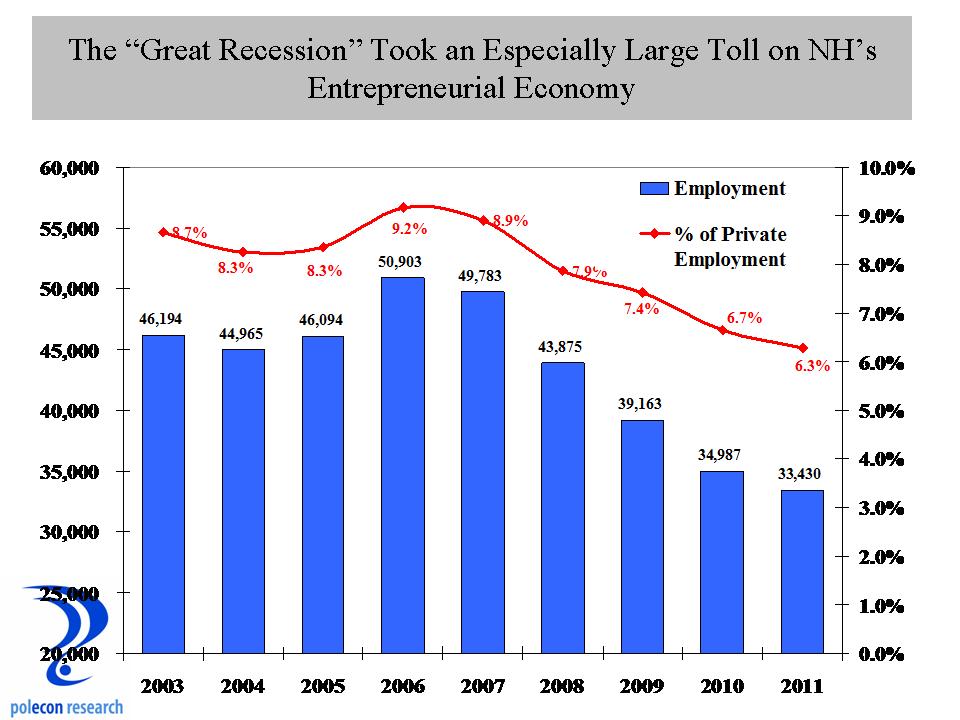
Looking at data on employment by age of businesses in NH from the past decade, it is clear that while NH may have suffered less than most states during the recent recession, it is not so clear that our entrepreneurial economy did as well.  The chart below shows that the recession had an especially large impact on NH’s entrepreneurs, as the the number of people employed at firms operating for three years or less declined by 34% between its peak in 2006, and 2011.

As a percentage of private employment, workers at firms three years old or has fallen from over nine percent of private employment to just over six percent.  This data does not mean that 16,000 workers in firms three years old or younger actually lost their jobs.  Remember, this is time series data so the firms in 2006 that were three years old or younger are not the same firms in the three year old and under category in 2011.  Certainly there were substantial job losses among young firms during the recession (as well as some gains) but the data more likely suggests that the next wave of new businesses (some of whom could be expected to become “gazelles”) simply did not start or  were not able to survive and grow.   For how long those effects lasts should be a question for anyone wondering what to do about the slow pace of job creation in the state.  It would be nice to have a control group of data from Massachusetts to examine for comparison purposes but they do not participate in the program from which these data are drawn.  Recessions always take a toll on smaller and newer businesses because those businesses are often in more precarious financial positions.  The data for NH do not go back earlier than 2003 so it is difficult to say whether this recession was different in its impacts on entrepreneurial activity in NH but we really should be concerned about whether the impact of the recession on entrepreneurial activity will have longer-term impacts on the NH economy.

The Skills Gap Debate – Round 1

October 18, 2012

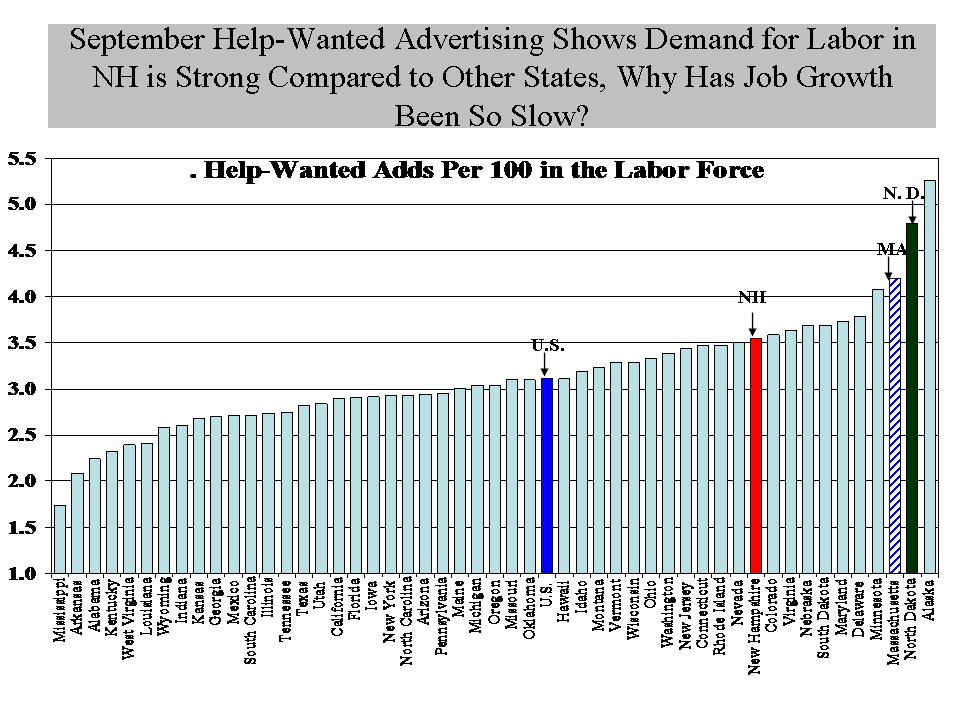
Two charts may tell an important story about New Hampshire’s labor market and perhaps trends in the economy.  Help-wanted advertising has been rising in NH and as I’ve written before, it suggests job growth should be higher in NH  based on the long-term relationship between help-wanted ads and employment growth in the state.  A “skills gap” is one explanation for the divergence between help-wanted and job growth in NH, but I also offered that the divergence, along with trends in aggregate wage growth in NH  may mean employment numbers will be revised upward.   My money is still on an upward revision of job growth, with the skills gap playing an important  role for some industries and occupations, because NH has more help-wanted ads per 100 individuals in the labor force than all but 10 states – job growth should be higher (chart below).

I would be more convinced of the skills gap being broadly responsible for slow growth in the state  if a high percentage  of help-wanted ads in New Hampshire were for the highest skill occupations (professional, technical, scientific and management), but as the chart below shows, NH ranks well down the list of states on the percentage of help-wanted advertising that is for the highest skill occupations.  A skills gap could still exist between available jobs and available labor for occupations requiring specialized skills and training, even if they are not in professional, technical , or managerial occupations.  Anecdotal evidence suggest many employers are having difficulty finding workers with the right skills.  The skills gap demands further investigation, right now I am more concerned about what the relatively lower demand in NH for the highest skill occupations implies about our state’s economy.

What Does the “Misery Index” Say About Election Results?

October 16, 2012

I am not a political analyst and this is not a political blog.  The polemics of political discourse are as tedious to me as the graphs I use with two Y axes are no doubt tedious to politicos. If you are prone to apoplexy or unable to view any data or information without an ideological lens, stop reading now.

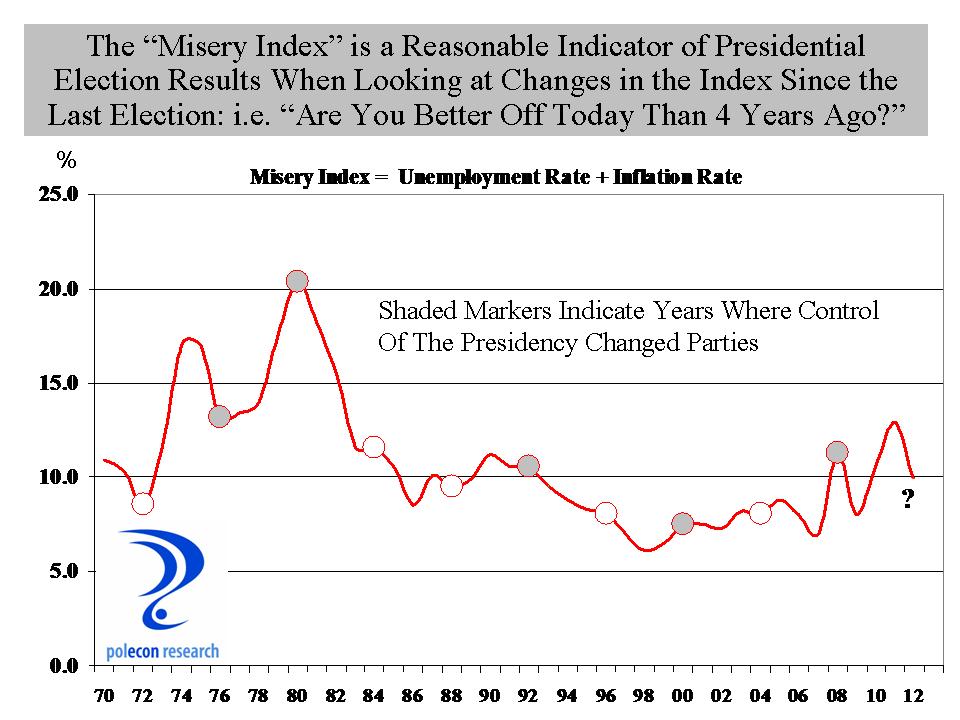
Since Ronald Reagan closed a presidential debate with Jimmy Carter by asking “are you better of today than you were four years ago” that question has been a benchmark in every presidential election and with good reason because  the answer to the question is a pretty good predictor of election results.  But how do you operationally define “better off”?    The sum of the unemployment rate and the inflation rate is  referred to as the “misery index”, since a high reading on either one or both of the components would likely have a negative impact on household sentiment.  When the misery index is lower in an election year than it was in the previous presidential election, the party in power typically retains the presidency,  and when the misery index is higher, the presidency typically changes parties.  The chart below highlights the relationship.  The chart line shows the value of the “misery index” in the 3rd quarter of each year (just before the election) and each circular marker indicates a presidential election year.  The shaded markers indicate a change in control of the party in the White House.

With the exception of the 2000 election of George W.  Bush over Al Gore, when the misery index was lower in an election year than it was in the prior presidential election year, the party in power retains the White House and when the misery index is higher,  party control of the White House changes.   The chart suggests that the 2012 election should be close, but probably leans toward President Obama’s reelection.  Looking at the individual misery indices in  swing states also gives The President a slight edge.

The misery index doesn’t say much about NH’s gubernatorial election however.   The chart below shows that declines in the misery index (compared to 2 years earlier during the prior election for governor) do not appear to be associated with changes in party control of the governorship in the state.  The chart does does show that a change is more likely to occur in a year in which the gubernatorial election coincides with the presidential election.

Overall, however, the chart suggests that NH voters do not hold gubernatorial candidates responsible for weaker economic conditions nor are they likely to credit them for good economic performance.  Rather, they make their choices based on the perceived qualities of candidates.  Isn’t that refreshing?

Manufacturing’s Toughest Sell

October 12, 2012

The percentage of younger workers in the workforce is declining in NH, as it is across the country, but the trends are different for specific industries and occupations (more about that in a later post).  Simply put, some industries are capturing a larger share of a smaller cohort of younger workers and the key for any industry or occupation is to have appeal for younger workers and students.  How does an industry capture more younger workers?   Is it because the industry is perceived as being desirable or “cool,” or do younger workers respond to signals about the opportunities in an industry or an occupation?

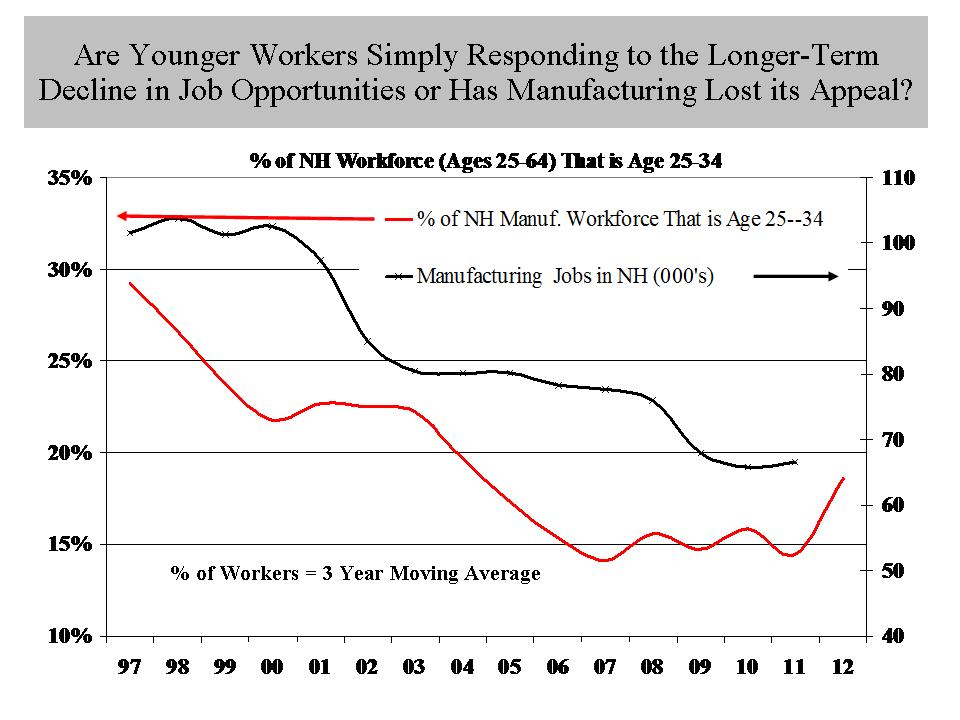
Manufacturing is one industry that has been capturing a smaller share of younger workers (government and utilities are others).   The chart below shows that over the past 15 years the share of younger workers (age 25-34) declined in NH’s workforce (age 25-64).  But the chart also shows that the drop was more pronounced in manufacturing than in the workforce overall.

Government employment hasn’t been perceived as cool for some time but job opportunities have grown or remained steady (except in very recent years) over the years suggesting that “coolness” is a factor in the career choices of younger workers.  For manufacturing it is likely to be a combination o cool and opportunities.  While manufacturers now have good opportunities for young workers, that perception must overcome  decade s of    labor market signals showing large declines in manufacturing employment.  The decline in younger workers in manufacturing roughly corresponds to the change in manufacturing employment in the state (chart below).

Manufacturing employers are in a difficult position.  Fewer households have workers with a history of manufacturing employment, limiting the legacy effects that can contribute to career choices.  A “twist”  (changing occupational makeup) in the manufacturing labor market mean that much of the public and almost no  high school guidance personnel have an understanding of the types of jobs in manufacturing. A general lack of “coolness,” perceived lack of opportunities, and  limited understanding of the opportunities that exist in the industry all mean that manufacturing will have a tough time capturing a larger share of the younger workforce, but it is important to do so for a number of reasons. I just don’t know if manufacturers can do it alone.