Archive for the ‘Educational Attainment’ category

Why Can’t a Man Graduate More Like a Woman?

January 31, 2013

Brains are the most valuable resource in the 21st century.  Unless your state or region sits on top of a recently discovered oil or natural gas formation, skilled, well-educated individuals are the key source of competitive economic advantage throughout the U.S..   NH’s stellar growth in a slow growth region during the 1980’s and 1990’s and early part of the 2000’s was primarily driven by the increased concentration of “talent” in the Granite State.  A great state to live and work, with access to a regional labor market with a major metropolitan area that is home to world-class companies and institutions, and facilitated by NH public policies that increased the returns to education (by allowing individuals to keep more of the fruits of the education and labor) are largely responsible.  But in NH, as in the nation, half of the population appears  not to be contributing as much as they could be to a concentration of  talent that can provide us with a competitive advantage.  Females are now both entering and graduating from higher education institutions at rates that significantly exceed those of males.  I don’t know what is wrong with young males in this country, but as the father of young females, I didn’t need to look at a lot of data to know that young males have been a disappointment for some time now.

In NH, an increase in individuals with the highest levels of educational attainment  has largely been the result of an increase in the number of females in our state with at least a BA degree.  Increasing in numbers, females with at least a BA degree in NH now comprise more than 50% of NH’s labor force aged 25-64 with at least a BA degree.

Growth in Females with BA

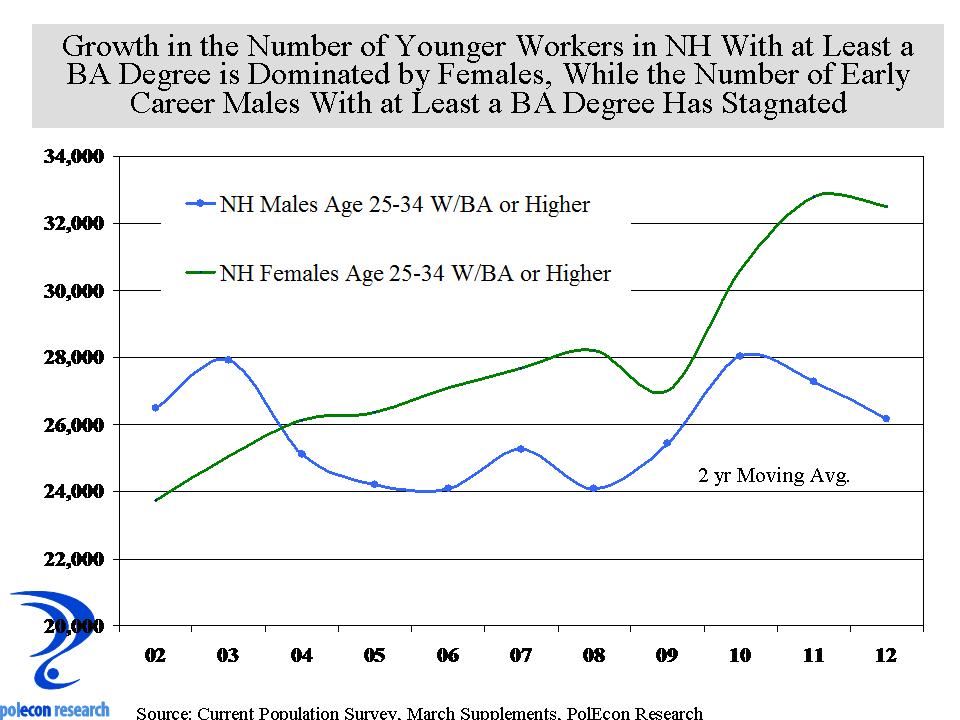
I am pleased that the number of women with higher levels of educational attainment in NH is increasing, but I would be just as pleased if the number of males was increasing similarly, so that the growth in “talent” in NH didn’t depend so much on just continuing the positive trends among women.  Unfortunately, it doesn’t look like that is going to happen soon.  As the chart below shows, the trends in the educational attainment of NH’s younger labor force (age 25-34) shows that the number of males with at least a BA degree has been stagnating, while the number of females has risen substantially.

Age 25 to 34 With BA

I’ve got no particular insights into reasons for these trends and I have no direct experience with the decision and thought processes of  young males,  for most of the past several years its been my job to hate them, but  I could probably overcome some of that if they started contributing more to the concentration of skill and talent among us.

Entrepreneurship and Gender Equity

January 16, 2013

I’ve written a couple of times (here and here) about gender equity issues in employment and unemployment.  I have an interest in almost all labor market issues but on this one I have three terrific and personal reasons for my interest.  One of them is a scientist in training and in a few years will be confronting the labor market issues I  examine  here.

My initial hypothesis was that larger businesses in NH would likely have more extensive policies and recruiting  efforts that would result in a higher percentage of women being employed in larger businesses in professional, scientific and technical industries in the state.  These industries include things like legal, architectural, engineering, laboratory, computer programming, accounting and scientific firms as well as veterinary services but not human medical services). As the chart below shows, that is not the case, as the smallest firms have a higher percentage of their employees who are women.   These industries also have the highest percentages of employees (male or female) with at least a BA degree.  Again, as the chart shows, smaller firms had the highest percentage of women among the employees with the highest levels of educational attainment.

Female Emp in Prof and Tech Industries

My new hypothesis is this – I don’t think (or at least I hope) that larger firms have any preference for hiring men over women.  Rather, it is that a higher percentage of the smaller firms in these industries are likely to be women owned and newer businesses started, owned, or managed by women.  I think the fact that the percentage of all women employees at larger firms, who have at least a BA degree or higher is greater than it is at smaller firms suggests that larger firms don’t just hire females predominately for lower-skilled occupations.  Women still represent a smaller percentage of graduates from many professional, scientific and technical programs (although that is changing) and thus present a smaller percentage of the potential workforce for many industries.  For smaller prof./scientific and tech. firms that are started, owned or operated by women,  female employment with the highest levels of educational attainment could, however,  be expected to be higher than at larger firms.

Anyway, that’s my story and until I get more evidence, I’m sticking to it.  More than just my interest as a parent, I think the issue has larger implications for policies to support gender equity and to increase the supply of highly skilled workers.   It may be that promoting entrepreneurship among women is among the best approaches to both.

NH’s Most Valuable Import?

December 11, 2012

I write a lot about the importance of skilled individuals with higher levels of educational attainment to the prospects for our nation’s and NH’s economic growth and prosperity.  I’ve also written about how important the in-migration of skilled individuals with higher levels of educational attainment from other states to NH has been to NH’s economic success.

I know  foreign immigration to the U.S. is a hot-button issue in this country and an increasingly high-profile one in cities like Manchester in NH.  Whether because of economics, legitimate  fiscal concerns, or simple xenophobia,  for many, foreign immigration is viewed with concern, skepticism, and sometimes hostility.  While some cities and school districts are more challenged by differing characteristics of immigrant populations in NH, on balance, foreign born individuals add significantly to the overall level of skill and educational attainment of the workforce in NH.  The chart below shows how much higher is the educational attainment of the foreign-born workforce in NH than it is in the U.S. as whole.

Ed Attainment by Place of Birth US and NH

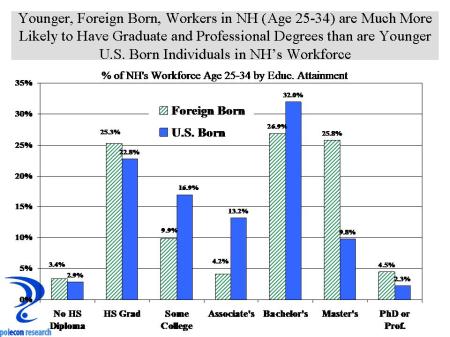
Comparing foreign born workers in NH to U.S. born workers in NH shows that foreign born workers are much more likely to have a graduate or professional degree than are U.S. born workers age 25-34.  Foreign born workers comprise a disproportionately large percentage of NH residents with graduate and professional degrees and that is reflected in many of the highest skill occupations in the state.  Which, of course, will be the subject of a future post.

Ed attainment by birth ages 25 to 34

Don’t Just Honor Them, Hire Them!

November 12, 2012

Today we honor veterans, at least that’s the idea if we can find the time between trips to the mall.  I hope you read about or  listen to their stories today.  If you happen to come by this blog, on this important day, here is one important story.  The unemployment rate among those who have served on active military duty  is higher than it is for those who have not served,  at all levels of educational attainment.  I am no expert on why, but I know it  is no way to thank men and women for their service.   Below is a chart that shows the unemployment rate among 25-34 year olds in New Hampshire, by educational attainment and whether or not they ever served on active military duty.    So honor them today for sure, but  hire them tomorrow if you can.

The Skills Gap Part Deux: Some Evidence and Who’s Fault is it Anyway?

November 2, 2012

A good national job growth report  was released today that showed private sector job growth was up 184,000 in October.  With government job losses at -13,000, total employment increased nationally by 171,000.   We  have to wait a few weeks to see NH’s job growth for the month but regardless of the number, the underlying causes of the state’s relatively slow recent  job growth still need to be debated .  A solid and empirically-based understanding of the  factors influencing job growth rates is the only way to formulate effective economic  policy in the state.  I am on record as saying (probably too often) that I believe NH’s job growth numbers will be revised upward at some point (probably with the annual revisions released early next year).  But even if that is true (errr, when it is conformed to be true),  by historical standards, recent job growth in NH will still have underperformed.   Whether job growth is slower now than in the past because employers are not willing to add additional workers or because they are not able to find qualified workers  (the “skills gap” argument) is among the most important issues to understand in setting both national and state-level economic policies.  If employers are unwilling to add employees that are readily available,  then the efforts to spur job growth focus more on factors affecting businesses (tax rates, regulations, costs etc.).  If job growth is constrained because employers are unable to find qualified workers to fill open positions, then the focus of efforts to spur job growth will be more effective if they look to increase the skills of the labor force, and/or better match them to the needs of employers.  In reality this is not an either or question because inadequate attention to the needs of either employers or the workforce will produce sub-optimal economic growth.  But in today’s polarized policy environment whatever light is shed on these issues is too often separated by an ideological prism that produces policy proposals aimed at either the needs of business or the needs of the workforce to the exclusion of the other.   If job growth is slowed because there are too few qualified workers to meet the needs of businesses then it is not policy maker’s  fault  but they can help alleviate the problem by adopting more “human capital” policies.  Businesses bear some of responsibility for any skills gap because studies have shown that businesses spend less time and money training workers than they did decades ago, and that more of the training that does occur is concentrated on management positions rather than mid- and lower- level positions.  In an age when job turnover has accelerated, and the tenure of workers with one businesses continues to decline, it is understandable that businesses would be less willing to invest in workers who may only be with their firm for a short while.  But who is more responsible for the decline in employer-employer loyalty and tenure?  The labor market has been signaling strong demand increases in many occupations – especially technical and scientific  occupations and increasingly skilled production occupations.  Older and experienced workers may have difficulty responding to these demands if their experience, education or training is in occupations in less demand but why are younger and new entrants to the labor market not responding  to these labor market signals by selecting the majors or training programs that would qualify them for more occupations in demand?  One reason is that regardless of whether or not the labor market is signaling many job opportunities in technical and scientific occupations (or skilled production occupations), if large numbers of the emerging workforce don’t have the intellectual and academic rigor to study these subjects the positions will increasingly go unfilled, go elsewhere, or as I will document in a later post, be filled by foreign born workers.

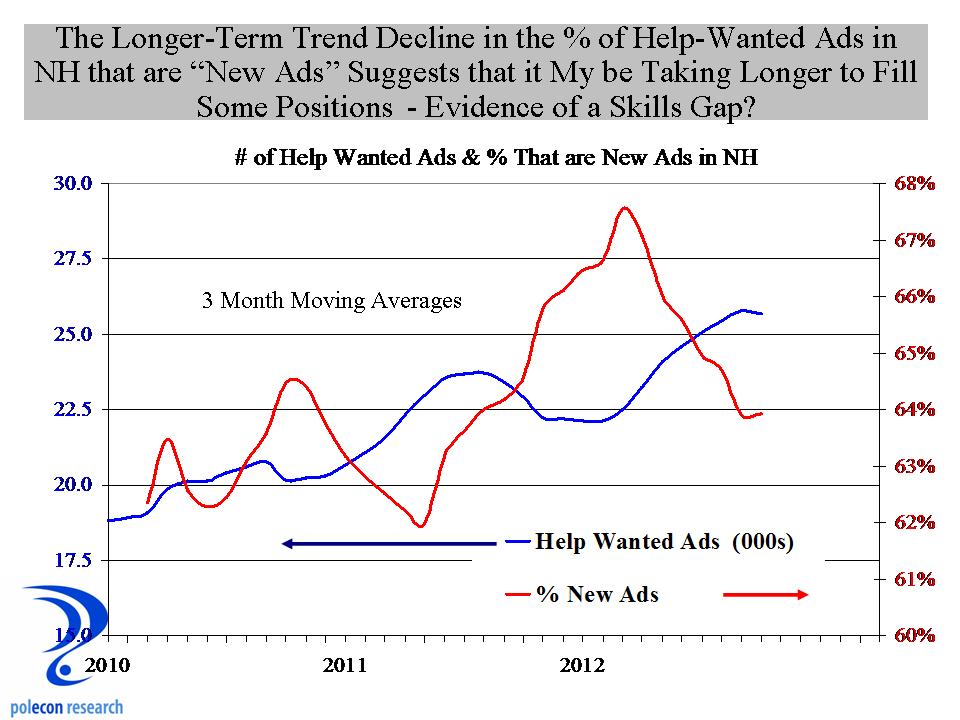
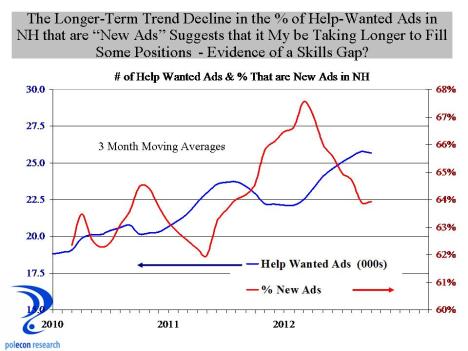
Ok, that was a bit of a rant, now back to the core issue.  Is there evidence of a skills gap in NH that is constraining job growth?  The answer of course, as it is with almost all economic issues,  is both yes and no and also something in-between and with a twist.  I will share this evidence across several postings, today I offer one, small bit of evidence that suggests the skills gap is playing a larger role in disappointing job growth trends.  I noted in an earlier post that help-wanted advertising has generally been on the rise in NH, while job growth has not.  Some of this will be corrected with job growth revisions, but evidence that a skills gap is playing a role comes in the form of the percentage of help-wanted ads each month that are “new ads”.  If help-wanted ads are rising and the number or percentage of new ads is rising similarly each month,  that means positions are being filled at a fairly consistent rate, but if the number of ads is increasing, but the percentage of ads that are “new ads” is declining, that suggest that positions are not being filled or taking longer to fill – perhaps suggesting employers are having a harder time filling the positions or a skills gap.  The chart below shows that indeed, the percentage of monthly help-wanted ads in NH that are :new ads” for the month has been slowly declining, providing some small bit of support for the skills gap explanation for job growth.  A lot more evidence is needed, but given the importance of the issue in policy making, it is worth the effort to find or refute it.
Keeping an Eye On Which Prize?

October 26, 2012

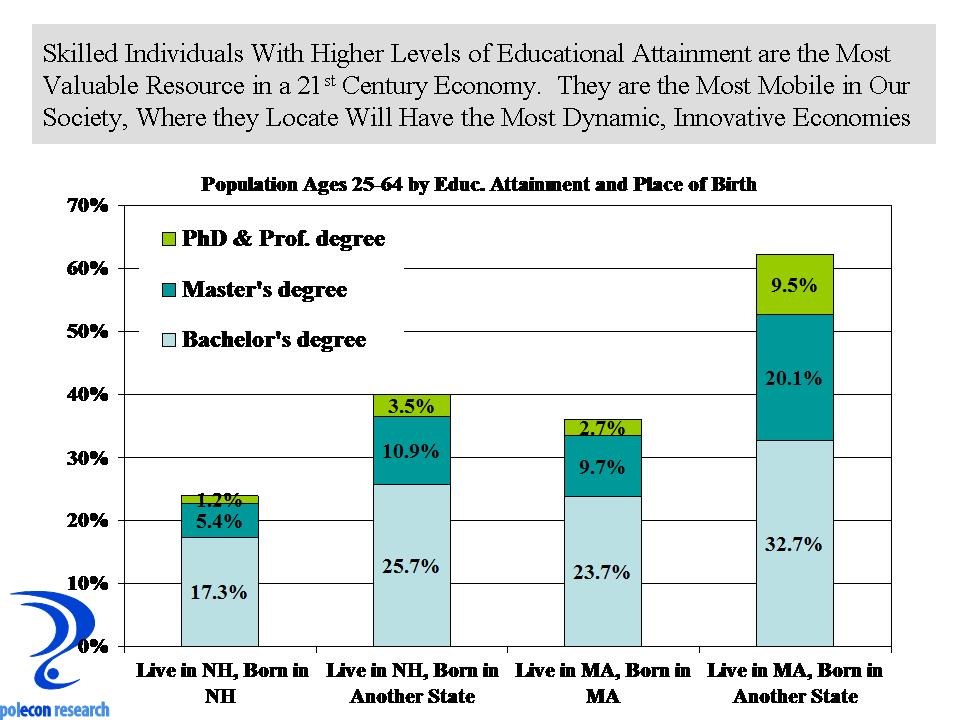
Every state is obsessed with maintaining or creating a “good business climate.”  I think NH has traditionally had a good business climate, with both the public and policymakers demonstrating a high regard for businesses,  and with a climate of mutual respect between the business community  and state policymakers.  At times they have differed in their views, and the balance of interests could change marginally from time to time, but over the years there was a nice balance where each was able to ultimately rely on one another to increase opportunities and prosperity in the state.  There is a lot of fretting over the business climate in the state and what it means for our ability to “attract” businesses. That is always a good thing to monitor, but I am concerned that we (business people, policy makers, citizens) may be spending too little time concerned with creating a climate that is attractive to individuals.  More specifically, skilled individuals with higher levels of educational attainment that increasingly are the source of competitive economic advantage in states and regions.  The in-migration of individuals with higher levels of educational attainment fueled NH’s economy and increased the concentration of technology and higher-skill industries and occupations during much of the past few decades, just as it has in other states that have been able to successfully attract skilled, well-educated individuals.   The chart below shows how the educational attainment of NH residents differs between  those who were born and continue to live in NH, and those who live in NH but where born in another state (in a future post I will discuss international migrants).

The chart shows that residents who have moved to NH from another state are much more likely to have a bachelor’s or higher educational degree.  NH regularly loses its natives with higher-levels of educational attainment to others states, just as other states lose those individuals.  Individuals with higher-levels of educational attainment are the most mobile in society.  They have the most opportunities and generally resources that afford them more choices on where to locate.  That means that the native population will often show overall levels of educational attainment lower than in-migrants from other states.  In-migrants to MA also have much higher overall levels of educational attainment than natives who live in the state,  but the native population that was born and lives in MA has higher levels of educational attainment than the native population in NH.  In fact, educational attainment among those who where born and live in MA looks a lot like the in-migrant population of NH, not surprising since about 300,000 individuals born in MA now reside in NH.

In-migration to NH has been slowing and recently stopped, with tremendous implications for our economy’s ability to grow, innovate, and remain dynamic.  Lets keep our eye on maintaining a good business climate (we can start by reinforcing our tradition of mutual respect between business and government), but I think we need to quickly  begin asking ourselves if a singular concern about business climate is sufficient to assure growth in our economy  if NH is losing its attractiveness to the individuals who are increasingly the source of its economic strength.

Manufacturing’s Toughest Sell

October 12, 2012

The percentage of younger workers in the workforce is declining in NH, as it is across the country, but the trends are different for specific industries and occupations (more about that in a later post).  Simply put, some industries are capturing a larger share of a smaller cohort of younger workers and the key for any industry or occupation is to have appeal for younger workers and students.  How does an industry capture more younger workers?   Is it because the industry is perceived as being desirable or “cool,” or do younger workers respond to signals about the opportunities in an industry or an occupation?

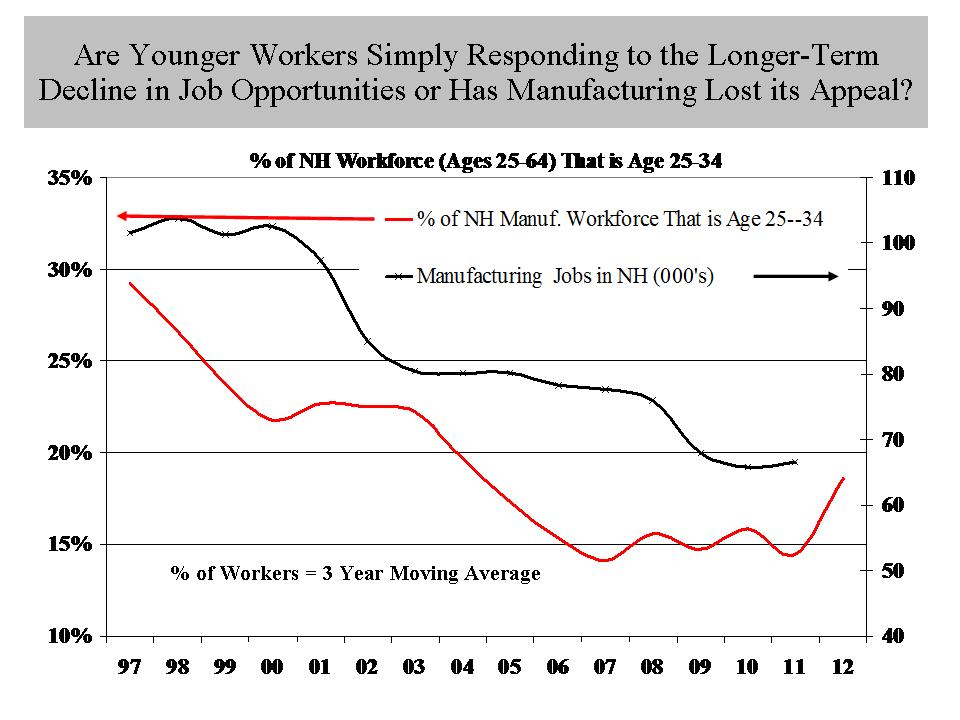
Manufacturing is one industry that has been capturing a smaller share of younger workers (government and utilities are others).   The chart below shows that over the past 15 years the share of younger workers (age 25-34) declined in NH’s workforce (age 25-64).  But the chart also shows that the drop was more pronounced in manufacturing than in the workforce overall.

Government employment hasn’t been perceived as cool for some time but job opportunities have grown or remained steady (except in very recent years) over the years suggesting that “coolness” is a factor in the career choices of younger workers.  For manufacturing it is likely to be a combination o cool and opportunities.  While manufacturers now have good opportunities for young workers, that perception must overcome  decade s of    labor market signals showing large declines in manufacturing employment.  The decline in younger workers in manufacturing roughly corresponds to the change in manufacturing employment in the state (chart below).

Manufacturing employers are in a difficult position.  Fewer households have workers with a history of manufacturing employment, limiting the legacy effects that can contribute to career choices.  A “twist”  (changing occupational makeup) in the manufacturing labor market mean that much of the public and almost no  high school guidance personnel have an understanding of the types of jobs in manufacturing. A general lack of “coolness,” perceived lack of opportunities, and  limited understanding of the opportunities that exist in the industry all mean that manufacturing will have a tough time capturing a larger share of the younger workforce, but it is important to do so for a number of reasons. I just don’t know if manufacturers can do it alone.