Natural Gas Production is a Game Changer

Posted November 19, 2012 by Brian Gottlob
Categories: Electricity Generation, Energy, Natural Gas, Uncategorized

Tags: , , , , ,

The rise in natural gas production in the U.S., along with the volume of proved reserves available in the future because of new technologies, could fundamentally change the energy landscape in the U.S. in a way that the significant and beneficial rise in U.S. oil production can not.  Both trends are good news for the country and  further efforts toward U.S. energy independence, but the lower prices and increased stability in supply of natural gas also have the potential to alter the energy fuel mix  in this country.  The use of natural gas has yet to make significant inroads in the transportation sector but it is hard to imagine how a fuel supply that (unlike gasoline) is, or could be, available directly at a majority of U.S. households at reasonable prices,  will not eventually fuel a much higher percentage of vehicles in this country.  In the electric power industry, the transition to natural gas is already occurring, in part because of the lower and more stable price environment for natural gas, but also because of the environmental advantages of natural gas.
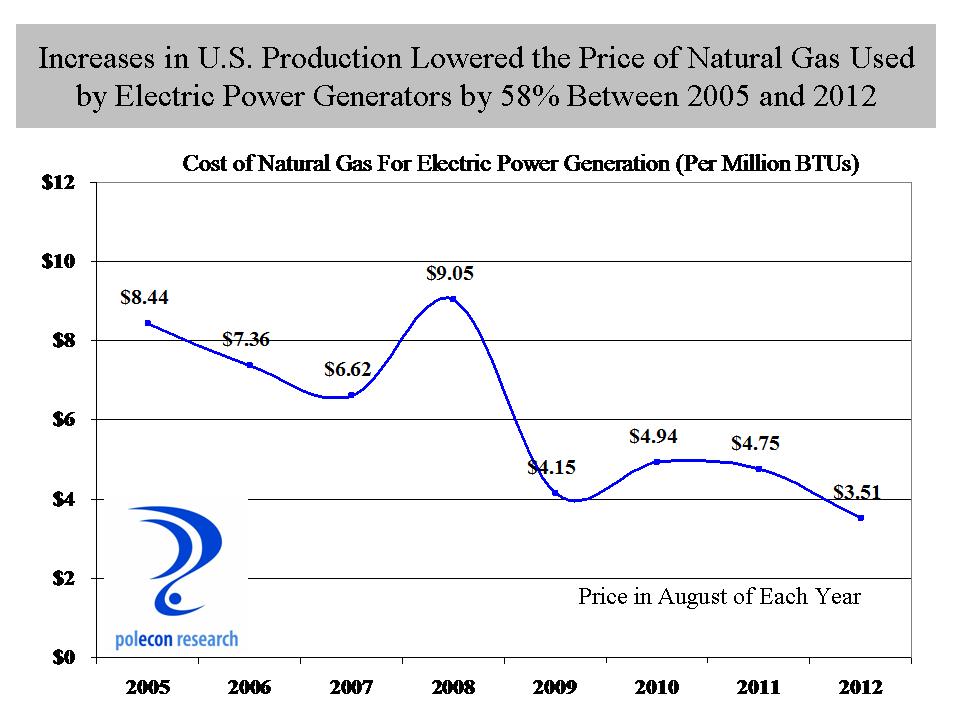
The chart above shows that the price of natural gas used by the electric power industry for generation has fallen by almost 60 percent since 2005.  Although that trend will not continue, production and proved reserves in the U.S. have created a much more predictable and stable price environment for natural gas as evidenced by forecasts by the U.S. Energy Information Agency and by commodity futures markets.  The electric power industry is already changing to reflect the new realities of natural gas markets.  As the chart below shows, in just the past decade electricity generated using natural gas has gone from 15 percent of the electricity generated by coal fired power plants to 31 percent.

That trend is continuing.  Just one company (First Energy), recently announced the closing of six coal fired power plants in Ohio, Michigan, Pennsylvania, and Maryland, noting that the costs of environmental compliance upgrades made the plants not economically viable to continue to operate.

The Rise and Fall of Homeownership Rates

Posted November 16, 2012 by Brian Gottlob
Categories: Homeownership, Household Finances, Housing, Real Estate

Tags: , , , , ,

The rate of home ownership increased significantly in the U.S. and in New Hampshire from the middle of the 1990’s until the housing market crash in the late 2000s.   The increased availability of financing (sometimes exotic) played a significant role,  as it did in the ultimate unwinding of the housing boom (nearly taking the nation’s financial system down along the way).  Home ownership rates are returning to levels closer to historical standards in the U.S., but not before a lot of household wealth in the form of homeowners equity was lost.  That has had a large impact on our recovery from recession.  One rule of thumb is that for every one dollar of household net worth lost, consumption expenditures by households will decline by 3-5 cents (the so called “wealth-effect”.   Using the lower figure (3 cents), implies that across the country, consumer expenditures were about $180 billion lower between 2007 and 2011 as a result of the housing market crash,  than they would have otherwise have been.

In NH, home ownership rates are higher than for the U.S. and they have yet to significantly move back toward their historical levels in the state.  They may never, but I have to think that until they do, putting a true value on houses in the state is going to be difficult.  In the meantime,  home price depreciation has had the same negative effect on household net worth in the Granite State and thus a substantial negative impact on consumer expenditures via the “wealth-effect”.

Measuring Consumer Financial Distress, are We Really Better Off Today?

Posted November 15, 2012 by Brian Gottlob
Categories: consumers, Financial, Household Finances

Tags: , , ,

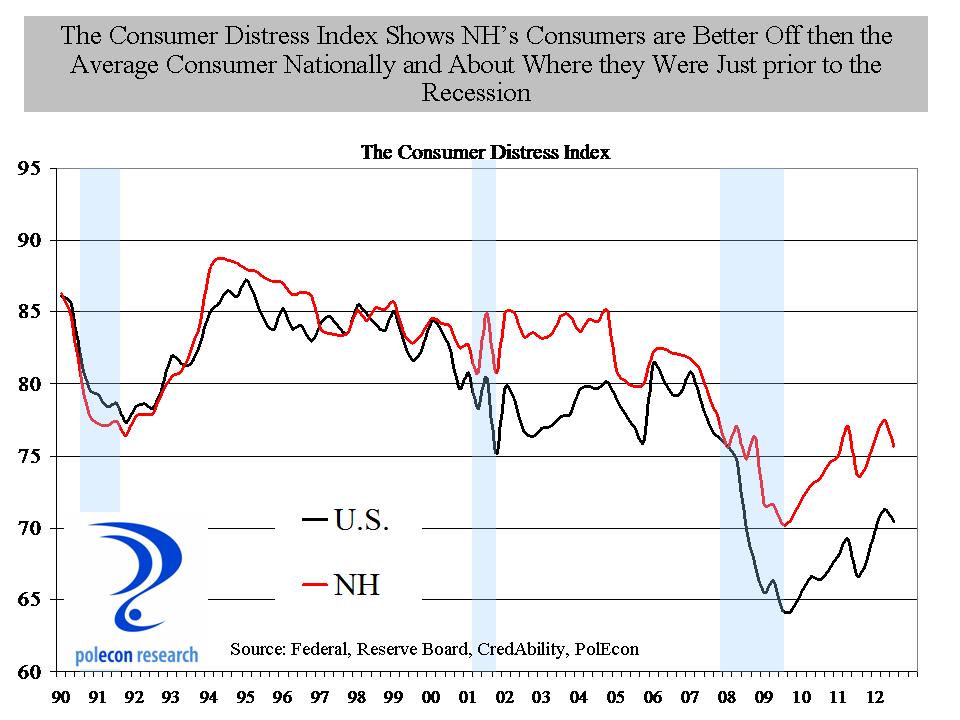
The Consumer Distress Index is a quarterly comprehensive picture of the average American household’s financial condition.  The index is calculated for the nation and each of the 50 states.  The index measures 5 categories of personal finance that reflect or lead to a secure, stable financial life—Employment, Housing, Credit, Household Budget and Net Worth.   It is calculated by CredAbility,  a  nonprofit credit counseling service, uses 65 data points using public and private data to measure consumer financial distress.  According to their Consumer Distress Index, only 12 states have lower levels of financial distress among households than does New Hampshire.    Lower scores indicate higher levels of financial distress.  The chart below compares NH with the U.S. average.    It shows that, by this measure, NH households are about as financially well-off as they were just prior to the recession, but that the financial health of households has generally deteriorated since the second-half of the last decade.  Not surprising given the increases in employment insecurity and decreases in the value of most households largest asset, their home.

 CredAbility categorizes distress scores using the following:

Less than 60 Emergency / Crisis
60 – 69 Distressed / Unstable
70 – 79 Weakening / At-Risk
80 – 89 Good / Stable
90 and Above Excellent / Secure

By that scale NH, with a score of 75.68 is “At-Risk”, while the U.S. average household is bordering on “unstable/distressed” with a score of 70.48.   According to this measure, NH households are about or just slightly below where they were prior to the recession in terms of financial distress, while the average U.S. household is in more financial distress than they were prior to the recession.  I don’t know how much concurrent validity this measure has but I do know that if I had used it, instead of a state-level “misery index” (the sum of unemployment and inflation) to predict the outcome of the election it would have been a less  accurate predictor of election results.

How Much Federal Government Revenue is Enough?

Posted November 14, 2012 by Brian Gottlob
Categories: Fiscal Cliff, Fiscal Policy, Tax Revenue

Tags: , , ,

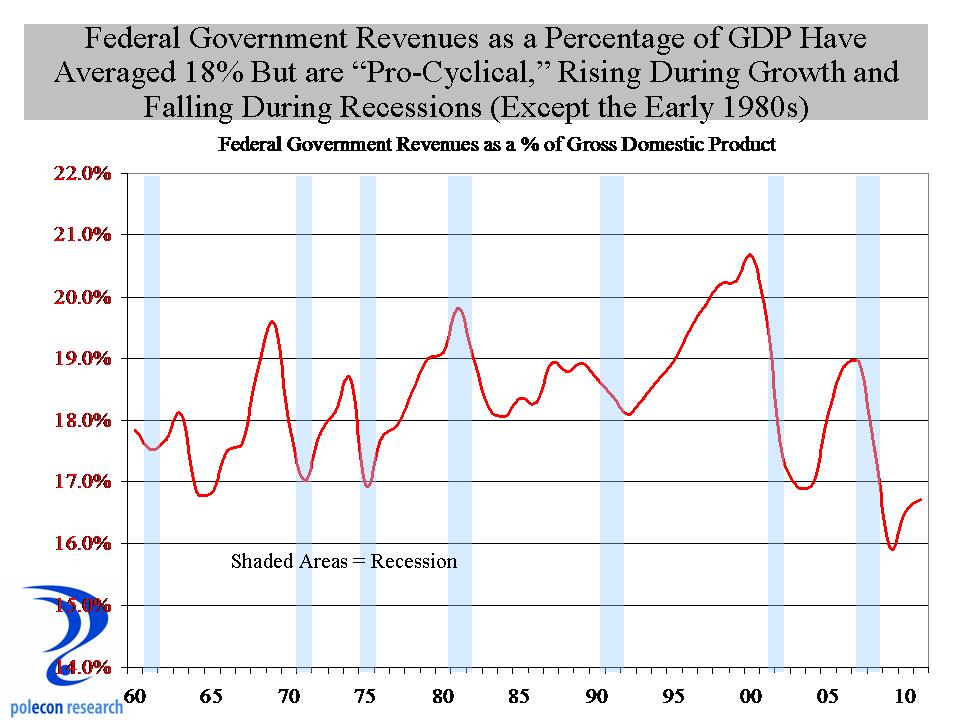
Federal government revenues as a percentage of gross domestic product have averaged about 18% over the past 50 years (the median is also 18%).  Federal government revenue is “pro-cyclical,” that means revenues as a percentage of GDP grow when the economy is stronger, as profitability of businesses increases and as individual wage, salary and investment income is increasing.  This relationship has a couple of important implications: First, it can confound ideological interpretations of the appropriate level of current revenues as a percentage of the economy because higher revenues as a percentage of GDP aren’t associated with slow growth and low percentages aren’t associated with higher rates of economic growth – just the opposite is true (with the exception of the dual recessions of the early 1980s), second it suggests how important economic growth is to revenue growth and thus to potentially reducing the nation’s budget deficit.

I haven’t done the math but others who have indicate that the various deficit reduction proposals all require revenues as a percentage of GDP of over 18%.  The U.S. House passed Ryan budget proposal would produce estimated revenues as a percentage of forecast GDP of approximately 19%, the President’s proposals would produce estimated revenues at 20% of GDP, and the “Simpson-Bowles” model would result in estimated revenues as a percentage of forecast  GDP of 21%.  That doesn’t sound like much of a difference, but in an economy with a GDP of $15.5 trillion each 1% increase equates to $155 billion in revenue.  Going from federal revenues that are 18% of GDP to 21% implies a revenue increase of $465 billion.   I could be ok with that if the bulk of the increase were the result of a roaring economy producing large increases in profitability and income, but that isn’t the foundation of any deficit reduction plan and it is hard to see a scenario where $465 of additional revenue is consistent with a high growth economy (the pro-cyclical nature of revenues aside – that relationship isn’t  infinitely linear).  The national debate over reducing our nation’s budget deficit is framed by two choices or their combinations,  increasing tax rates (or eliminating temporary reductions and reducing tax breaks etc.) or by cutting spending.  Revenues at 18% of GDP seems to have worked reasonably well over the past one-half century with the past decade being the exception.  It may be time to aim for a different ratio for the sake of longer-term fiscal balance, but I wouldn’t do it without first exhausting opportunities for spending reductions that maintain a ratio close to the historical average of 18%.  But whatever the combination of spending reductions and revenue increases that eventually becomes the strategy for addressing the nation’s long-term fiscal imbalances, I hope economic growth is the ultimate goal, because as the chart above shows, achieving that goal will make addressing fiscal imbalances a much more manageable task.

The World Needs Another Election Analysis

Posted November 13, 2012 by Brian Gottlob
Categories: Election, Politics, Uncategorized

Tags: , , , , ,

How many times over the last week have you heard someone say “I just don’t think there has been enough post-election analysis, where can I get more”?  Ok, nobody has likely said that to anyone, anywhere, in this country since November 6th.  But just like there is “always room for Jello,” there is always a little more room for political analysis, especially when it comes with absolutely no political spin, and from someone uniquely unqualified to offer it.  Examining town-by-town results from NH’s race for governor in the context of  demographic as well as political variables provides some clues to the problems facing the NH Republican party.   Using regression analysis to predict the percentage of votes both the Republican and Democratic candidates received in each of 230+ towns shows that several variables were significantly related to the percentage of votes each candidate received.  I know there are all sorts of explanations and contexts that account for the election results but I am striving for some level of empiricism in an ocean of spin, even if some of the important context (issues) can’t be quantified and are left out.  I am going for parsimony here.

Of course the percentage of voters registered in each party in a town is the single largest determinant of the percentage of votes received by the party’s candidate, but after and controlling for that, what other variables were significantly related to the election results?  The chart below shows the most important demographic variables (at least the most important of the 30 or so I examined).  The bars are standardized results (z scores) that show the RELATIVE importance of the variables in determining the percentage of the vote that went to the Republican candidate.

Results show that sometimes, empiricism supports rather than refutes conventional wisdom.  The variable that has the strongest negative association with the percentage of votes for the Republican candidate (controlling for all other variables) is the percentage of the town’s population age 25+ that has at least a bachelor’s degree or higher.  The percentage of the population age 25-34 also has a strong, statistically significant negative association with the vote received by the Republican candidate.  On the plus side, higher income towns and towns where a higher percentage of residents moved to NH from another state (again controlling for all the other variables and with a caveat that this data include only those who moved to NH between 1995 and 2000) were both associated with higher percentage totals for the Republican candidate.  The percentage of households with children in a town  just missed a statistically significant relationship with higher vote percentages for the Republican candidate.  In combination, these three variables point to Republican strength in higher income communities that also have a high percentage of families with children and that have a higher percentage of households that moved into NH from another state- that is a good description of many of NH’s, bedroom communities near our southern border.  It is (or was until recently) also a pretty good characterization of the bulk of NH’s in-migration from other states.   The notion that movement to NH is positively related to Republican vote totals suggests that other explanations (demographic but also issue-based) besides “NH is becoming Massachusetts north” may be responsible for NH’s emerging blue hue.  In any case,  in-migration to bedroom communities slowed a lot this past decade.  More troubling for Republicans is the negative association between higher educational-attainment and the percentage of votes received by the Republican candidate.  A higher percentage of population aged 25-34 is also negatively associated with the percentage of Republican votes, although the true meaning of this is harder to glean because this age group is also associated with a higher percentage of independent voter registration.  Whether it is age or lack of party affiliation that is the cause, however, votes for the Republican candidate were negatively associated with a higher percentage of individuals in a town in this age group.  None of this is an epiphany, but sometimes you just have to document the obvious (even if only to make it patently or inherently obvious) in order to really believe it.

Don’t Just Honor Them, Hire Them!

Posted November 12, 2012 by Brian Gottlob
Categories: Education, Educational Attainment, Unemployment

Tags: , , , ,

Today we honor veterans, at least that’s the idea if we can find the time between trips to the mall.  I hope you read about or  listen to their stories today.  If you happen to come by this blog, on this important day, here is one important story.  The unemployment rate among those who have served on active military duty  is higher than it is for those who have not served,  at all levels of educational attainment.  I am no expert on why, but I know it  is no way to thank men and women for their service.   Below is a chart that shows the unemployment rate among 25-34 year olds in New Hampshire, by educational attainment and whether or not they ever served on active military duty.    So honor them today for sure, but  hire them tomorrow if you can.

Will NH’s Fiscal System Get Better Looking Each Year?

Posted November 9, 2012 by Brian Gottlob
Categories: Demographics, Fiscal Policy, Tax Revenue

Tags: , , ,

Up close everyone sees the wrinkles, greys and infirmities that come with age,  but some things do, in fact,  get better looking with age.  Surprisingly,  NH’s revenue structure  may be one of them.  For a lot of people New Hampshire’s fiscal system has been out of balance for a long time.  I see it somewhat differently.  The state was able to maintain a fiscal structure that was unlike any other in the country.  Some hate it, some like, but one thing it absolutely most depends on is balance.  Specifically, those identifying with the left of the political spectrum had to be satisfied with doing the things that state government has to do and only a limited amount of what it may want to do.  While those on  the right of the political spectrum had to be willing to occasionally adjust the tax price of services (adjust rates and fees etc. temporarily or in some cases permanently).  Without a recognition of the need for balance from either side, the pressures from one side that were met with complete inelasticity from the other could cause the system to burst.   If NH has lost some of that balance I hope it regains it quickly because while some may see our system as flawed, it has also been a big part of our successes.

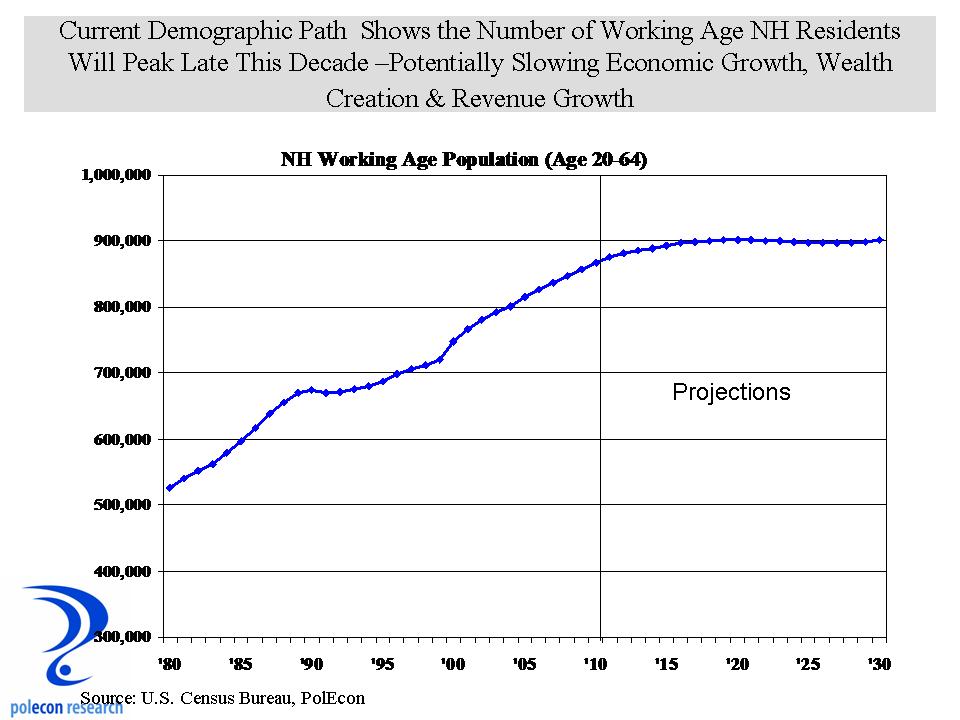
Looking toward the future, our current system is likely to suffer less from some of the demographically and economically induced changes in the growth in state-level revenues.  I don’t know if we will be the envy of other states but we should consider the impacts of the changes before walking too far down the path of big changes.  The biggest change is the fact that growth in the working age population is slowing and may continue to do so for decades (see below for NH).

That, of course, implies slower growth in wage and salary income and states most reliant on income taxes will feel that pinch the most.  On the flip side, with more older citizens, likely more income will be in the form of interest and dividends, a benefit for NH’s current system if interest and dividends tax revenue grows proportionately .  NH’s business enterprise tax (BET) depends on wage and salary payments so that revenue source would be negatively affected but because of the way the BET interacts with the business profits tax(BPT), a decline in either source is cushioned by impacts to the other source.  Moreover, as labor becomes more scare, the capital intensity of businesses should increase as businesses look to produce more with fewer people.  While the BPT impacts will be mostly neutral, it is possible that a deepening of capital in the economy could  increase in the relative profitability of businesses which would provide more lift to the BPT.

As the age structure of the population changes to include more older residents, in the aggregate, less money will be spent on the types of things subject to general sales taxes and more on goods and services that are not taxed (health care being the most notable), thus sales tax revenue growth rates could slow.  Combined with more sales occurring digitally via the internet and the generally increasing geographical separation of  buyers from the location of sellers, this does not bode well for long-term growth in sales taxes.  NH’s hybrid mix of taxes and fees collectively are likely to suffer less as a result of demographically induced changes in revenue .  As the risk of impacts is spread over a greater number of sources, any negative impacts on one source will have less of an effect than if the state relied on either of the two major sources of most other state’s revenue, the income and general sales tax.  For the most part, property taxes will also be relatively less affected by demographically induced changes.

It may not look like it now, but with the kind of balance that characterized fiscal policy making in NH for decades, and with coming shifts in revenue growth resulting from demographic and economic changes, NH’s fiscal structure  may well be better positioned to avoid the next (and inevitable)  fiscal calamity to hit states.

Its the Dependency Ratio That Matters Most

Posted November 8, 2012 by Brian Gottlob
Categories: Demographics, Dependency, Fiscal Policy, Spending

Tags: , , , , ,

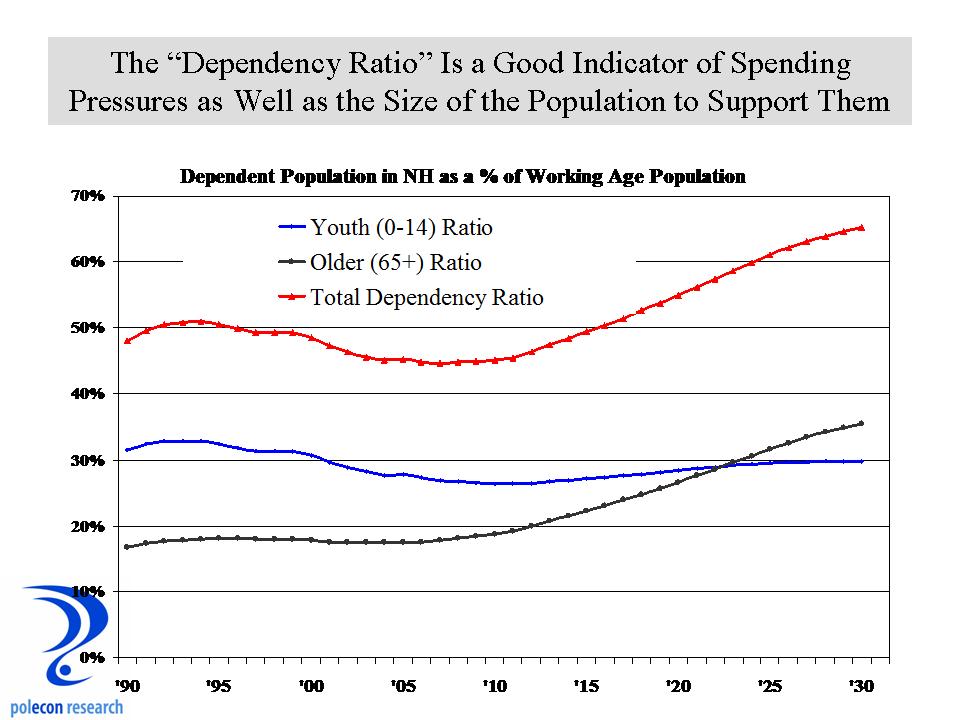
There is a good deal of fretting (warranted) about the impact on national and state-level government spending of a population that is growing older.  It is relatively easy to project a path for age-affected expenditures both nationally and in NH and to model how changes in spending programs and policies could alter the projected path of those expenditures.   Getting agreement on which policies to alter to influence the spending path is a much more difficult task.  What is missing from most discussions is an understanding that aging isn’t the only important demographic trend.  The dynamics of an increasing number of older individuals and median age of the population are largely misunderstood, but that is a subject for another post.  From a fiscal perspective, the most important indicator of spending pressures resulting  from the age structure  of the population is the “dependency ratio.”   The dependency ratio measures the ratio of working-age individuals in a population to those who are generally more ‘dependent” in a population (that is are likely to draw greater resources from governments then they give to governments).  Generally dependency is defined as age groups least likely to be in the labor force (children and those age 65+ – which may be unrealistic as individuals are healthier and for a variety of reasons stay longer in the labor force).  The dependency ratio affects both spending and revenues (revenue impacts are mostly missing from the demographic discussion and are the subject of tomorrow’s post).  A lot of government spending is directed at these groups – young people via schools and older citizens via things like Medicare, Medicaid, Social Security etc.  The chart below shows the rise in the projected dependent population in NH.  The chart shows that the past decade has been a “sweet spot” for the dependency ratio in NH, with an overall decline in the percentage of the population in “dependent” years (albeit with an increase in older dependency).  I produced a similar chart in the early 2000’s and suggested state government make good use of the state’s time in the “sweet spot” by adopting policies to minimize the impacts of future increase in the dependency ratio in the state (it wasn’t the first nor will it be the last time my thoughts were ignored by lawmakers – in fairness, it’s not always unreasonable for them to do so).  Certainly some policies have looked to reduce the impacts of an increasing older population.  But with limited, and in some years declines in the youth dependency, less attention has been given to innovative ways to slow the growth in spending (largely education expenditures) in a way that is proportional to growth in the youth population.   Effectively managing changes in spending pressures without producing unacceptably large overall increases in spending or unacceptable reductions in services requires that resources not be locked in specific spending categories or programs, but rather be allowed to rise and fall and flow to and from programs programs and services most influenced by demographic and economic pressures.  Tomorrow: The other side of the ledger – demographic influences on revenues.

Renewable Energy in the Era of Rising U.S. Oil and Gas Production

Posted November 7, 2012 by Brian Gottlob
Categories: Electricity Generation, Energy, Natural Gas, Oil

Tags: , , , , ,

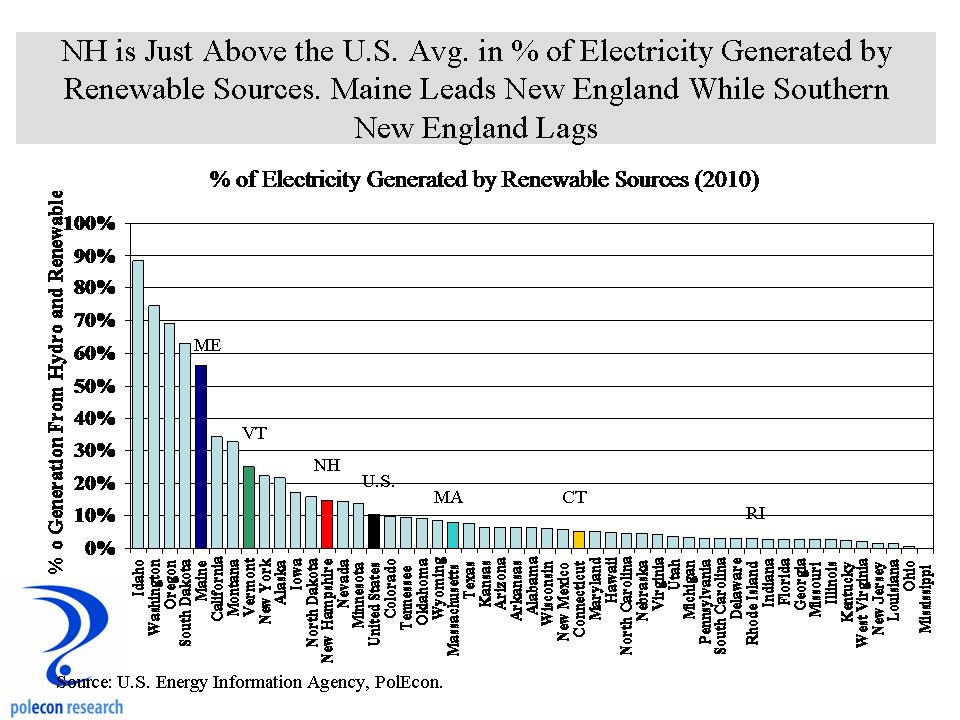
Dramatic increases in natural gas and oil production in the U.S. have increased the nation’s prospects for energy independence.  Increases in oil and gas production are good news for the U.S. economy and consumers, but one unfortunate result could be reduced efforts to increase the nation’s production of energy from renewable sources.   High oil and gas prices, as painful and harmful economically as they are,  spur development of renewable sources of energy.  I couldn’t be more enthusiastic about the positive implications of increased domestic oil and gas production but my enthusiasm is tempered by the prospect of a stalling emphasis on developing  renewable energy sources.   Northern New England states are above the U.S. average for electricity generated by renewables, with Maine being a national leader at 56% of it electricity generation.  Vermont is at 25% and NH 14% (each of these states generates a large percentage of electricity from nuclear fuel while Maine does not).

Southern New England states lag in electricity generated from renewable sources of energy, and as the chart below shows, have a long way to go in meeting their goals for the percent of electricity generated by renewable resources – even when the goals are modest.

Whoever Wins, I’m Rooting for Propserity

Posted November 6, 2012 by Brian Gottlob
Categories: Election, Fiscal Policy, Recession, Tax Revenue

Tags: , , ,

The winners of today’s state and national elections face some daunting budgeting tasks.  Compounding those difficulties is the fact that winners will likely begin their efforts having disappointed close to 50 percent of the people who care enough about their country and state to exercise their right of franchise.  Its hard to set a course when half the oarsmen and women are are using them to poke you in the eye rather than right the ship of state.  This is not a circumstance unique to this election, but what does seem different is how many people think they still win even when their candidate loses, if the country or the state fail to prosper under the administration of the victor.    Some may have, but I never have  been better off when the economy is weak,  so whether or not my candidates win today, I’m rooting for prosperity.

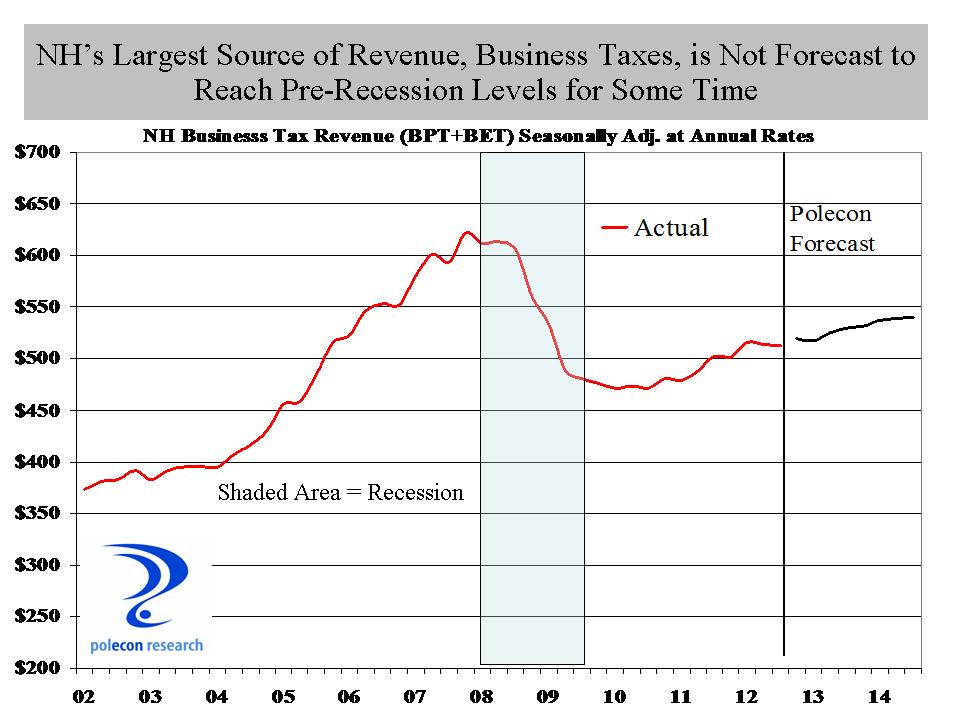
In NH, today’s winner of the race for governor will confront pent-up demand for limited state resources that show no near-term signs of significant increase.   The state’s largest source of general fund revenue, the combined business profits and business enterprise taxes, has shown limited growth recently.  In the past, this source of revenue has demonstrated an ability to rise quickly and dramatically as the state’s and nation’s economies rebound, but a severe recession and changes to the state’s business loss carry forward provisions will dampen some of these effects that typically occur early in a recovery.  The chart below shows the seasonally adjusted,  annualized, business tax revenue over the past decade, along with our forecast for the next two years.  This forecast uses a statistical model (ARIMA) that makes no assumptions about changes in the strength of the economy and it indicates that, without significant changes,  business tax revenues can be expected to increases by about 5.3 percent over the next two years.  We will update the forecast as new data becomes available as well as use modeling that incorporates key assumptions about changes in state and national economic variables, but as it stands now, it appears that  little of the pent-up demand for state spending  is likely to be satisfied under the current path.