“…..No Fury Like the Middle and Upper Classes Scorned”

Posted November 1, 2013 by Brian Gottlob
Categories: college, Debt, Education, higher education

Tags: , , ,

College students rage against  a lot of things (including their parents as I have learned) but tend not to channel that energy into exercising  their right of franchise.   I think that helps explain why, after decades of rapidly rising college costs and levels of student debt, the tipping point on the issue appears to have finally been reached.   As I noted in a recent study on student debt, one of the features today that distinguishes debt to pay for higher education from prior periods when the issue bubbled to the surface is how much more of the debt appears to be being borne by parents as well as students.  Parent debt is not included in the popularly reported student loan debt by college or by state, but as the chart below shows, along with unsubsidized federal loans to students, federal parent “PLUS Loans”   have been the second fastest growing category of student debt.

Growth in Student Loans by Type

PLUS Loans are still a much smaller category of debt for higher education than are loans to students but there is no data available on the non-federal loans parents have accumulated (such things as home equity loans) to pay for their children’s education so overall parent debt has likely increased even more .  It is much easier to avoid the public debate about debt for higher education when it affects just students than it is to avoid when  it affects parents as well ( whom lawmakers are much more likely to respond to as constituents).  Another troubling aspect of the chart above is the increase in federal unsubsidized student debt.  Because the interest on this debt is not paid for by the federal government while a student is in college (unlike subsidized debt), it is more costly, and thus the higher percentage of unsubsidized debt today than a decade ago suggests that student debt levels actually understate the impact on students of the increase in student debt since 2001.

Examining data from the Federal Reserve Board’s “Survey of Consumer Finances” highlights how debt for higher education has increased over 20 years as a percentage of household’s non-mortgage debt, with the biggest increases coming since the mid 2000s.

H Installment Debt by Purpose

The chart above reflects both parent and student debt.  More of household installment debt going to pay for education implies less borrowing (and spending) for other purposes and helps explain (along with generally weaker economic conditions during much of the 2000s) why consumer expenditures on other goods have been relatively weak.  The economic implications of student debt are typically seen as constraining recent graduates spending, household formation, home buying, entrepreneurship, etc., but the reality is that student debt is likely constraining more than just recent graduates.  I think some evidence of this is seen in the changes in installment debt of households by income (chart below) .

Installment debt by income

As the chart  shows, the largest increases in  the percentage of installment debt that goes for education are among middle and higher income groups.  These are income groups with the most disposable income and anything that constrains them from “disposing” of their income (like repaying debt for higher education) on goods and services that boost economic activity will have detrimental impacts on the economy.  Lower income groups have seen significant increases in installment debt for education as well, much of it attributable to increased enrollment rates over the past few decades which have been highest among students from lower-income households.  With more students from families with modest incomes attending college, the share of installment debt for education among these income groups can be expected to rise.  Higher college costs also play a role but increases in financial aid for lower-income students have helped offset some but certainly not all of those cost increases.   In no way do I want to minimize the impact of college costs and debt on lower-income students and households but that has been a fairly consistent problem that does not distinguish the current situation from the past the way changes in debt among higher income groups appears to have changed.

The large increase in the percentage of installment debt that goes to education among middle and higher income groups reflects economic conditions (savings for education dropped the most among these income groups over the past decade) but also financial aid policies and practices of governments and colleges that appear to especially squeeze middle-income households.

The rapidly rising debt for education held by parents and households, not just students, I think explains a lot about the new urgency to address college costs and student debt.  The fact that middle and higher income groups seem more affected by these pressures than in the past may say even more about why the issue has risen on the public agenda.  Beyond the political, when the households that typically have the most disposable income appear to be especially affected by higher education debt, we should not discount the role debt for higher education may be playing in constraining economic activity in the U.S.

How Much of Housing’s Recovery Depends on Interest Rates?

Posted October 11, 2013 by Brian Gottlob
Categories: House Prices, Housing, Interest Rates, New Hampshire, Real Estate

Tags: , , ,

Low interest rates did much to float the housing bubble of the 2000s, but like all bubbles the higher pressure inside the bubble eventually caused it to burst as it rose higher and encountered the  thinner atmosphere at high elevations.  Recently, even lower interest rates (lower than those that helped create the bubble) have significantly helped the housing recovery .Median price and Mortgage Rates

I haven’t written about the housing market lately because you can only jump off the “booming housing market” bandwagon so many times before people start wishing it causes you a fatal injury.   I won’t jump off the housing recovery bandwagon this post so much as I will move to the back of the wagon.  There is a nice modest recovery occurring in New Hampshire’s housing market.  It is not the boom that some national headlines indicate,  or even as strong as some data on median sales prices in New Hampshire would suggest, but the market is recovering.  CoreLogic’s home price indices show New Hampshire prices appreciated at about 5% over the past year.  Not bad but still 30 states had greater home price appreciation.  Home prices in the Granite state remain almost 17% below their peak levels and in only 12 states to prices remain  further below their peak levels.

Population growth (largely through in-migration) appears to be resuming again in New Hampshire and as household formations and job growth accelerate the market should improve at a faster rate.  Housing affordability is as high as it has been in decades.  The chart below shows a housing affordability index, or how  the monthly income of a NH household at the median income in the state relates to the monthly principal and interest costs of buying a home at the median price in the state.  When the index is above one, the index shows that the “typical” household with income at the state median, has more than enough income to cover monthly principal and interest costs (it says nothing about whether they have enough to make a 10 or 20% down payment to make the purchase or the ability to qualify for a mortgage).  The chart also shows how affordability changes at higher interest rates, indicating that for every 1% rise in mortgage interest rates, affordability declines by about 10%.

affordability index

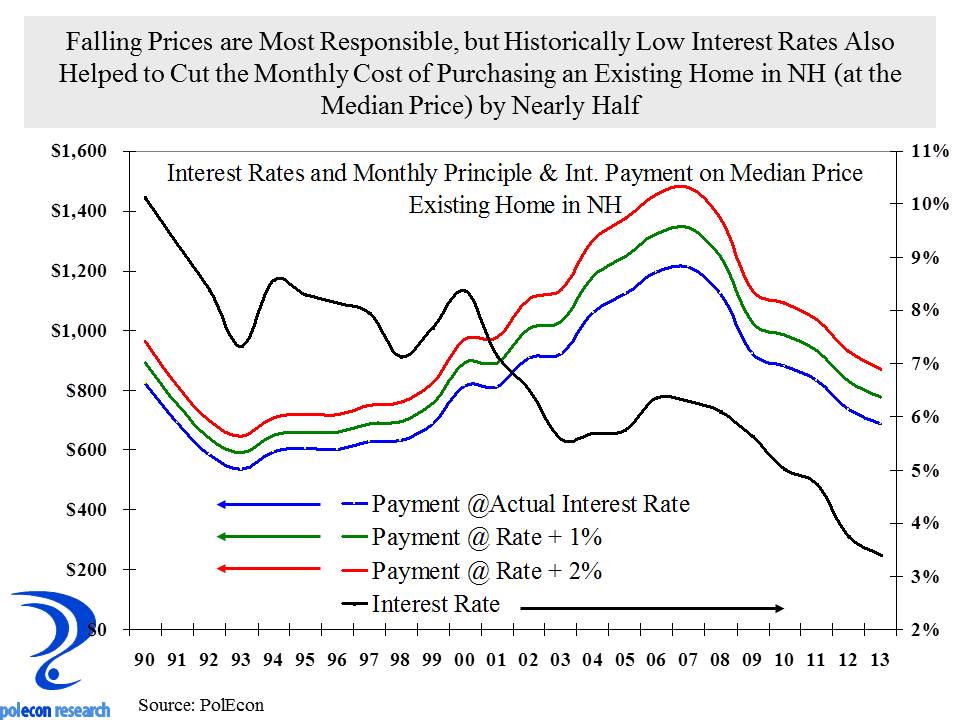
The final chart shows how dramatically the combination of lower prices and falling interest rates affects the monthly principal and interest payments required to purchase a home in New Hampshire at the median purchase price and prevailing interest rates.   The chart also shows how the monthly principal and interest payments on a median priced home in NH would have been affected by interest rates that were 1% and 2% higher than they actually were.  The chart shows how significant changes in monthly payments can be at higher interest rates.  The impact of interest rates on monthly payments is more dramatic when home prices are higher so lower prices in this case suggest that an uptick in rates may have  somewhat less  of an impact than in the past.  Nevertheless the impact on affordability and prices of higher interest rates will be clear.

monthly pruchase costs and interest rates

A key question is how much of the recent rise in prices is the result of a genuine increase in effective demand for homes and how much is the result of the capitalization of interest rates into the purchase price (when rates are low sellers can get higher prices and still keep housing affordable but when mortgage rates are higher sellers must charge less to keep the same level of affordability).  For certain we know that more homes are being purchased, what we will find out, if interest rates continue to rise, is how much of that and sales prices are driven by low interest rates.  In new Hampshire this is especially critical because we have a relatively high percentage of homeowners with negative or near negative equity in their homes and changes in interest rates may determine whether or not they can sell their homes without incurring a loss.

Competition Raises Rather Than Lowers College Costs

Posted October 9, 2013 by Brian Gottlob
Categories: college, Education, Educational Attainment, higher education

Tags: , , ,

I’ve written about student loan debt and college costs in the past.  A report I recently completed on the issue was released earlier this week, you can read it here .  It is long and detailed so even if your aren’t that interested in the topic it is an effective substitute for a strong drink or a mild sedative as a sleep aid.

The report didn’t get a lot of media coverage and in any case it is difficult for media coverage to capture more than a few highlights of a long study that deals with complicated issues (although Kevin Landrigan at the Nashua Telegraph did his usual good job, as did Kathleen Ronayne at the Concord Monitor).  One small portion of the study that I think is interesting and important examines the issue of competition in higher education as a contributor to higher tuition levels.  Colleges in New England and the Northeast have higher tuition prices on average than colleges with similar characteristics (public, private, selectivity, state support, etc.) located elsewhere in the country.  No doubt the region has some of the finest higher education in the country but not every institution in the region is world-class with an ability to charge a premium for educating students.  I thought state-level differences in cost-of-living would account for some of New England’s and the Northeast’s higher tuition prices but multivariate (regression) models using data from about 700 four-year colleges and universities across the country failed to demonstrate that cost-of-living differences were significantly related to differences in tuition prices among universities with similar characteristics but in different regions of the country.

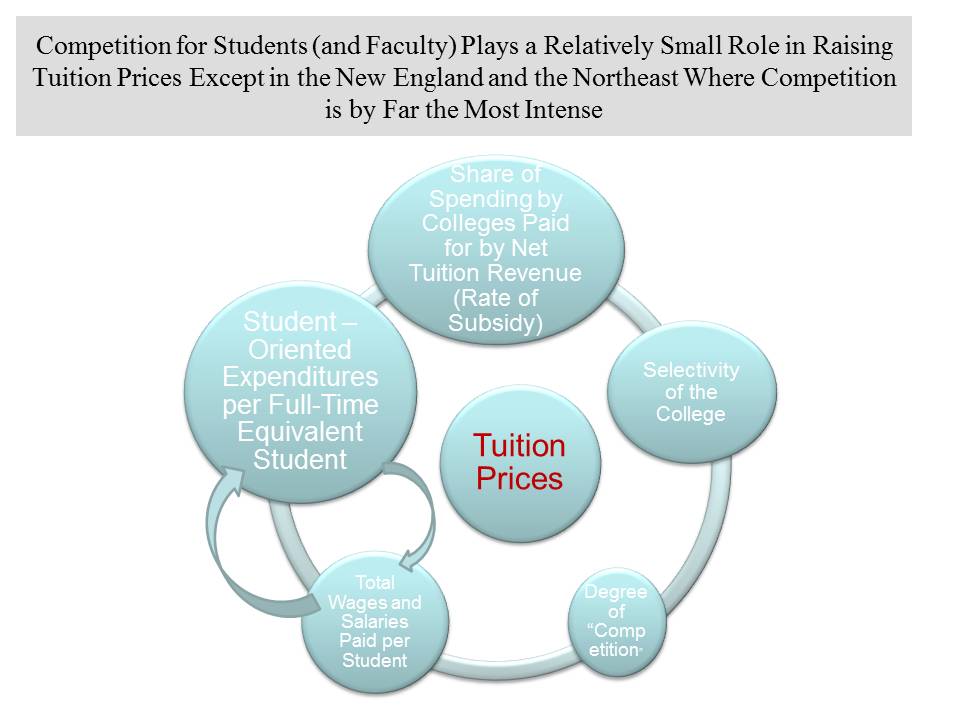
Tuition FactorsOne characteristic of higher education in New England and the Northeast that distinguishes them from other regions of the country is how many colleges and universities are located here.   It is possible that increased competition for students and for faculty could increase college costs in New England and elsewhere.   To date, few colleges and universities have been willing to compete on price.    Colleges generally compete by offering more and better faculty, facilities, student services, and amenities. Colleges want to be the best they can be and they compete for students, for faculty, and with businesses for talent (PhD’s in fields in demand). This is especially true in a region like New England where there is a high concentration of higher education institutions and where there is a large base of technology, business, and professional employment that is more likely to employ individuals with advanced degrees and to compete with colleges for available “talent”.

To test the degree to which competition among colleges might influence regional college costs and prices, I had to develop a meaningful measure of competition among colleges. The study operationally defined the level of competition among colleges in each region as the percentage of regional employment that is employed in higher education.  Specifically, I calculated a “location quotient” for higher education employment in each state and averaged the location quotients for each state in a region to arrive at regional location quotients for nine census divisions (regions).  This measure roughly approximates the degree of choice students in each region have regarding college enrollment.  The figure below highlights regional differences in the concentration of higher education employment.  I won’t get into a discussion of location quotients (LQ) but a LQ of greater than 1 for a service industry indicates it is serving more than local markets and is also “exporting” its services.  We know colleges in New England attract student  nationally and internationally.  The darker regions of the country are where there is a greater concentration of higher education employment (and thus the potential for competition among them).

Higher Ed Emp Concentrations

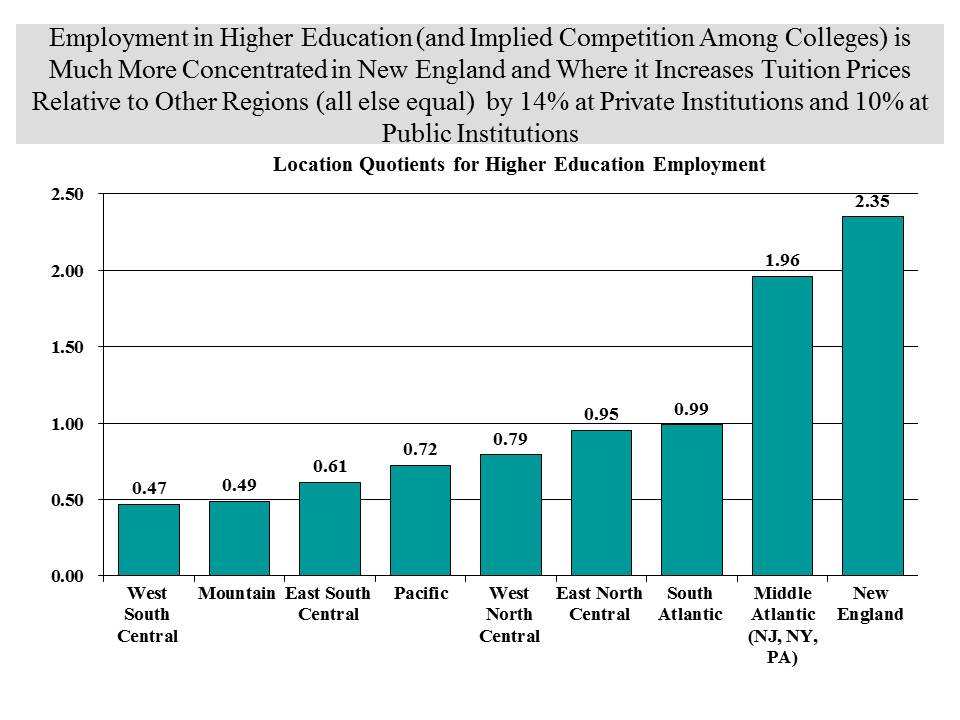
Testing the impact of the LQ measure of regional competition on tuition and fee levels shows the variable to be significantly related to tuition levels at both public and private colleges, with regional location quotients showing a larger impact on tuition and fees at private colleges than at public colleges (implying that competition for students at private colleges has a greater impact on prices than it does at public colleges) .  The elasticity of tuition and fees with respect to our measure of competition was small (.10) at private colleges, and even smaller (.076) at public colleges. However, as the chart below shows, the magnitude of the difference between higher education employment in New England and other regions is great (indicating much higher levels of competition among colleges in the New England region), so this small elasticity still implies that competition has a relatively large impact on tuition and fees at colleges in New England.

Higher Ed Location QuotientsAs an example, New England’s location quotient of 2.35 is about 140 percent larger than is the location quotient (or concentration of higher education employment) in the South Atlantic region. The elasticity of tuition and fees at private colleges with respect to this measure of competition suggests that for every 10 percent increase in higher education competition in a region, tuition and fees will be one percent (1%) higher. Thus the 140 percent difference in higher education competition in New England compared to the South Atlantic region implies that all else equal, we can expect tuition and fees at private colleges in New England to be 14 percent higher than in the South Atlantic region.  For public colleges, with a smaller elasticity of tuition and fees with respect to competition, these results imply that tuition and fees would be about 10 percent higher in New England as a result of higher levels of competition among colleges in the region.

I think these findings have important implications for tuition prices, student debt, and higher education in New Hampshire and New England and their economies.  The biggest reason student debt levels are so high in New Hampshire is the fact that the primary strategy used by families for reducing the cost of college and for limiting student debt is attending a lower cost, in-state, public institution.  Over the past decade more New Hampshire families have attempted that and with little success because of the high cost of attendance at New Hampshire’s public colleges and the low levels of grant aid awarded by them.  State aid plays an important role in tuition prices at public colleges (just as endowments do at private colleges) and has a big impact on NH’s prices but even accounting for differences in state aid, competition for students and faculty appears to be contributing to higher tuition prices among  public (and private) colleges in the region.

Like all of us colleges want to be the best they can be and they compete with other colleges on national and regional rankings to prove it.  A sad byproduct of that is that most rankings count per student spending heavily in their assessments so that any college that can offer as good or better educational services while restraining expenses will suffer in national rankings.  It is important for public institutions to remain a key strategy for families in limiting the cost of college and student debt.  It is probably more important now than national rankings and competing for a shrinking population of college age students.

Competition is a wonderful thing and it is addicting (I know –  it is my drug of choice).  I am a believer in markets and I believe that the market for higher education is changing and will result in more price competition among private and hopefully public institutions. The competition won’t be on price exactly,  it will be based on “value” not just price (it won’t do anyone any good to say I got the “cheapest” education unless the result of that education is greater opportunity for success in the labor market and in life).  Competition among public colleges and public colleges with private colleges could accelerate market-based changes  in higher education by focusing on value, not on facilities, amenities, high-profile faculty or programs, or whatever basis colleges typically compete on.  Given the fiscal realities of states, colleges will not be able to compete with private institutions by spending more to be the best.  When you can’t effectively compete on one field you are wise to move the competition to one more favorable to your chances of success.  Public colleges can do that and parents and families in New Hampshire and New England looking to limit college costs and debt would be winners if they did.

Residential Customers are Reshaping NH’s Electricity Market

Posted July 9, 2013 by Brian Gottlob
Categories: Electricity, Energy, New Hampshire, Policy

Tags: , , , , ,

You can’t write about energy debates in New Hampshire without writing about the largest provider of electricity in the state – Public Service Co. of NH.  This is not an anti-PSNH post, they already have enough people calling for their heads and I am uncomfortable among crowds.  I have known and worked with too many good PSNH employees to want to “pile on” with criticisms and even if I did the company has too sophisticated a public and community relations operation to be concerned with the writings of a blogger.   By way of disclosure, I am not currently involved either professionally or personally in any issue that directly affects PSNH.  I am, however, intensely interested in energy markets and energy policy in NH and the nation.

The NH Public Utilities Commission and Public Service Company of New Hampshire have sharply differing views on the outlook for the electricity market and what should be done about it.  Whichever view is deemed more accurate by the PUC will likely determine the how electricity markets are regulated and deregulated in NH in the coming years.   In this post I look briefly at the most prominent issue facing customers, regulators, and PSNH,  and the issue at the heart of what will be the most important policy debates (no offense Northern Pass proponents and opponents) over the electricity market in the state.

For decades electricity markets were affected much more by large commercial and industrial customers than by residential customers but that has chganged.  As I suggested at the beginning of the year in my post “The Coming Consumerism of Residential Electricity Customers”, competition for residential electricity customers would likely accelerate in NH.  As the chart below indicates, the migration of residential electricity customers away from PSNH has been accelerating and the implications are enormous.

residential customers

As PSNH’s electricity customers switch to competitive suppliers revenues decline, and  more importantly for the future of the market, the customer base shrinks.  For a company like PSNH with high “fixed costs” in electricity generating plants and other system costs, these fixed costs do not shrink with a reduction in electricity sales or a decline in the customer base .  The result is that fixed costs are recovered from a smaller number of customers which of course leads to higher prices and a further migration of customers and still greater costs for the smaller number of customers of that remain.  For an electricity provider with high fixed costs and a regulatory system that allows those fixed costs to be recovered from its customer base, revenues will not decline in proportion to declines in electricity sales.   As the chart below shows, the decline in PSNH’s electricity sales has been much larger than has been the decline in its revenues from electricity sales.

Energy sales and revenues

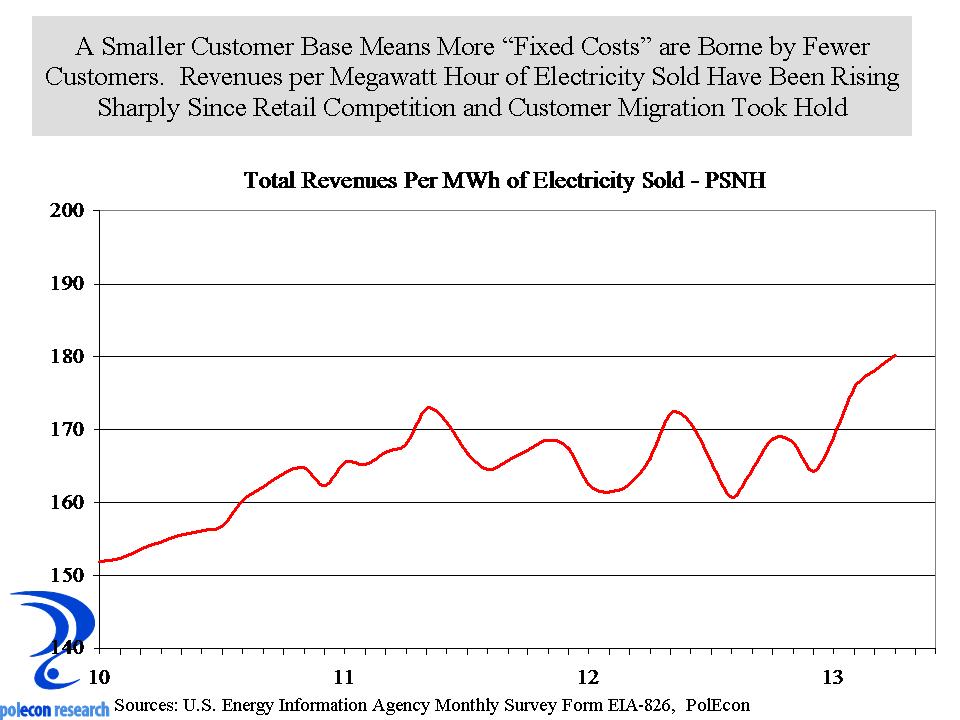
When revenues decline more slowly than do sales of electricity, the revenue derived per unit of electricity sold increases, despite a decline in both sales and revenues.

revenue per MWh

That can temporarily help cushion an electricity provider from the impacts of declining customers and sales but  is not a sustainable long-term strategy or good thing for customers and the economy.  It seems that both PSNH and the Public Utilities Commission agree on that.  What they don’t agree on is how long these trends will last, how far they will go, and most importantly, what to do about them.  Some of these issues will be topics of future blog posts.

There Goes the Punch Bowl – Quantitative Easing for Dummies (Like Me)

Posted June 21, 2013 by Brian Gottlob
Categories: Banks, Federal Reserve, Monetary Policy

Tags: , , , ,

Economic recovery following a recession is almost always characterized by rapid employment growth, not this one.  In an effort to boost demand, central banks across the globe, and especially the U.S. Federal Reserve, have pursued easy money policies in the wake of a worldwide financial and economic crisis.  Despite these efforts job creation continues at a tepid pace compared to recoveries from prior recessions.

Over the past decade the U.S. production of self-degreed constitutional scholars as well as Federal Reserve haters has grown exponentially.  I am neither.  The Fall of 2008 was a frightening time for anyone with even a cursory knowledge of the U.S. and world financial systems.  The Federal Reserve’s actions, along with other central banks, helped avoid an unimaginable calamity and while I am no Fed hater it is appropriate to consider the Fed’s policies in the three plus years since the Fed did what it needed to do to avoid a financial catastrophe.

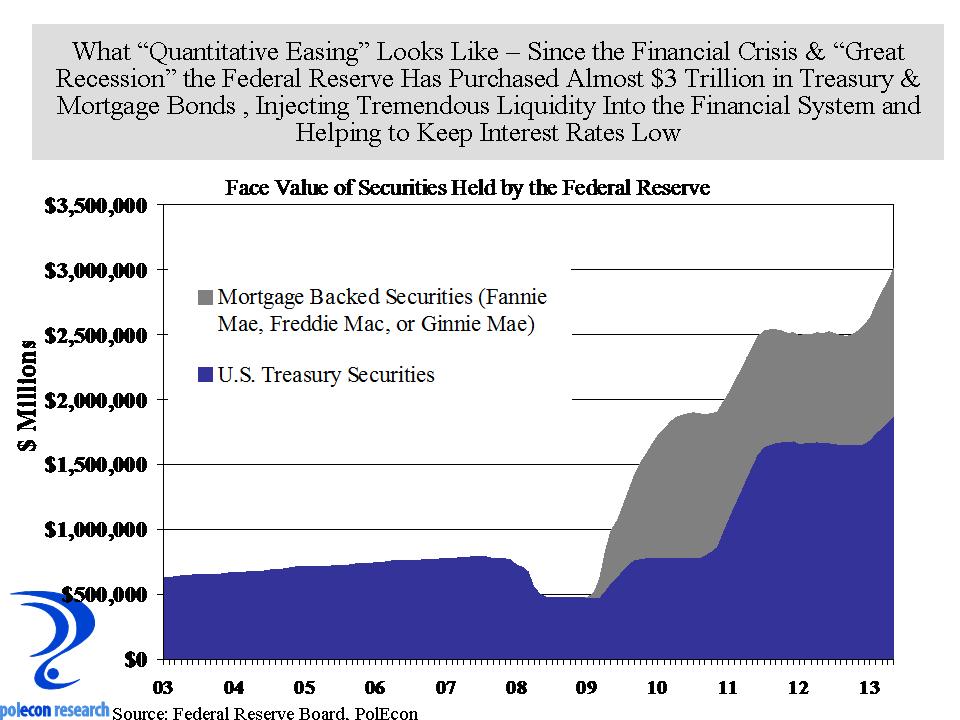
The Fed first began injecting liquidity into the financial system by purchasing the assets (loans and securities) of financial institutions (quantitative easing or QE 1) as the financial crisis and recession were taking hold.  This helped assure that there would be a supply of funds available to fuel the credit needs of the economy at a time when many banks were badly weakened and most were unwilling to lend even to each other.   As the chart below shows, the initial round of quantitative easing was followed by a continuation of purchases of mortgage backed securities (MBS) and treasury notes and bonds (QE 2 and QE 3), tripling the size of the Federal Reserve’s balance sheet.   The increase in demand for MBS and treasuries helped boost the price of these assets pushing their yield down and keeping interest rates in the economy low.

Quantitative Easing

The problem is that the Fed’s liquidity injections have not created credit or the demand for credit in the real economy, but rather they have increased leverage and risk-taking in financial markets.  They have also helped increase asset values.  Increasing the value of stocks and bonds and especially homes is a good thing but as a method of stimulating the economy, not especially efficient.

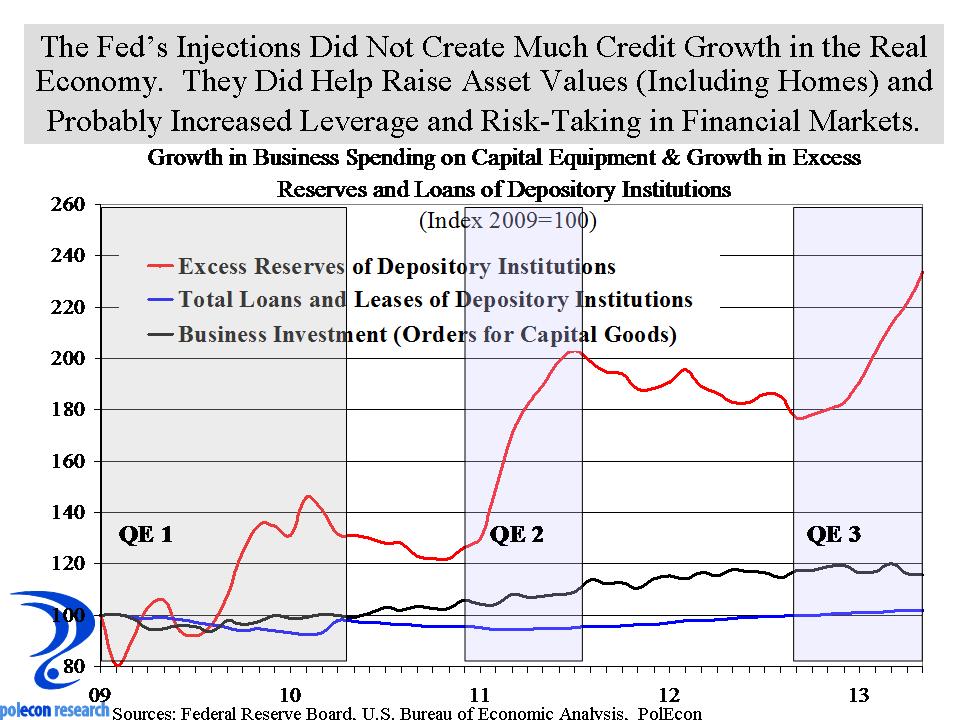
Fractional reserve banking means that every dollar available to a financial institution can result in many more dollars in loans.  Every introductory economics student learns that the rapid expansion of the money-supply inevitably fuels inflation – except in this case it has done neither, at least thus far.   Inflation has remained subdued at roughly 2% because there is still a substantial amount of slack and a lack of demand in the economy and because banks are not using their swelling reserves to expand credit and increase liquidity.  This is not at all an indictment of banks.  They are responding to the tepid demand for credit at a time when de-leveraging has been the norm.  Banks earn 0.25% on the excess reserves (the fractional reserves in excess of those required to be held based on the volume of their loans and other assets).  With interest rates at historic lows, de-leveraging occurring among businesses and consumers, and at a time when banks face increasing scrutiny and regulation, we should expect that banks would be most willing to lend to the government and large stable corporations and less likely to extend credit to riskier borrowers like small businesses, start-up companies or first-time home buyers.  The chart below shows how the excess reserves of banks have grown with each round of quantitative easing, along with growth in the loans and leases of domestic banks, and growth in capital equipment purchases by U.S. businesses.  The chart suggests that about 2% of the liquidity injected into the financial system during QE 2 and QE 3 has been circulated into the economy, while the rest sits idle.

Bank Excess Reserves and Loans

The last time, interest rates were too low for too long (2001-2004) the result was huge bubbles in credit, housing, and equity markets and we know how that movie ended.  As the Fed begins to reduce its purchase of securities, the stock and bond markets are reacting with fear, too bad, its time for a movie with a better ending for the “real economy” and that will take policies that don’t just satisfy financial markets.

Demographic Demise – The Sequel

Posted June 17, 2013 by Brian Gottlob
Categories: Demographics, New Hampshire

Tags: , , ,

Those well known demographers at Governing Magazine are likely to ignite another round of hysteria about NH’s aging population with their recent article highlighting increases in the median age of state populations.  I do not plan to go “gently into that good night” and for the past decade, as I hurtle toward my dotage,  I have “raged against the dying of the light” by highlighting why, at least in NH’s case, demographic trends are far less apocalyptic than popularly portrayed.

I can’t say it enough, I  believe that demographics explain two-thirds of everything.  Current trends will present the U.S. and NH with many challenges but we will be infinitely better able to confront these challenges with an accurate understanding of the forces that are creating them.  Too often demographic data is tortured to yield conclusions in support of some issue or cause rather than analyzed to reveal the real underlying  forces affecting the economy and society.  If we think the state’s population is aging because of zoning restrictions or because contraceptives are too widely available,  or because there aren’t enough skateboard parks or coffee shops then policies designed to manage the changes resulting from demographic forces are going to be profoundly ineffective.

I first made the arguments below  about a decade ago and despite the protestations of those who have horror stories to tell and books and documentaries to sell, nobody has shown why they are inaccurate.

Aging is a permanent, irreversible consequence of low average family size and longer life expectancies in developed societies.  Because NH has both wealthier and healthier older citizens (on average) than does the US, we expect greater longevity.  NH also has among the lowest fertility rates of any state in the nation and this, more than anything, accounts for our increasing median age relative to the US.  The chart below shows how much lower and how much faster the fertility rate among women of child bearing years has been declining in NH compared to the U.S. average, along with how much lower NH’s mortality rate is than is the U.S. rate.

Fertility and mortality trendsUnlike the brother and son of former U.S. presidents I don’t know anything about how fertile women of different races or ethnic origins are but I am probably just as prone to putting my foot in my mouth, so here goes:  “Fertility rates,”  or the number of births per 1,000 women in child bearing years does vary  by the educational attainment, labor force status, and as is evident in the state of Utah, even the religious beliefs of women and their partners.  Fertility rates largely account for NH’s rising median age, just as they do for Vermont and Maine.  Fertility almost always has a more powerful effect on the age structure of a state’s population than does either migration or mortality because all of the population changes that it generates arise at age zero and work their way through the age structure for 70+ years.  The chart below shows how much lower is NH’s fertility rate among women age 15-44 than is the rate in most other states in the nation.  The chart also largely explains why Utah has the youngest median age of any state and why NH, VT, ME and other New England states have older median age populations.

State Fertility RatesWomen in NH (as well as in most New England states) have higher educational attainment (on average) and are more likely to be in the labor force than are women overall in the U.S..  Both of these factors are associated with lower birth rates. Much of NH’s increase in college educated workers is the result increases among women and this has produced substantial economic benefits for the state and its residents.

For two decades NH has added large numbers of families with children and lost younger people who attend college or otherwise leave the state in young adulthood.   In recent years a weak economy and a housing market that made it difficult to both sell and buy a house has greatly curtailed migration into NH.  Mover’s to NH over the past several decades are more likely to be a married couple family age 30-44 with children and  likely to both be college educated and working.  That demographic doesn’t do a lot to lower the median age of a population but it can help keep the median age stationary in the middle of the age range.  However, economic conditions not only have curtailed state-to-state migration, they have also lowered fertility rates, as income and employment trends appear to have given  pause to more families considering expansion.   Across the nation state-to-state migration has been lower than at any time in a half century and fertility rates started to decline in the U.S. (after rising in a few consecutive years) as the last recession took hold. 

The long-term trend in NH is for a gradually increasing median age that should be rising at about the same rate as the much of the U.S..  The state is not even close to the top among state on the percentage of its population age 65 or older and that fact alone should eliminate some of the more simplistic explanations for why NH’s median age has been rising faster than the U.S..  Because of our low fertility and mortality rates, NH is more dependent upon in-migration to offset trends that would produce more rapid increases in median age than seen in much of the country.  Over the past several years those migration trends haven’t been favorable.  If the economy and housing markets recovery continue and NH focuses on the right policies (hint – zoning regulations aren’t it) this should be a temporary  phenomenon, but that doesn’t mean we aren’t going to get any older, it just means that we can keep the median age at a more stationary point in the middle of the age distribution.  The middle has gotten a pretty bad name in recent years, but demographically at least, its not at all a bad place to be.

Is Your State Overrated?

Posted May 24, 2013 by Brian Gottlob
Categories: college, Educational Attainment, higher education, Skills Gap, Workforce

Tags: , , ,

My penance (and your burden) for being an absent blogger over the past week or so is a longer post with extra graphics today.

A lot of people, including me, are accustomed to assessing the overall skill level of a state’s or a region’s workforce (and thus its potential to capture growing industries that rely on more highly educated workers) based largely on the percentage of the workforce with a college degree.  It is simple, intuitive,  and more than a  little lazy.  It is also becoming a  less useful indicator of the supply of labor that is in demand by businesses.   Populations with higher levels of educational attainment confer a lot of benefits on a state or region but today, having a high percentage of a state’s or region’s population with at least a BA degree probably says as much about the state’s political and cultural sensibilities (as well is its “demand” for services rather than its “need” for services but that is another post)  than it does about its economic performance and potential.

The sense of self-satisfaction we in New England and in New Hampshire enjoy about  having a population with among the highest levels of educational attainment in the country is palpable, but the reality is that more states are increasing their levels of educational attainment and New England and the Northeast stand-out far less than in the past.  Moreover, in an economy that is increasingly rewarding particular skills and degrees more  than  just high educational attainment, it is not as clear that much of the region still has an edge  on the one resource that  it has that is always in demand – talent.

Much of New England and the Northeast has a high percentage of its adult population with a four-year college degree or higher (see chart below).

% With BA or Higher

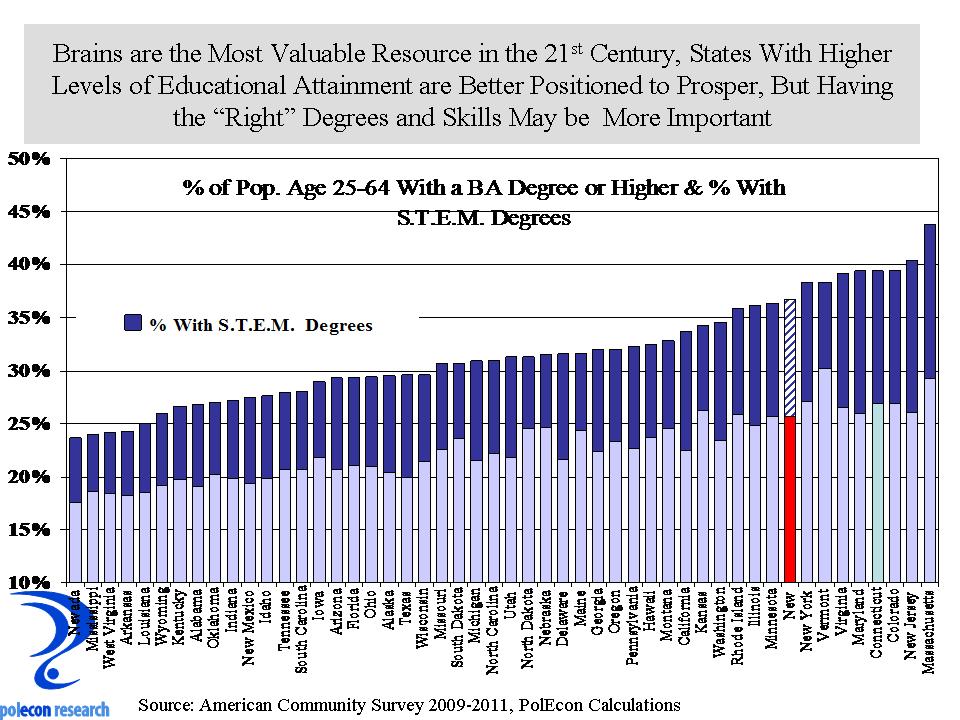
Just looking at levels of educational attainment tells only part of the story.  I can’t blog for too long without talking about the “skills-gap”  so here goes.  Much of the demand for college-trained labor is in fields that require scientific, technical, engineering,  or mathematical (STEM) skills and degrees.  The percentage of a state’s population with a BA or higher degree tells a lot about the availability of STEM skills but for a number of states it tells a lot less.  I calculated the percentage of a state’s population with a STEM degree (based on first college degree earned) and included it above as the dark blue portion of the bar graph.  The official listing of STEM fields is maintained, surprisingly, by the Dept. of Homeland Security ( I categorized 171 college degrees into STEM and non-STEM degrees and I think my listing is close but not a perfect match).  If you compare  the percentage of the population with a four-year or higher STEM degree (chart below) with the percentage of the population with a BA degree or higher (chart above) it shows a large change in the relative rankings of a number of states, and a some in New England in particular.

% with STEM degrees

The final chart makes just that comparison, it shows the change in ranking  between a state’s position on the percentage of its adult working population with at least a BA degree and the percentage of its population with a STEM degree.  The chart highlights states that may be over and underrated on the skill level (at least skills in demand) of their workforce.   Vermont stands out as having the biggest drop in rankings between the percentage of its population with at least a BA degree and its ranking on the percentage of the population with a STEM degree.  Maine also fares poorly.  But New Hampshire, Rhode Island, and Connecticut also drop in rankings when measuring “talent in-demand” among the workforce.  Only Massachusetts does not  drop in ranking  ( it is ranked number one on both measures so there is no way it could show anything but a drop in relative rankings).   On the other hand, states that are often derided by Northeastern “elites”, such as Texas, Arizona, Florida and Alabama  have a smaller percentage of college-trained labor but more of them (on a percentage basis) are trained in the STEM fields most in demand.  Still, they  don’t have as high a percentage of their adult populations with a STEM degree as do some New England and some other states, but with population and migration trends, and as more individuals with those skills and more companies that want access to them agglomerate in those states, how long before some take the lead in “talent”?   I don’t think Massachusetts has as much to worry about as do other states in  New England because of their unique higher-education assets.  The question for the rest of us is, can we continue to “beggar our neighbor” and benefit from the Bay State’s ability to churn-out and attract individuals with the degrees and skills in demand?

over and under rated states

As New Jersey, New York, and Connecticut show, having a lot of “talent” in your workforce doesn’t guarantee strong economic growth.  The business, political, environmental, and even cultural and social climates also play an important role in promoting prosperity.  I look at states with a relatively higher  percentage of their college trained workforces  in STEM fields as “up-and-comers.”   Most don’t have the history of high educational attainment in their populations that New England does, so their overall ranking on educational attainment tends to be lower.  Some, like Texas and Arizona also have had a large influx of individuals with traditionally lower levels of educational attainment.  Nevertheless, they are accumulating and growing a larger portion of the nation’s “talent” in STEM fields and over the long-haul, that is the biggest threat to New England’s most valuable and most in-demand resource, and thus the biggest threat to its prosperity.

“Honest Brokers” and Revenue Estimates

Posted May 14, 2013 by Brian Gottlob
Categories: Fiscal Policy, New Hampshire, State budget, Tax Revenue

Tags: , , ,

Unlike the federal government, states can’t easily budget and spend more money than they take in revenue so revenue estimates play a much more important role in state budgeting than they do  in federal budgeting.  I don’t know how anyone can accurately forecast revenues when the revenue yields are based on negotiations, lawsuits or other non-economic variables but that seems to be the basis  of much of the disagreement among budget writers in New Hampshire. When a comparatively large percentage (compared to many other states) of your revenues are derived from a “Medicaid enhancement tax”  and “tobacco settlement”  money budget writing can become even more politicized than usual.

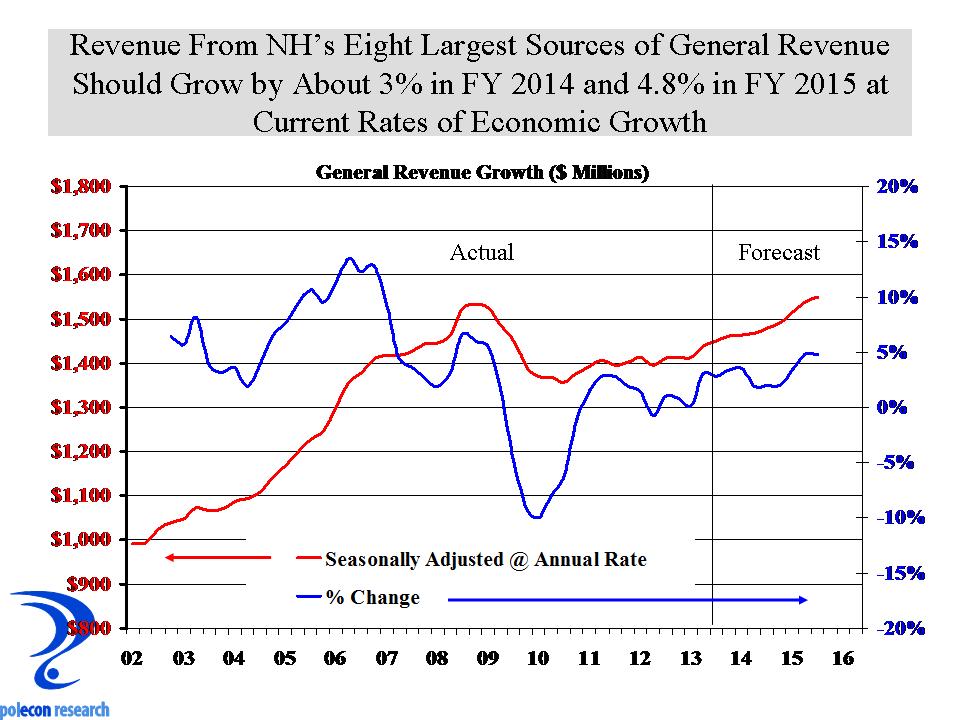
I don’t pretend to know what these non-traditional sources of revenue will yield in the coming years but I get a sense that those who do are fitting their forecasts to their meet their budgetary goals.  I  don’t think revenue forecasting is that difficult as long it is based on real economic data and trends and it minimizes the use of assumptions about changes in the performance of the economy.   I make forecasts with assumptions all the time but  minimizing their use  in revenue forecasts will mean that even if the forecast is wrong, it won’t appear as though the error resulted from a desire to “coax” a specific result from the forecast.   In January I presented my outlook to the NH House Committee on Ways Means.  At that time I said I thought revenue growth from major, “own-source” revenues would average about 2% each year of the biennium and that businesses tax revenue growth would be a bit higher, but with even modest economic improvement could average 5-6% annual growth.  Now, several months later, based on recent revenue performance, and making  no assumptions about significant changes in economic conditions, I see growth at about 3% in FY 2014 from the eight largest sources of general revenue, and just under 5% in 2015.  Those numbers don’t count the “non-traditional” revenue sources but I think they are important in reflecting the fundamental underlying growth in the state’s economy and a better assessment of  general revenue trends.

NH General revenue forecast

Clearing out some old boxes from my attic  I came across a number of old college tests and papers.  One was from a graduate school class on public finance where I argued that all federal budgeting and budgeting  debates should proceed from a common economic and revenue forecast.  I also found one from an undergraduate class on the philosophy of Marxism in which I wrote phrases like “man should never be a means to end but only an end in himself ” so clearly I was prone to a lot of bad and muddled thinking back then.  In the 1990’s I wrote a column in a publication arguing for a non-partisan revenue estimating committee in NH.  That was a pretty good idea  and it did happen – although my prompt had nothing to do with it –  and it was enacted largely absent the “non-partisan” aspect (or at least “unbiased”).  I still think a true, non-partisan, representative revenue estimating panel would be a good thing for NH, not to bind any actions but simply to serve as a baseline scenario that any policymakers who wishes to deviate from would have to offer solid reasons for doing so.  Some group in the budget debate has to serve as the “honest broker”  but the honest broker role won’t happen if the group is loved too much by some or hated too passionately by others.   The current estimating panel has some of the best and most qualified people I know to do revenue estimating .  It just doesn’t have the  credibility among many policymakers that it could have  if  no one loved or hated it too much, but instead almost everyone complained a little (or a lot) about  it.  It is too bad because we are still going to need an “honest broker” when the NH House and Senate begin negotiations on the next budget.

More Early Evidence on the Impacts of the Affordable Care Act

Posted May 9, 2013 by Brian Gottlob
Categories: employment, Health Care

Tags: , , , ,

First, let me start by noting that this is not a post about the merits of the Affordable Care Act (ACA), depending on your political leanings either pejoratively or admiringly labeled “Obamacare,” it is a post  about  policy analysis.  I love public policy analysis and I  tell almost everyone who asks me (there aren’t many) that to understand the full impacts of any  proposal it is far more important to understand the incentives inherent in a policy proposal than it is to understand the goals, objectives or intentions of the proposal. Businesses, just like individuals, will respond to changes in public policies according to their self-interests.  In the case of the ACA, businesses wishing to avoid providing health insurance coverage to some or all employees have an incentive to keep employment levels below the employment threshold at which the ACA applies to a business (50 employees) or reduce the number of full-time employees in order to fall below the threshold.

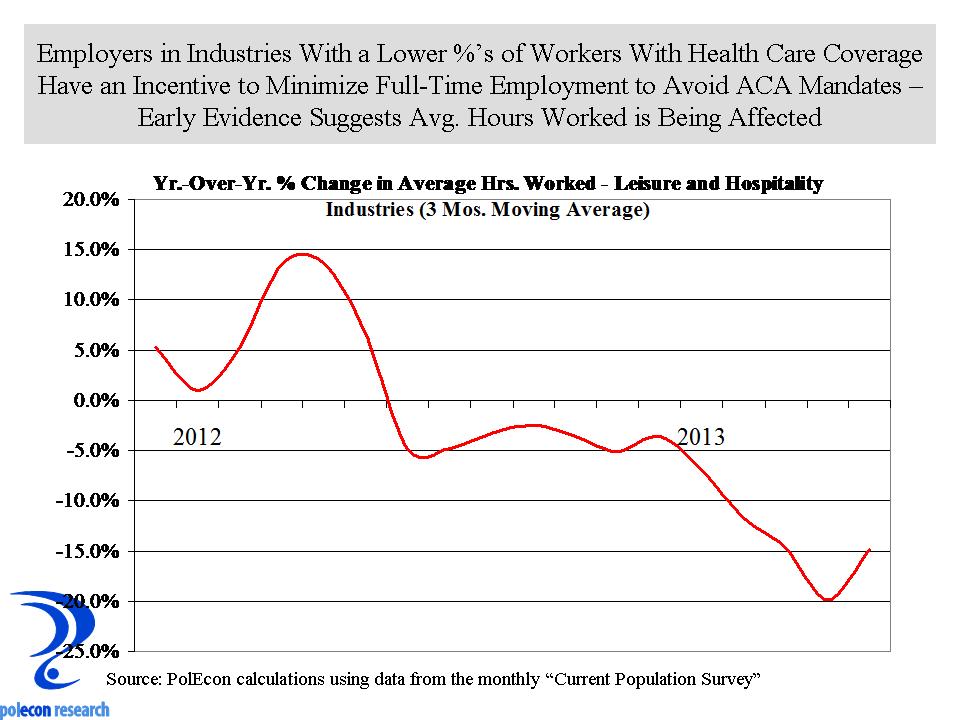
In a prior post I noted that there was some early evidence of the effects of these incentives on retail employment (an industry with a higher percentage of workers without health insurance coverage) but that I thought more evidence was needed to evaluate any impacts from the ACA.  At that time I suggested that the expiration of the payroll tax cut might be more responsible for declines in retail employment than any impacts from the ACA. I promised to follow the issue so here is some additional evidence and unfortunately it points to some negative employment impacts from the ACA.  Whether this will continue and if it is does whether the negative impacts outweigh any positive impacts from the ACA is fodder for future posts.  For now, the chart below shows how the average hours worked in the leisure and hospitality industry has been declining.  This is an industry with the highest percentage of workers without health care coverage and also with a high percentage of employers near the threshold at which the ACA mandates apply.  It is also an industry that employs large numbers of part-time workers, making it relatively easy for employers to reduce the hours worked by employees in order to have them fall below the criterion that would have them classified as full-time employees for purposes of ACA mandates.   As the  chart shows, the average weekly hours worked in the industry (compared to the same month of the prior year) has declined significantly since the end of 2012.

Avg Hours Worked in Leisure and Hospitality Industries

It is still to0 early to make claims about negative employment impacts from the ACA but the evidence is beginning to point to some troubling impacts.  As we move toward the implementation date for the ACA any employment impacts will become clearer as employers looking to avoid mandates get closer to finalizing the employment level averages that will be used to determine their inclusion or exemption from ACA mandates. Empirically it may be too early to make a definitive call on the ACA’s employment impacts, but based on what I see as the incentives inherent in the ACA, it is just a matter of time before the call gets made.

The Outlook for Natural Gas Prices in New England

Posted May 3, 2013 by Brian Gottlob
Categories: Electricity, Electricity Generation, Energy, Natural Gas

Tags: , , , ,

There is a lot of discussion, debate, advocacy and lobbying about whether New England’s energy future is becoming more vulnerable because of the region’s increasing reliance on natural gas for electricity generation.   Some see the prospect of rising natural gas prices (because of increasing demand in the region and nationally) as a vulnerability and others are concerned about constraints on the pipelines that bring natural gas into the region.  I’ve posted a lot about natural gas and electricity related issues and as I have previously stated my belief that regional increases in demand along with greater U.S. production of natural gas are more likely than not to create scenarios that will increase the capacity of the regional pipeline infrastructure. New England has traditionally been a region with a relatively low percentage of its energy consumption in the form of natural gas.  That is changing rapidly, but increases in U.S. production of natural gas along with demand driven incentives to increase infrastructure capacity in the region should reduce a lot of the volatility of natural gas prices in New England.

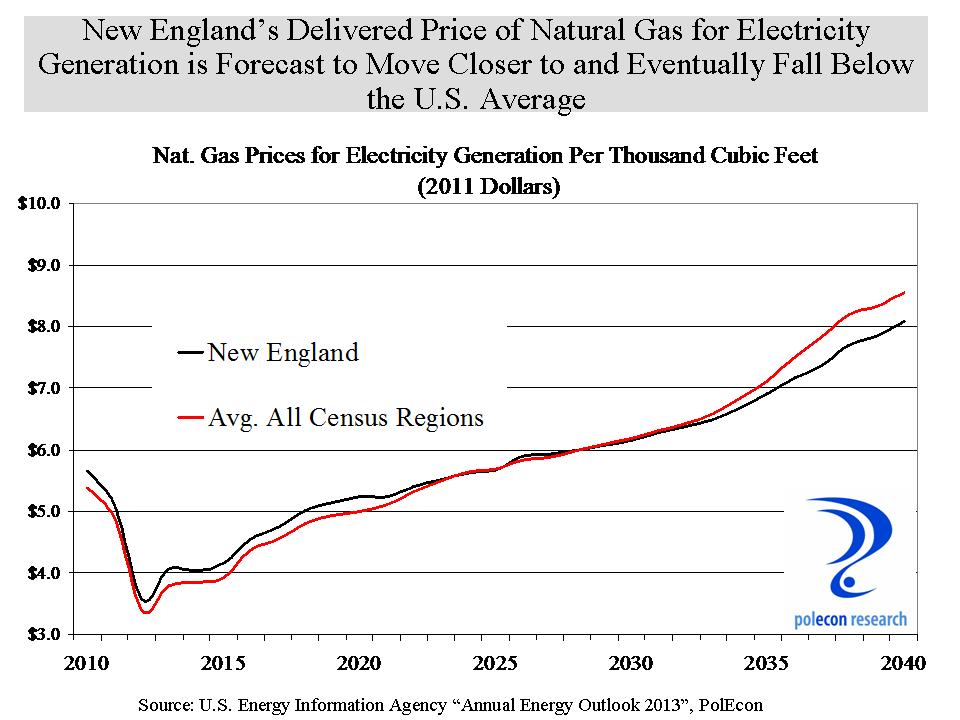
Apparently there are other folks who feel similarly.  The U.S. Energy Information Agency (EIA) released its “Annual Energy Outlook” last month and it has a wealth of historical data, forecasts and projections.   Their forecast of natural gas prices across the country are based on many economic, energy demand, production and other variables.  They also produce a range of forecasts based on different assumptions about economic growth , energy demand and prices.  The good news is that their baseline forecast for natural gas prices in New England (chart below) shows that  prices in the region, which are traditionally higher than in most other regions of the country, are expected to align with the national average early in the next decade, and then move lower than the national average over time.  Even better news is that this forecast is not dependent on a much weaker economy in New England than in the rest of the country (which would imply lower increases in energy demand in the region compared to the rest of the country).  I don’t think EIA would be forecasting lower relative prices in New England if they did not see  region’s pipeline infrastructure issue as being addressed.
NE Nat Gas Price vs US Forecast
The EIA also projects that the price of natural gas relative to coal will continue to increase.  Coal will probably almost always be a cheaper fuel than natural gas but today’s typical “combined-cycle” natural gas generating facilities are much more efficient than coal-fired plants.  When the ratio of natural gas prices to coal prices is approximately 1.5 or lower, a typical natural gas-fired combined-cycle plant has lower generating costs than a typical coal-fired plant.   Natural gas-fired electricity generators enjoyed a strong competitive advantage over coal plants in 2012 but natural gas plants will begin to lose competitive advantage over time, as natural gas prices increase relative to coal prices.    The retirement of older coal-fired generating plants, however, will mean that coal continues to generate a smaller percentage of the region’s and the nation’s electricity.

Some see New England’s increased use of natural gas as a concern.  There are issues that need to be addressed but none that are insurmountable or that should have the region reconsider its increasing reliance on natural gas.  Long-range energy price forecasts are notoriously difficult but New England’s energy needs and interests are finally becoming more aligned with the rest of the nation.  For too long New England has been an anomaly as the most oil-dependent and least natural gas-dependent region in the country.  Personally, I would rather have 300 million people concerned about my energy needs than just 15 million.