Archive for the ‘New Hampshire’ category

Getting What You Want But Not What You Need

April 10, 2013

Business taxes are about one-quarter of NH state government revenues and an even higher percentage when you take out sources such as the statewide property tax which is largely an accounting fiction that really does nothing to support state services.  That is a higher percentage than any state with the exception of some states that get oil, gas and mineral extraction revenues.

When business taxes are that important to a state’s fiscal health it better make sure that it takes care of its businesses and its business climate because if and when they go south (or south and west just as more people have) it becomes very difficult for the state to produce a budget.   The chart below shows how NH’s “own source” general and education fund revenue from the nine largest sources of revenue (exclusive of the statewide property tax) have grown comparatively since 2003.  I think the chart shows how important trends in business tax revenues are to overall revenue trends in the state.  The bad news is that revenues from the business profits and business enterprise tax are still more than 20 percent below peak.  The good news is that they are growing.

Growth in Own Source Revenue

The chart also says a few other things to me.  First, a strong and dynamic business climate is the best fiscal policy for the state.  Second, if you are going to cut business taxes you had better be certain that it is a good way produce a strong and dynamic economy because if not, the fiscal health of the state will suffer.  Third (and related), if revenues rise in response to cuts in business taxes great, it will be evidence of a stronger economy and healthier state finances, but if revenues  fall you better be sure that the service and spending reductions that result don’t affect those things that most contribute to a strong and dynamic economy because economic growth (and thus revenues) will be at risk for falling further.   All businesses want lower taxes and it that is the quickest and easiest way for policymakers to demonstrate how much they love  businesses.  But businesses also need and want a lot of other things to prosper and, like lowering taxes, they aren’t shy about asking for them.  Unfortunately, in a state so dependent on business tax revenues businesses getting what they want can sometimes make it more difficult to get what they need.

NH lawmakers, like lawmakers in most other states, want prosperity and opportunity for residents .  Most  also recognize that a strong and dynamic economy is the way to assure that.   So unless you are big financial institution, a big oil company, or just about any business or industry that is prefaced by “big,”  it’s a pretty good time to be in business because almost everyone wants to show you some love, they just can’t agree on how to demonstrate it.  Right now a lot of ideology and little evidence is being brought to bear on the question of “what policies are most helpful in producing a strong and dynamic NH economy.”   That makes it a lot harder to see that we all have a common interest in a strong economy and even more difficult to agree on what to do about it.
Striking an Economic Strategy With Maslow’s Hammer

January 22, 2013

The great psychologist Abraham Maslow is famously quoted as saying:  “When the only tool you have is a hammer you tend to see every problem as a nail.”   Maslow gave us all too much credit. When we (NH) have a hammer and know how great it is, we not only treat everything as a nail, we actually perceive everything to be a nail.  We (me included) develop a blindness to “non-nail” problems and creative problem solving takes a back seat to picking up that hammer and smashing the problem.

NH’s relatively low state and local tax burden, especially compared to other states in the Northeast, has and should continue to provide the state’s economy with significant competitive economic advantages.  In an era where “talent” – skilled, well-educated individuals are the resource businesses are most in need of, our state’s fiscal structure has been a magnet for higher-skill, more highly-educated and more mobile individuals and families.  So why does it currently not appear to be offering a competitive advantage (based on job growth and population migration data)?   The question is whether our fiscal system will be enough of an advantage in today’s economy to assure the kind of growth and prosperity the state became accustomed to over much of the past several decades.  Based on the screams of joy I heard last week, the answer for many in NH is a resounding yes.  The news that Massachusetts’ Governor Patrick is proposing to raise income tax rates in that state has been greeted by many in New Hampshire as if the cloud that is NH’s slow job growth is about to be lifted.  Once those new Massachusetts tax rates are enacted NH’s schools and students will perform better, our electricity prices will drop, our young people will choose to enroll in the  newly affordable colleges in NH,  and our communities will be safer, cleaner and offer more and better services at ever lower prices.  For too many in our state,  the future of  NH’s economy is largely determined not by what we do as a state, but by the mistakes that other states make.  I’m no Doc Rivers or Bill Belichick but I don’t think their game plan is ever solely predicated on the other team’s mistakes.   Great states, like great teams, can succeed even when the other “team”  is playing their best.

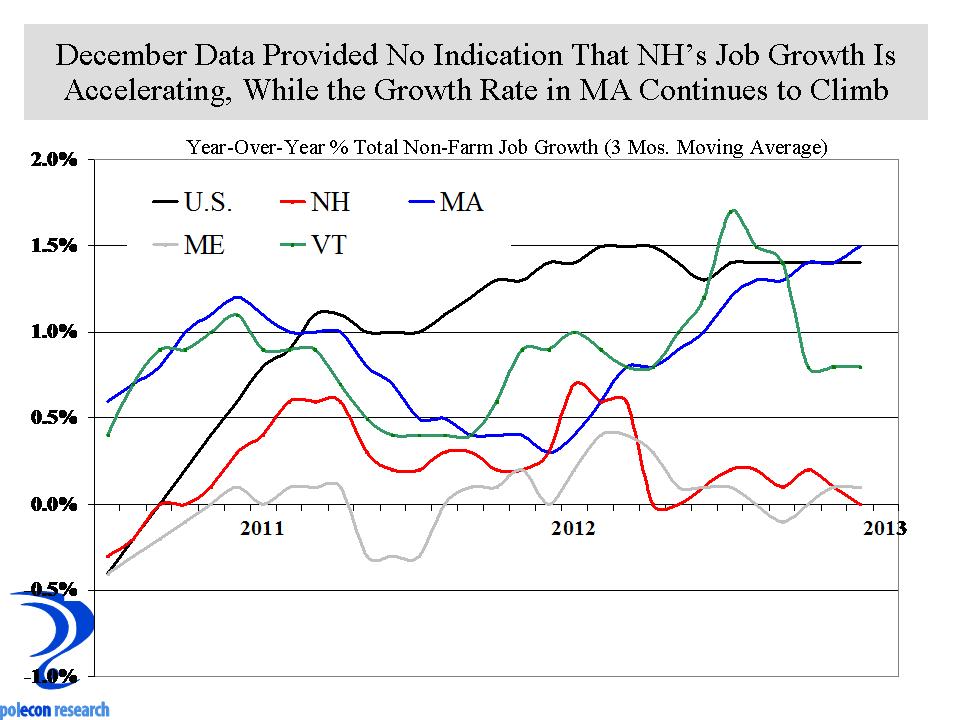
The monthly state job growth numbers for December, released late last week, continue a disappointing trend that should have NH businesses, policymakers, and citizens asking whether Maslow’s hammer is the only tool to use in shaping an economic strategy for NH’s future.

Annualized Emp. Growth

In the case of economic policy in NH, the “nail” is the high taxes which we have been pounding with our hammer for decades.  For the most part,  NH has successfully pounded that nail well below the surface.  As the chart below shows, state and local taxes as a percentage of personal income in NH are well below the U.S. and neighboring state averages.  Occasionally the nail it pops-up but is usually driven down.  Note that while it did rise for a time during the recession, this was a result of a slow and declining income growth rather than a rise in taxes.

State and Local Tax Burden

The problem is that our love of the “hammer’  as our primary economic tool appears to result in us using a longer and longer nail set in an effort to achieve the same levels of economic success as we have in the past.   Governor Patrick’s proposal to raise Massachusetts’ tax rates may benefit NH, I hope it does, but if it increases the use of our hammer, to the exclusion of other tools,  the benefits may be illusory.  A low tax burden is a great asset but the skilled, well-educated, individuals that drive economic success for the most part (it is certainly not unanimous)  also want the amenities and services that people free from want generally like to enjoy – things like good schools, civic, cultural, social, natural  and recreational amenities.  People want to pay as little as possible for these amenities for sure (and in many cases they expect them for free), but they want them nevertheless.  I think NH’s advantage is really been about providing ‘value” as much as it is about providing just a low tax burden.  As long as we can provide the services and amenities that people want, at a tax price lower than other places, we should be a magnet for the kind of individuals that will help our state thrive.

Our state’s hammer is and will continue to be a great tool, but not for every job, and not if it is used indiscriminately.  Every increase in a tax or raising of a fee isn’t an end to the “NH advantage.”  It wasn’t during the 1980’s or 1990’s when the state was growing remarkably even as taxes and fees with tinkered with (and even one or two major changes) by both Republican and Democratic administrations.  The key is knowing the true economic consequences of changes to different fiscal policies, which ones really hurt or help the economy and which ones have little impact  and by how much.

I like NH’s hammer and I have argued how it has been a great tool in helping us build a house that withstood the ill winds that blew through the Northeast region for decades.  I hope NH’s basic fiscal structure doesn’t change.  But we have become so comfortable wielding our hammer that in our casual over-reliance on it we may just be pounding on the thumbs of those who would live in the nice house with which it was built.

Ideologically Uncomfortable Economic Growth in New England

January 11, 2013

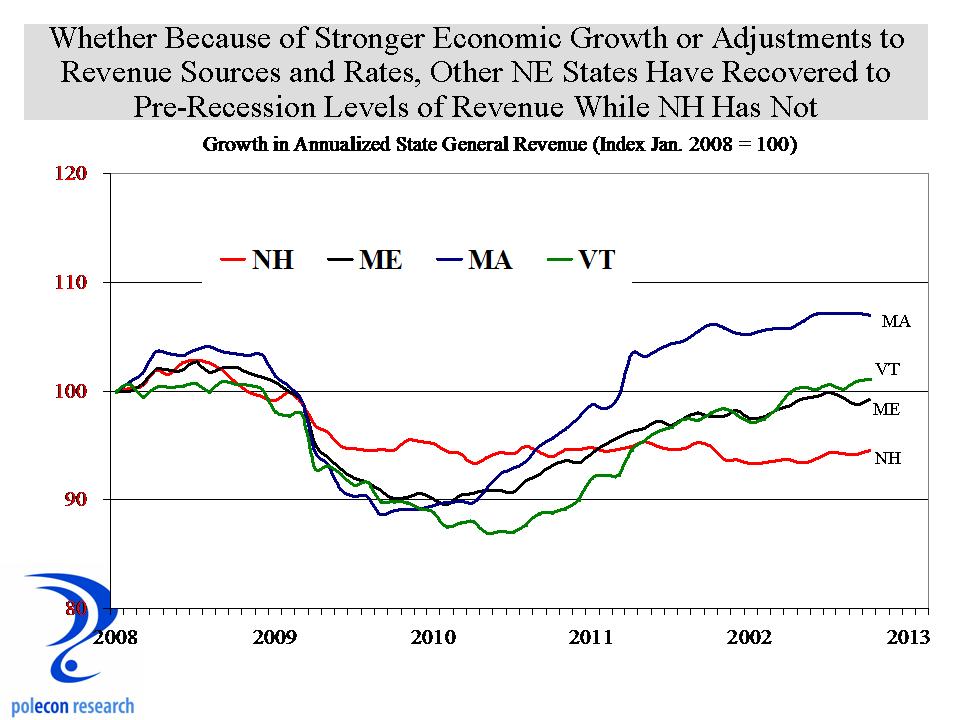
State government revenues in NH have grown more slowly over the past few years than almost every other state in New England and there aren’t any signs on the horizon that revenue will grow substantially over the next biennium.

General Revenue Growth

Some of that is the result of policy decisions that looked to reduce taxes in NH in order to increases economic growth, some is the result of other states willingness to expand or raise taxes, and some of it is the result of the fact that NH’s economy has been growing more slowly than most NE states with the exception of Rhodes Island and Maine.  How much of the slow revenue growth is attributable to a weaker economy and how much is attributable to policy changes is difficult to discern.  In some cases it is easy, the cigarette tax was reduced and produced less revenue (almost exactly the amount that I forecast) but more generally, slower growth (or declines) in revenues will occur in a weak economy regardless of policy changes.   Even without a definitive answer to that question we can still learn something from the fiscal and economic experiences of NH and neighboring states over the past few years.

Because it seems that it  is all ideology all the time in public policy debates these days, lets filter the revenue and growth debate through the ideological prism that characterizes most legislative bodies and public debate today.  For some in NH, it is bad enough that both Massachusetts and Vermont (that would be two-thirds of the Holy Trinity of New England socialism if socialists were allowed to believe in the Holy Trinity) have enjoyed stronger economic growth than NH over the past nearly two years.  But it is even tougher to accept that each of these states can enjoy faster growth than NH at the same time they are seeing stronger growth in revenues, and maybe even at a time when they took steps to keep revenues from falling too far, because to ideologues on one side, more revenue has to mean slower economic growth and the only way to get stronger growth is to cut revenues.

NE emp growth

The other end of the political spectrum will argue that the collecting more revenue has allowed these states to invest in more of what their economies need to grow, but there hasn’t been a whole lot of “investing” by state and local governments anywhere in recent years and each of these states has taken some steps to reduce the size and scope of state government expenditures in recent years.  The reality of course, as it almost always is, is somewhere in that wasteland (according to ideologues) known as “the middle”.   The stronger revenue growth of some states is largely a function of stronger economic growth and not necessarily the “investments” those revenues allowed but it can also be said that their generally higher levels of taxation have not disadvantaged their economic performance in relation to NH with its lower level of taxation.  Some of NH’s slow revenue growth is the result of policy decisions but most is related to an economy growing more slowly than neighboring states.  If there is anything to learn from recent economic and revenue trends it is that taking less in revenue  does not, in itself, guarantee stronger growth and that more revenue doesn’t always stifle (although it could) economic growth.  I know business taxes in NH remain high, but that has been true for as long as almost anyone can remember.  It didn’t keep NH from growing faster than any other state in the region for most of 30 years so I doubt it is the singular reason why we are growing more slowly now.  That doesn’t mean it isn’t an issue that should be addressed, it just means that its not likely the only answer to NH’s problem of slower economic growth.  For all of us non-ideologues, I hope lawmakers look to broaden the range of issues in the policy debates over how best to strengthen NH’s economy.

The Coming “Consumerism” of Residential Electricty Customers

January 9, 2013

It is no secret that the price of electricity in New Hampshire in relation to prices in most of  the U.S. is high.  That is true for all types of consumers of electricity, residential, commercial, and industrial, but prices for industrial customers were especially high compared to prices across the country.  New England is known for high energy prices but New Hampshire’s electricity prices compare more favorably to the region than they do to other regions and states.  Industrial consumers of electricity in NH, however,  seemed to pay relatively higher prices in comparison to industrial consumers across New England.  Over the last half of the past decade that  changed.  Either because of competition for industrial customers, special rates, or other reasons, the relative price of electricity for industrial customers in NH fell significantly in relation to average prices in New England and are now (through 2011) just below the regional average.  For residential consumers price trends are different.  Compared to the New England average, prices per kwh were relatively low for NH’s residential consumers, but they have been rising and are now (through 2011) just above the New England average.

NH Electricity Prices as a Pct of NE

The price competition that has benefited industrial consumers of electricity in NH is likely partially responsible for the rising prices and higher relative prices facing residential customers. Prices for residential consumers seemed to rise more just as  prices for industrial consumers fell.   As a result, as is being reported in a number of media outlets, competition is becoming more robust in NH for residential consumers of electricity.  That will eventually result in lower or more slowly growing average electricity prices for NH’s residential customers.   Competition does lower prices but it will only do so  for those who actively  participate in the competitive market.  Just like a car dealer,  electric utilities will look for someone to pay the full “sticker price” for every consumer who gets a “deal”.

The Sun Will Come Out Tommorow

January 3, 2013

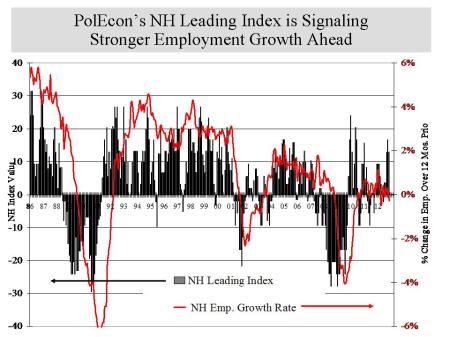
I have been uncharacteristically and uncomfortably gloomy in my assessment of the NH economy lately, but I still hold out hope that New Hampshire’s job growth numbers for 2012 will be revised upward early in 2013 based on the volume of help-wanted advertising in the state and reported growth in aggregate wage and salary income in the state.  Even if that doesn’t happen there are encouraging signs that job growth will accelerate.   PolEcon’s NH Leading Index increased this month to a value of 13.0, down slightly from 16.7 the prior month, but it has registered its highest three-month reading since early in 2010.    At least some uncertainty around the  “fiscal cliff” that caused many firms to postpone hiring has been removed.   The U.S. Treasury debt ceiling still needs to be raised this month and a repeat of the last debt ceiling antics could produce another big drop in business and financial market confidence, but overall, the national and NH economies appear poised to see accelerating job growth as 2013 progresses.

Polecon NH  Leading Index

PolEcon’s NH Index of Leading Indicators is a diffusion index consisting of nine state and national indicators of economic activity designed to predict changes in the rate of employment growth in NH.  When index scores are above zero, more of the leading indicators are moving in a positive direction and the NH economy is expanding. The Index has a strong statistical relationship with changes in NH employment, Index scores lead changes in the rate of NH employment growth by 3-6 months.  Using statistical techniques, Index scores can also be converted into a probability that NH will be in  a recession sometime within the subsequent six months.

Leadin Index Components