Archive for the ‘Energy’ category

Tilting at Windmills?

February 11, 2013

“Do you see over yonder, friend Sancho, thirty or forty hulking giants? I intend to do battle with them and slay them. With their spoils we shall begin to be rich for this is a righteous war and the removal of so foul a brood from off the face of the earth is a service God will bless.”     

Don Quixote

I hope I am not, but I probably am, the only person that sees the irony in the fact that the latest wind farm battle in New Hampshire involves a Spanish developer of wind farms (Iberdrola Renewables).   The proposed wind farm near Newfound Lake has many of the residents in that area concerned about the visual and noise impacts of the project.  Electricity generation from wind has grown significantly throughout the country over the past several years and along with this growth has come a concomitant increase in opposition to the projects.

Wind generators accounted for a significant portion of capacity additions since 2007 (see chart below), and were the largest source for generating capacity additions in 2008 and 2009. If all planned wind generators in 2012 come on-line, as reported by industry participants, wind capacity additions could top 12,000 MW for this year. This would account for 45% of total additions and exceed capacity additions from any other fuel source, including natural gas, which was the leading fuel source for electric generating capacity additions in 2010 and 2011.

additionsbytype

The wind energy production tax credit (PTC), along with state-level policies, has boosted the growth of the U.S. wind industry over the past decade and the anticipated expiration of the PTC at the end of 2012 created a rush to complete projects in 2012.  This tax credit was first implemented in 1992, when the United States had less than 1.5 gigawatts (GW) of installed wind capacity. By the end of 2011, wind capacity stood at more than 45 GW, about 4% of U.S. power generating capacity, and provided 3% of total U.S. electricity generation in 2011.

The most recent state level data available on electricity generated from wind (2010) show that less than 1% of NH’s electricity was produced by wind but with recent projects in the state that figure is outdated.
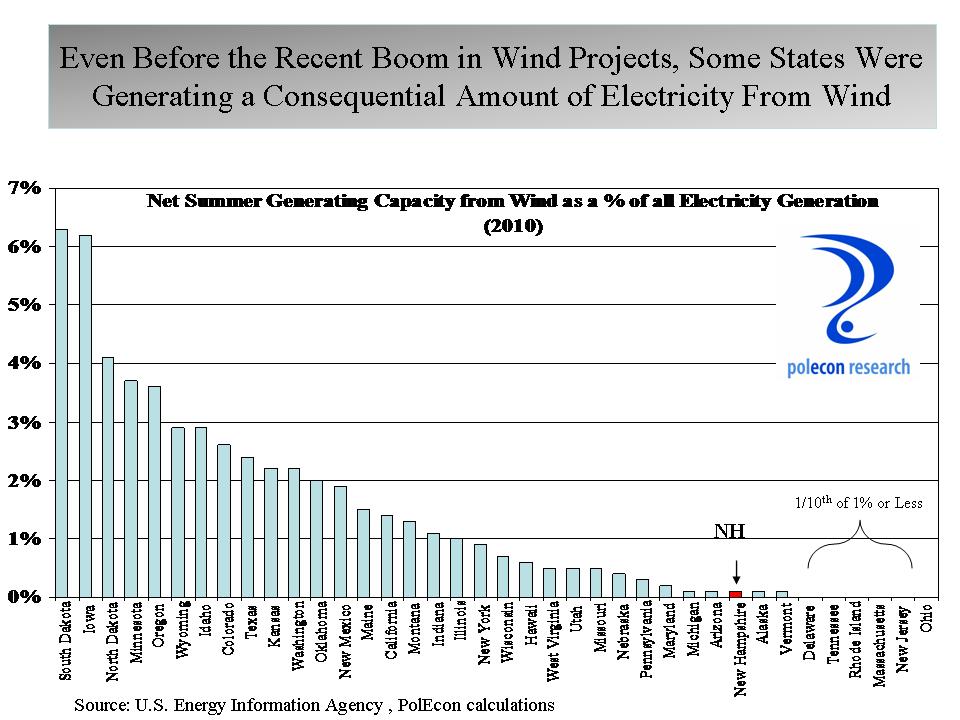
Wind Generation by state

I don’t know what the future of wind power is in New Hampshire.  I have no professional or business stake in the issue. Like everywhere, aesthetic issues and local opposition will play a prominent role in determining its growth but there are other issues that must be considered if policymakers are to make reasoned decisions about its efficacy in meeting the state’s power needs.  The two most often cited concerns about wind as a source of electricity (besides aesthetic and local opposition) seem to be that turbines are so inefficient that they actually increase carbon dioxide emissions, and that they are so unreliable that they require constant backup from conventional coal and gas-fired generators.  Concerns about increased carbon from wind seem misplaced to me.   As electricity demand increases, say on a weekday morning when people are waking up and getting ready to go to work,  power plants increase output to meet it. Plants with the lowest marginal cost – that is, those that can produce additional electricity most cheaply – are selected first by the market. Here wind beats gas and coal, as no fuel is needed to generate electricity.  So in theory at least,  adding wind power to the energy mix should displace coal and gas, and hence cut carbon.  On the important matter of reliability, the obvious worry is that because the wind does not always blow, the system will sometimes not be able to supply electricity when needed.  This seems like common sense.   But the reliability of wind power does not depend on the variability of wind, it depends on how well changes in wind power output can be anticipated. Forecasts of wind farm output are increasingly accurate, and drops in output can be predicted and compensated for using conventional power stations.

I have driven by wind turbines in several states and am in awe of their size visual impacts.  I don’t know how I would feel about living near them,  but I also can’t ignore that the world (especially in the UK) is increasingly using wind power as a way to limit fossil fuel consumption and carbon emissions.
Raising Issues With Raising the Gas Tax

January 28, 2013

“With the Patriots headed to the Super Bowl, now is not the time to increase the beer tax.”   Either the Governor strongly identifies with us commoners or there was going to be one heck of a Super Bowl party at the Hassan household.   I hope our Governor’s positions on important fiscal issues are more considered than her sports predictions and  I wonder  how she feels about raising the gas tax in New Hampshire now that many Patriots fans are more likely than they were a couple of weeks ago to go driving to ski, shop, or hike next Sunday.

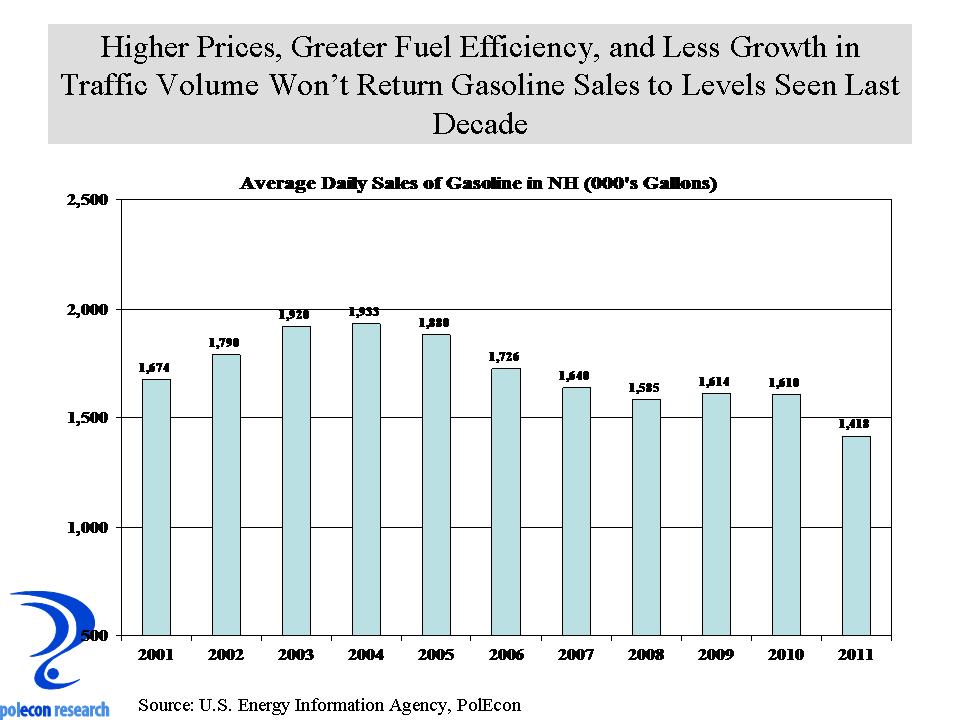
No doubt revenues from NH’s gasoline tax and its road tolls are stagnant or declining.  Higher gasoline prices have reduced discretionary driving and prompted greater fuel efficiency in our choice of automobiles and a steep recession further dampened gasoline consumption.

NH gasoline sales

No doubt there are a lot of transportation infrastructure needs that are clamoring for state revenues that are not likely  to increase organically.  Gasoline sales (and the revenues derived from them) will not rebound to levels seen early in the past decade.  Beside greater fuel efficiency, the volume of traffic at key border locations (I93, I95, Everett Tpk.) has declined by 7.4% between 2004 and 2011.  Traffic volume at toll booths on these roads, however, declined by just 3.9% during the same time period (chart below).

Border traffic

Of course the implications for gas tax and road toll revenues are significant, but those trends follow trends across the nation.  When I look at the data, the smaller decline in toll booth traffic than in overall border traffic suggests to me  that commuting is being less affected than is more discretionary travel.  That has even more profound implications for longer-term trends in NH’s general revenues because they depend so heavily on discretionary travel and discretionary spending.   One measure of how important discretionary travel is to NH is the fact that the state ranks fourth in spending per capita on gasoline.

Gasoline Exp per capita

Like beer or cigarettes, its not that we drink or smoke that much more than residents of other states, its that our numbers are increased by the high volume of visits the state receives.    I appreciate that the implications of the gas tax in terms of infrastructure investments is an important discussion to have.  I also think a discussion of the implications of a higher gas tax on the larger revenue issues facing the state ought to be evaluated.  That evaluation needs to be more thoughtful than the typical arguments made by opponents of any excise tax increase (“if we raise the gas tax we will lose not only gasoline sales but a billion dollars in potato chip and chewing gum sales”).  I don’t know whether the gas tax should be raised and I don’t know what the impact of an increase would be in a larger economic and revenue context but  I do know that higher gasoline prices affect a number of revenues because I have analyzed that in the past.  That isn’t reason enough to drop the idea of raising the gas tax, but it is reason enough to discuss it in a broader context than just the funding of infrastructure.  Maybe I’ll get that chance when my invitation to the big Super Bowl party in Exeter arrives, I’m eagerly off to the mailbox now to look for it.

The Stone Age Didn’t End Because of a Shortage of Stones

January 24, 2013

The operator of the New England power grid (ISO New England) issued a media release yesterday noting that because of the decline in natural gas prices, overall, wholesale electricity prices in the region dropped in 2012.  Reader”s” (if there is more than one) of this blog know I write a lot about energy issues and have noted the trends and benefits of natural gas to energy prices in the region (here, here, here, and here as well as in posts about other energy issues).

Increased U.S. production of natural gas has resulted in price declines and price declines are resulting in more fuel switching that will put more pressure on the price of natural gas unless production increases faster than increased demand.  U.S. production of  natural gas is likely to continue to increase faster than other fossil fuels (see chart below), but increased fuel switching will put more pressure on natural gas prices.

US fossil fuel production

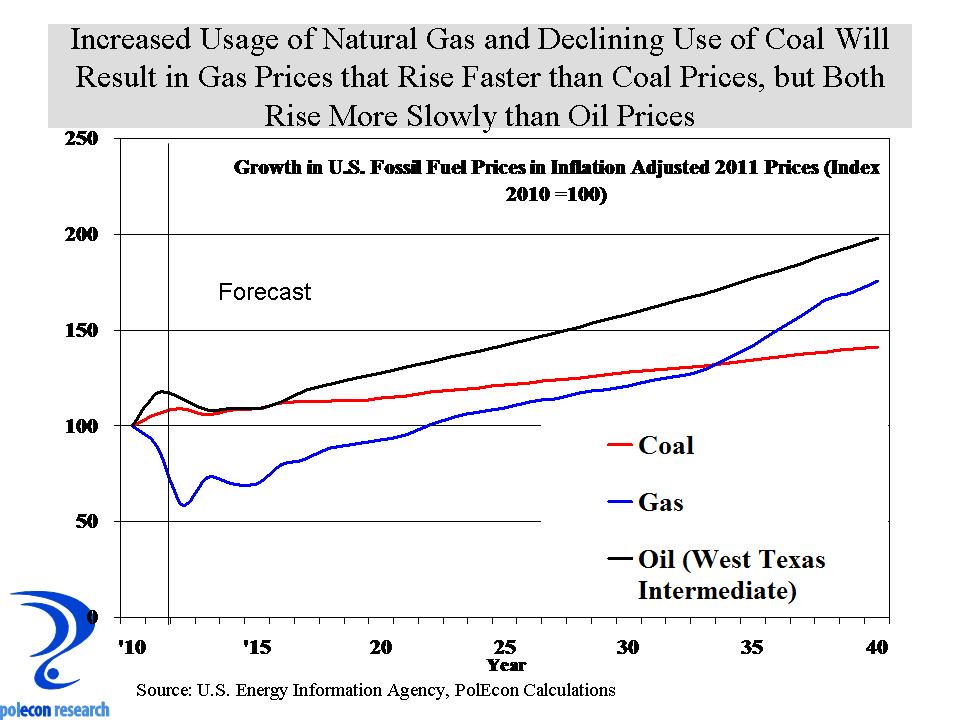
One problem for New England is that our infrastructure for delivering natural gas to the region is the weakest of any region of the country and one result is that unless or until that changes, we won’t benefit as much as other regions from increased production.  The chart below shows a forecast of real, inflation adjusted fossil fuel prices to 2040.  Nationally, natural gas prices will rise faster than coal, but more slowly than oil.  The natural gas price trends here are for prices at Louisiana’s  Henry Hub distribution point (the reference price for natural gas prices), New England prices are higher but the question is, how much faster or slower will they grow in New England?  Improved infrastructure would help.

US fossil fuel prices

Coal is abundant and prices will grow relatively more slowly, but the economics of coal as an energy source still don’t give it an advantage over gas.  Over the next 3-5 years over 200 coal-fired electric generating plants will be retired according to a coal trade group.  They blame environmental regulations but there is more to it than that.  Besides the greatly narrowed gap in fuel costs between natural gas and coal, the fact is most people don’t want coal used, or have it used near them.  The cost of burning coal more cleanly is relatively high (it’s not just regulators that impose those costs, it’s the only way a majority of the public will support coal and if it costs too much they wont support it as long as there are more competitively priced alternatives – as there are now). Finally the cost of constructing a coal plant, compared to combined-cycle natural gas power plants is much higher (even without the new equipment required to reduce emissions) and they take longer to build 4-5 years compared to 2-3 years for natural gas, making financing of such projects more difficult.

I am not a coal hater.  Although I have worked on many more combined-cycle natural gas electric generating plants, I have also worked on two or three electric generating projects that burn coal, most recently one involving super-critical clean coal technologies and carbon capturing,  but phasing out older, less efficient, coal-fired plants makes perfect sense and can be done over time without jeopardizing the reliability of the grid if new natural-gas fired plants are built.  Relying just on natural gas doesn’t solve our  CO2 problem but it helps (ok deniers, let loose – I am a believer that CO2 is a problem that needs to be addressed).

The point of this post (by now you are probably asking if there is one) is that fossil fuels are not going away anytime soon.  Not too long ago there were apocalyptic predictions about the availability of fossil fuels in the future.  Those predictions aren’t proving accurate but at some point fossil fuels will run out.  Not in my lifetime, which is a good thing for my business as long as I still can get hired to work on natural gas or (gasp) coal-fired electric generating projects.   But more abundant fossil fuel doesn’t (or shouldn’t) lessen environmental concerns over its usage.  The stone age didn’t end because of a shortage of stones and the fossil fuel age shouldn’t wait to end until we run out of it.  Somebody will have to pay for developing new technology that ends the fossil fuel age.  Unless we start now,  the cost of the U.S. debt that we pass down to future generations will look small compared to the costs of developing new energy technologies that we will be passing down in the face of genuine declines in fossil fuels.  It is not just a matter of  increasing renewable energy,  although that will help.  Solar and wind and even hydro generation suffer from over/under demand issues.  Balancing power output to need is extremely problematic once you try to get renewable power above 20% of total generation, new technologies need to be developed.

The stone age was replaced because newer and better technologies were developed despite an abundance of stones, lets hope the same is true for the fossil fuel age.

We Need Better Incentives for Households to Reduce Electricty Consumption

January 14, 2013

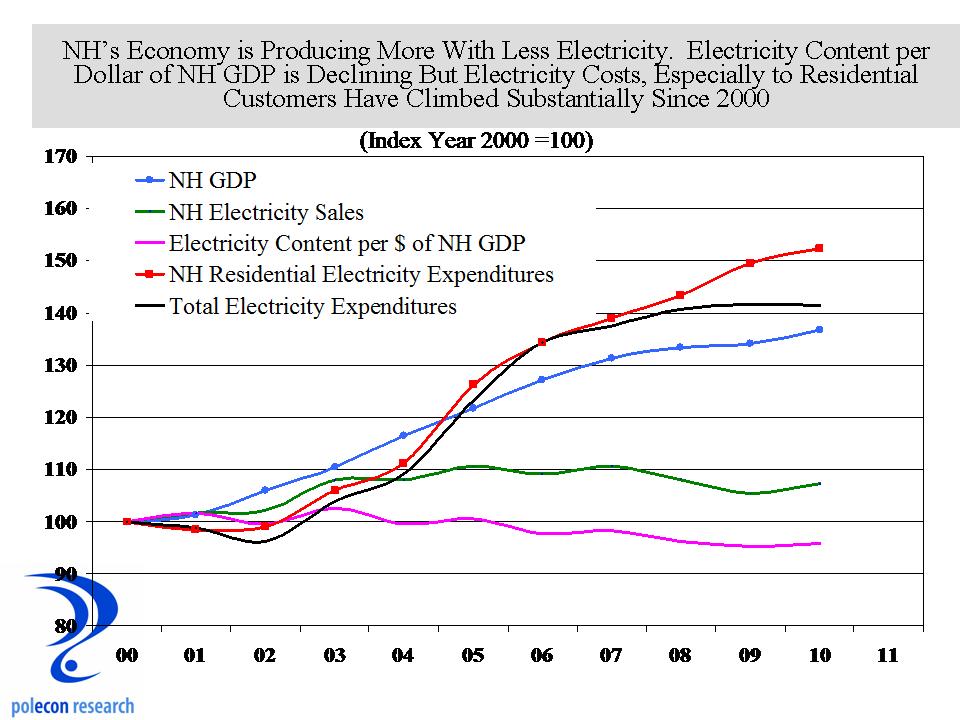
Just like the NH and US economies are producing more goods and services with less and less energy content (as measured in BTUs per dollar of gross domestic product), so too is the NH economy producing more goods and services with the same or less electricity content.  As the chart below shows,  over the previous decade the total electricity consumed in NH (in kwhs) increased by just over 7%  while real gross state product increased over 36%.  The result is that electricity content (in terms of khws) per dollar of real NH GDP declined during the decade.

Electricity Consumption and Expenditures in NHl

Conservation and a changing industry mix have gone a long way toward restraining electricity consumption but a steep recession also contributed.  High electricity prices play a role in creating incentives for conservation but as the chart also shows, despite only a 7% increase in electricity consumption during the decade, total expenditures on electricity in NH increased by over 40% while expenditures by residential customers increased by over 50% during the decade.  Unfortunately, in a regulated market that guarantees a rate of return for some producers of electricity and which depends on variable  fuel costs, consumption of electricity and expenditures on electricity do not (for long) show the negative relationship that they do in many markets.  I think this tends to discourages household conservation efforts because they see less evidence of the payback from their efforts, even less so than say in oil and gasoline markets.  With gasoline or heating oil markets an individual or household can take steps to reduce consumption that yield tangible results in terms of reducing energy expenditures.  Reducing oil or gasoline consumption won’t always reduce absolute expenditures, as in the case of very dramatic price spikes seen in the recent past, but consumers at least see (and feel) a direct impact on their cash outlays as a result of their conservation or consumption behaviors.  But how do financial incentives for conservation affect  consumers of electricity when guaranteed rates of return allow for electricity prices that offset the impact on expenditures of their conservation efforts?   I think they produce what appears to be happening now in NH, the conservation efforts transform into just a  quest for lower prices.   Electricity consumers seek lower-cost providers of electricity who may not offer ceilings on future prices but who also don’t set a floor on prices because of guaranteed returns or because a shrinking base of customers requires guaranteed returns be paid for by fewer customers.  I am all for lower electricity prices but I get to call myself an environmentalist when I support incentives for conservation.  Such incentives will work best when they don’t yield only intermittent or temporary benefits

I don’t know whether the proposed Northern Pass Transmission Project (NPT) will actually result in lower prices for wholesale electricity or not.  I’ve seen conflicting studies from proponents and opponents (by way of disclosure I conducted a study of the NPT employment impacts for competitors of the companies planning NPT but I did not examine impacts on electricity prices nor do I have any contracts or agreements with anyone opposing or competing with NPT).  I do know that NH spent an estimated $1.616 billion on electricity in 2010 (the last year for which data is available from the U.S. Energy Information Agency).

NH Electricity Expenditures

That means if proponents of NPT are correct, and wholesale electricity prices in NH are reduced by about $25 million, and that wholesale price results in a similar reduction in retail electricity prices (?), then electricity expenditures in NH would be about 1.5% lower then they otherwise would be.  Whether illusory or not, given the consumption and expenditure trends lines above, it is hard to see that this impact on wholesale electricity prices will have much of an impact on the high cost of electricity in NH.

The Coming “Consumerism” of Residential Electricty Customers

January 9, 2013

It is no secret that the price of electricity in New Hampshire in relation to prices in most of  the U.S. is high.  That is true for all types of consumers of electricity, residential, commercial, and industrial, but prices for industrial customers were especially high compared to prices across the country.  New England is known for high energy prices but New Hampshire’s electricity prices compare more favorably to the region than they do to other regions and states.  Industrial consumers of electricity in NH, however,  seemed to pay relatively higher prices in comparison to industrial consumers across New England.  Over the last half of the past decade that  changed.  Either because of competition for industrial customers, special rates, or other reasons, the relative price of electricity for industrial customers in NH fell significantly in relation to average prices in New England and are now (through 2011) just below the regional average.  For residential consumers price trends are different.  Compared to the New England average, prices per kwh were relatively low for NH’s residential consumers, but they have been rising and are now (through 2011) just above the New England average.

NH Electricity Prices as a Pct of NE

The price competition that has benefited industrial consumers of electricity in NH is likely partially responsible for the rising prices and higher relative prices facing residential customers. Prices for residential consumers seemed to rise more just as  prices for industrial consumers fell.   As a result, as is being reported in a number of media outlets, competition is becoming more robust in NH for residential consumers of electricity.  That will eventually result in lower or more slowly growing average electricity prices for NH’s residential customers.   Competition does lower prices but it will only do so  for those who actively  participate in the competitive market.  Just like a car dealer,  electric utilities will look for someone to pay the full “sticker price” for every consumer who gets a “deal”.

Natural Gas Price Outlook Improves Again This Year

December 7, 2012

The U.S. Energy Information Agency issued an early release version of its 2013 Annual Energy Outlook and the increase in U.S. energy production and the production outlook over recent years continue to keep forecasts of price increases modest.  That is especially true for natural gas where long-term price forecasts have fallen by 15% to 30% in just the past three years (chart below).

Nat Gas Forecast

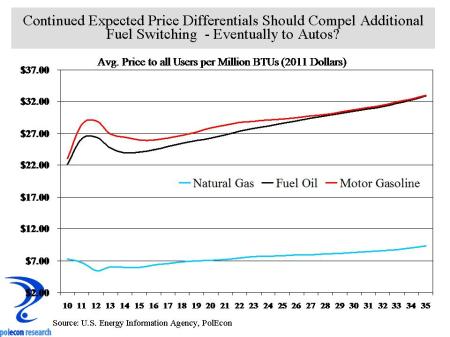
Of course all sorts of national and international events can interrupt these trends, but the  price forecast along with the expectation of a continued, long-term, price differential between oil and natural gas should  result in continued  fuel switching by electricity generators, and an increase in switching by end users as well.  Natural gas is already the majority source for home heating everywhere in the country except the Northeast, but opportunities for fuel switching in the  transportation sector are enormous.  Unfortunately, with a gasoline station located about every quarter mile, and large industries supporting them, the prospect of consumers being able to fuel their autos at home using the existing natural gas infrastructure and a relatively small investment in equipment for their home doesn’t have the same appeal to everyone as the economic, environmental and consumer  rationale of switching  implies.

Fuell Price Forecast

Natural Gas Production is a Game Changer

November 19, 2012

The rise in natural gas production in the U.S., along with the volume of proved reserves available in the future because of new technologies, could fundamentally change the energy landscape in the U.S. in a way that the significant and beneficial rise in U.S. oil production can not.  Both trends are good news for the country and  further efforts toward U.S. energy independence, but the lower prices and increased stability in supply of natural gas also have the potential to alter the energy fuel mix  in this country.  The use of natural gas has yet to make significant inroads in the transportation sector but it is hard to imagine how a fuel supply that (unlike gasoline) is, or could be, available directly at a majority of U.S. households at reasonable prices,  will not eventually fuel a much higher percentage of vehicles in this country.  In the electric power industry, the transition to natural gas is already occurring, in part because of the lower and more stable price environment for natural gas, but also because of the environmental advantages of natural gas.

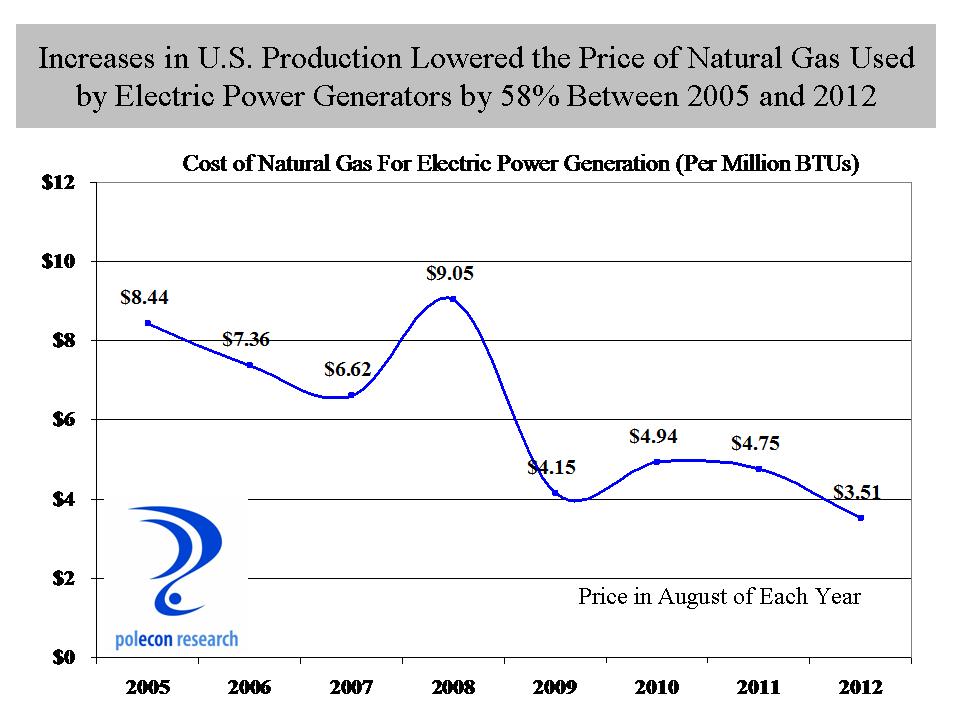
The chart above shows that the price of natural gas used by the electric power industry for generation has fallen by almost 60 percent since 2005.  Although that trend will not continue, production and proved reserves in the U.S. have created a much more predictable and stable price environment for natural gas as evidenced by forecasts by the U.S. Energy Information Agency and by commodity futures markets.  The electric power industry is already changing to reflect the new realities of natural gas markets.  As the chart below shows, in just the past decade electricity generated using natural gas has gone from 15 percent of the electricity generated by coal fired power plants to 31 percent.

That trend is continuing.  Just one company (First Energy), recently announced the closing of six coal fired power plants in Ohio, Michigan, Pennsylvania, and Maryland, noting that the costs of environmental compliance upgrades made the plants not economically viable to continue to operate.

Renewable Energy in the Era of Rising U.S. Oil and Gas Production

November 7, 2012

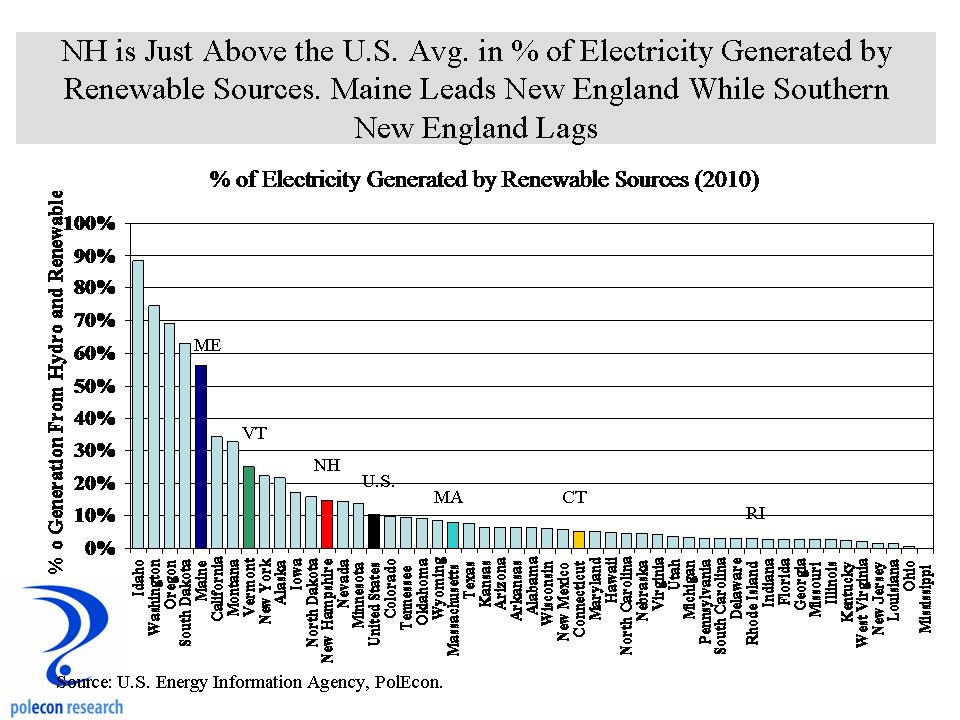
Dramatic increases in natural gas and oil production in the U.S. have increased the nation’s prospects for energy independence.  Increases in oil and gas production are good news for the U.S. economy and consumers, but one unfortunate result could be reduced efforts to increase the nation’s production of energy from renewable sources.   High oil and gas prices, as painful and harmful economically as they are,  spur development of renewable sources of energy.  I couldn’t be more enthusiastic about the positive implications of increased domestic oil and gas production but my enthusiasm is tempered by the prospect of a stalling emphasis on developing  renewable energy sources.   Northern New England states are above the U.S. average for electricity generated by renewables, with Maine being a national leader at 56% of it electricity generation.  Vermont is at 25% and NH 14% (each of these states generates a large percentage of electricity from nuclear fuel while Maine does not).

Southern New England states lag in electricity generated from renewable sources of energy, and as the chart below shows, have a long way to go in meeting their goals for the percent of electricity generated by renewable resources – even when the goals are modest.

Energy Consumption and Conservation in NH

October 31, 2012

The energy intensity of the NH economy (as measured by BTUs per dollar of real gross state product) continues to decline as it does in other states and the nation as a whole (chart below) .  NH is among the bottom ten states in energy intensity as more of the value of what we produce is in the form of services and in goods that have more human and less energy content.  In New England, only Maine is above the U.S. average in energy use per dollar of gross state product.

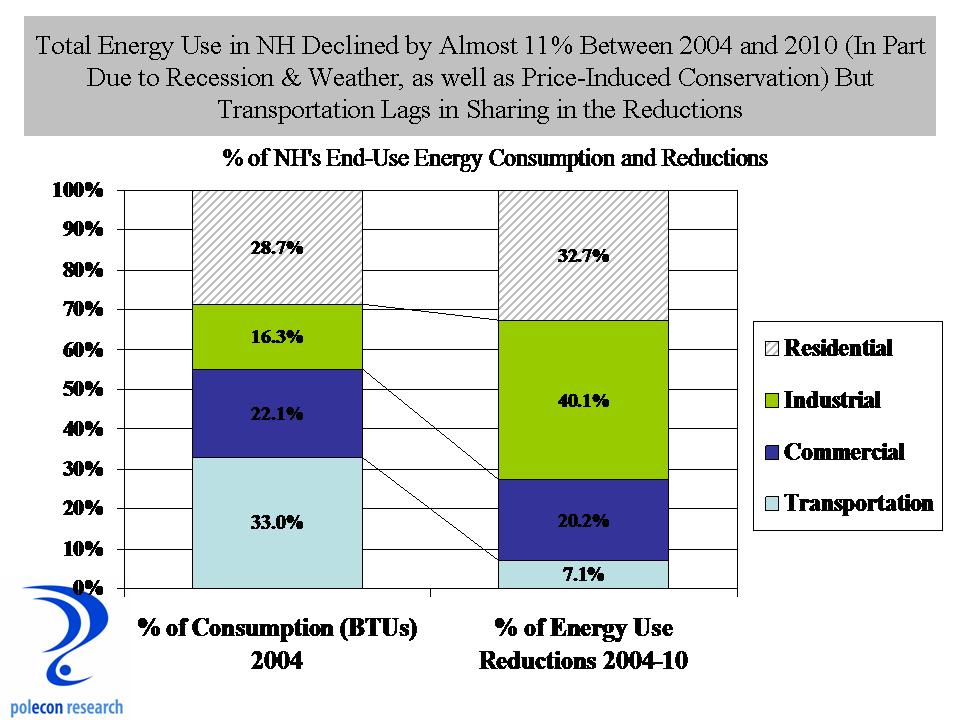
The second-half of the past decade saw especially large increases in energy prices in the U.S..  The nation als0 experienced a severe recession that reduced the demand for energy.  Between 2004 and 2010, end-use energy consumption in NH (end-use consumption excludes energy used for electricity generation) declined by about 11%.   Some of the recent declines in energy use in New Hampshire and the nation is the result of a severe recession as well as the impact of petroleum price increases.  Some is also the result of energy conservation efforts, but whatever the prompt, economic, environmental, weather or other, some end-users have cut back much more than others.  The chart below shows the percentage of total end use energy by type of end use in NH in 2004, along with the percentage of the reductions that each type of end use was responsible for between 2004 and 2010.  Industrial use accounted for a disproportionate share of the reductions, in large part because of the recession and changes in the industrial mix in the state.  But conservation no doubt also played a role.  At the other end of the spectrum is the transportation sector which although accounting for one-third of consumption, accounted for only 7% of reductions in energy consumption in NH between 2004 and 2010.   It is hard to imagine continued declines in energy use unless the transportation sector contributes more to the reductions.

The Disconnect Between the Cost of Generating Electricity and Retail Prices

October 24, 2012

It is hard for consumers of electricity to understand why retail prices are what they are and how they are determined.  It is beyond one blog entry to fully describe the process but in overview, the suppliers  of electricity (generating companies) in a region offer to supply electricity to the market at a given price and the offers are accepted beginning with the lowest cost providers first, until enough energy is supplied to meet expected demand in the region.  The price of electricity offered by the last electricity generator needed to meet the regional demand determines the market price paid by companies that supply the electricity to businesses and consumers.  Retail prices are a function of the market price of electricity, plus many other costs such as transmission, special infrastructure charges, and profits by suppliers, among others.  Much of these costs are determined at the state level by regulators, as well as the characteristics of the retail electricity market in the state (competition) and the practices and policies of the companies that supply electricity to retail markets.

The end result is that retail prices for electricity in any state bear only a limited relationship to the cost of generating electricity in the state.  The chart bellow shows that the cost to generate 1 million BTUs of electricity in New Hampshire is about in the middle of all 50 states.  Vermont is also relatively low.  Both states have a relatively lower generating cost per million BTUs because a significant portion of the electricity produced in their state is from nuclear generators.

The correlation between the fuel costs to generate electricity in a state and retail prices per 1 million BTUs is modest, explaining less than one-third of the price per million BTU at the retail level.  The chart below show that despite fuel costs that are in the middle of the pack,  NH, VT and CT have high retail prices per million BTU of electricity.   The regional nature of electricity markets along with the policies of state governments and the actions of individual retail sellers of electricity all play a role in disconnect between costs for generating electricity  and prices at the retail level.  We don’t have much control over the  supplies of electricity beyond our state but we do have some control over the mix of suppliers of electricity which determine the cost of fuel for generation and we have a lot of control of the structure of retail markets and many other factors that determine the non-generating costs of electricity in the state and ultimately prices at the retail level.