Archive for the ‘Uncategorized’ category

Some Good News in Some Very Bad Weather

October 29, 2012

(My apologies for the late post – I posted this 3 hours ago but it didn’t publish so I am trying again)

PolEcon’s NH Leading Index jumped from a revised + 3.7 to +13.0 this month. its highest value since January of 2011.  An Index reading of + 13.0 isn’t a signal of robust growth but it is a substantial improvement over much of the past 18 months and if it continues for another month or two it will be a clear sign of a much improved NH economy.

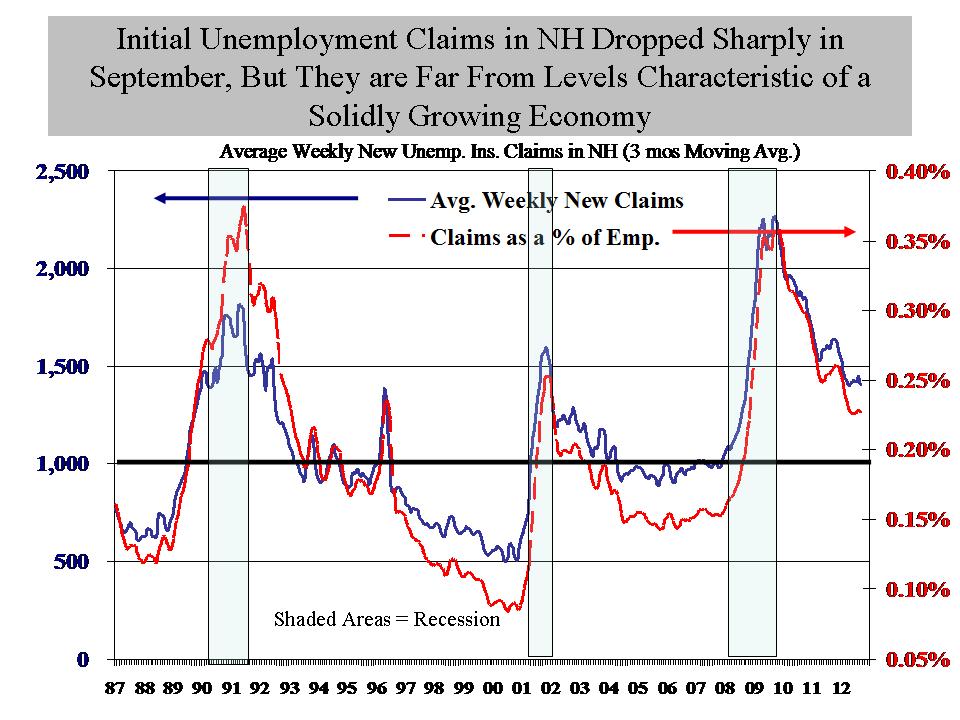
Weather and electricity permitting, the October edition of the Trend Lines will be emailed or available to read online at http://www.issuu.com/polecon.    Seven of the nine indicators in the Index improved over the month, with initial claims for unemployment insurance showing an especially large drop.  I prefer initial claims data to the unemployment rate, as it gives greater insight into the near-term direction of the labor market.  I’ve stated in a prior post that I believe job growth in NH will be revised upward, based on aggregate wage and salary growth and the volume of help-wanted advertising in the state.  Declining initial unemployment claims are another indicator that actual  job growth is likely somewhat higher than is currently being reported (NH has seen a few negative year-over-year monthly job growth reports recently). At an average weekly number of claims at 1,400 for the month, it is still much higher than the under 1,000 number that is typically seen during periods of solid job growth, but the number continues its downward trend.  The chart below shows how new claims currently compare with claims during previous periods of growth and recession.  On a three-month moving average basis, the number of new claims in NH  is now about what is was during the short-lived recession of the early 2000s, and compared to the first “great recession” of the early 1990s, it is also about as high now as during that difficult time.  But there is also a larger population in the state and also more employment  so examining initial claims as a percentage of employment in the state provides a better comparison to where the labor market stands today and where it may be heading.  That comparison makes the current labor market appear to be in the early stages of recovery from recession rather than two years removed from the official end of one, but its a sign of recovery nevertheless.
Empiricism – 1, the Orthodoxy of Ideology – 0

October 11, 2012

The tally is in and according to the NH Department of Revenue, last year’s $.10 cut in the rate of the state’s cigarette tax resulted in a loss of $12 million dollars for the state.  Note that tobacco revenues were down much more than that for the year, but that is the amount attributable to the rate cut.  It is about $500,000 less in revenue (out of over $200 million) than I forecast in a study that I conducted for a number of health related organizations, you can read it here.

In that report I wrote:

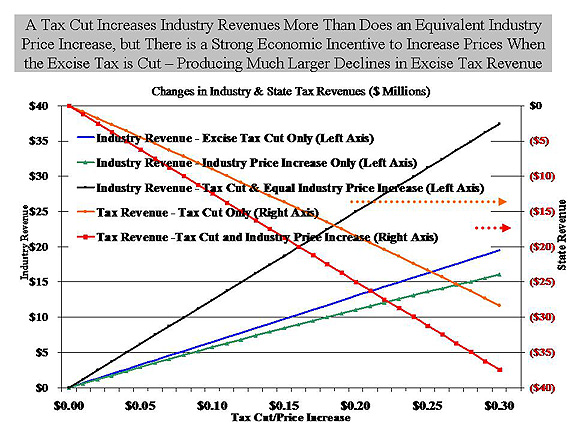
Industry revenue (net of excise taxes) is estimated to increase by $6.5 million with a $0.10 decrease in the states excise tax.  However, if the industry increases prices by the average over the past 20 years ($0.10 – the median is $0.08), industry revenue increases by an estimated $12.5 million.  Clearly there will be a strong incentive to capture the potential surplus from an excise tax decrease (rather than allow it to be passed on to consumers).  At the same time, a $0.10 excise tax decrease will lower state government cigarette tax revenues by $9 million, but if the industry raises prices by $0.10 then revenues will decline by $12.5 million.”

About a week after the rate cut took effect the industry raised prices by $.10 in New Hampshire.  In case you are wondering,  industry prices are not the same and do not move similarly in all states (look at the industry produced “Tax Burden on Tobacco” for historical state sales and price data to confirm this).     If you want a way too busy chart thati illustrates the strong incentives the industry has to raise prices when tax rates are cut,  here it is ( from page 22 of my report).

The $12 million reduction in revenue related to the rate cut is also $16  million less in revenue than the proponents of the tax cut argued in a “study” introduced during legislative debate ( that does not appear to be available any longer online).  There are a lot of reasons why cigarette sales and revenues decline over time (demographic changes, gasoline prices, etc.) all of which I included in my modeling of revenues but none of which were included in the estimates produced by advocates.  Advocates of the rate cut never mention these factors when sales drop, they only cite tax rate increases for declines (higher rates do decrease sales) but they are now offering them  as the reason why tobacco revenues are are  $16 million less than they forecast (because the orthodoxy says lower rates on their own can never be accompanied by lower revenues).  Except that isn’t the reason.  Factors outside of the rate decrease (demographics, gas prices etc.) account for the difference between the total decline in tobacco tax revenue over the year (just over $20 million) and the amount attributable to the rate decline ($12 million).  So about $8 million in the total decline in revenue is a result of factors other than the rate cut.

Sometimes cuts in tax rates can increase revenues, but the belief that they always do has become an ideological orthodoxy that can undermine cases where reduced rates can empirically be shown to increase revenues.  I am all for ideological arguments in policy making when they are based on evidence and not orthodoxy, but we run a risk of making bigger errors in public policy when we can’t distinguish between the two.

What’s Wrong With This Job Growth Picture?

October 10, 2012

I’ve recently written  and spoken about the declining trend in New Hampshire’s rate of job growth relative to the state’s past performance and relative to the growth of neighboring and states across the country (as an aside, suggesting  that the emperor’s new vestments may not be as fine as others envision is not the best way to relax and enjoy the procession).

Pointing out that NH shouldn’t feel entitled to superior economic performance has generated a fair amount of  “discussion” but the analysis is not especially useful if it simply reinforces hardened ideological positions about how to best facilitate prosperity in the Granite State.  One way to help avoid that is to not end our analysis of job growth in NH by simply noting disturbing trends.  We need a better and more consensus understanding of the causes of NH’s  slow rate of  job growth and of its decline relative to other states.

In the first ever Trend Lines blog post I begin by asking a basic question:  Could the most recent job growth picture in NH be distorted by numbers that will later be revised?  Monthly job growth counts are based on  surveys of employers and they can be revised significantly, especially in small states, when they undergo their annual “benchmark revisions” early each year.   There is some evidence that NH’s job growth will be revised significantly upward. In NH, and the nation, there is a strong statistical relationship between the volume of help wanted advertising and the annualized rate of job growth.  The chart below shows the relationship between on-line help wanted advertising in NH (the number of ads per 100 people in the labor force), and the year-over-year rate of job growth in the state.  The strong relationship is evident except in the most recent data from the past year or so.

Two potential reasons for the recent break in the relationship between help wanted advertising and job growth in NH are the so called “skills gap,” as well as the possibility that the help wanted and job growth relationship has not changed and the recent job growth numbers will be significantly revised upward.  The belief that there are many jobs being offered for which there are not enough qualified job seekers has profound implications for the policies necessary to grow NH’s economy.  There  is a skills gap but I am skeptical that it could have such a dramatic impact over just the past year.  In addition, the occupations comprising help wanted ads in NH don’t suggest a dramatic increase in the skills gap over the past year.  In later posts and writings I will be looking further at the “skills gap” issue.

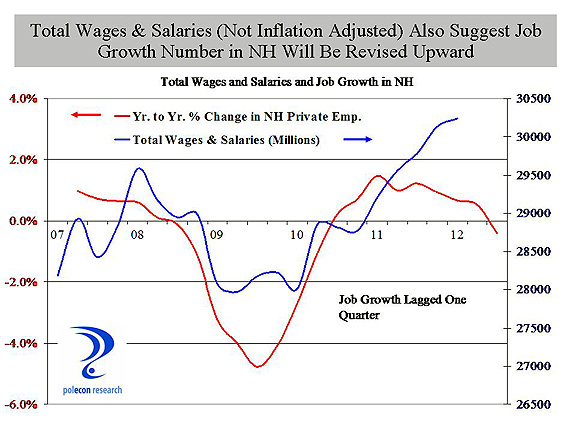
Another possibility,  that the jobs data is wrong and will be revised upward early next year, is real,  but that doesn’t mean the revisions will show NH is again outperforming its neighbors or the nation.  It just means we will look less bad over the past year or so than we do right now.  One indicator that job growth will be revised upward in NH is the growth in wages and salaries in the state.  The chart below shows that wage and salary growth (not adjusted for inflation)  is indicating a stronger labor market than are the job growth numbers.